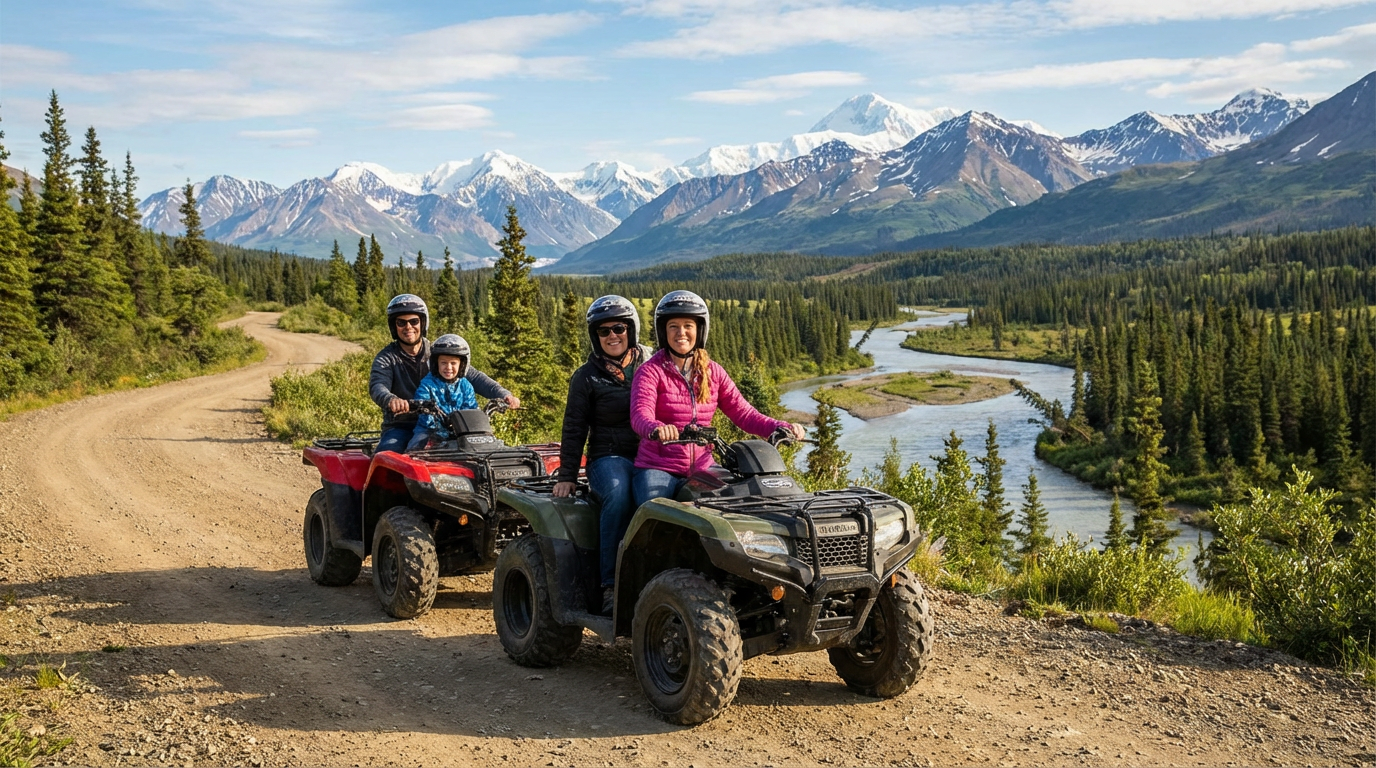
Knowing exactly which atv tour is best for families in southcentral alaska begins with accepting one guaranteed fact about the Last Frontier in 2026. Kids possess a supernatural radar for freezing permafrost puddles and anything that permanently stains a clean winter layer. As a local guide running Alaskan backcountry off-road trips since 2018, I have watched hundreds of visiting parents drastically underestimate the harsh, jagged composition of our northern trail systems.
If you bring your crew north this season, strictly prepare for rugged ground conditions that violently differ from flat dirt roads back home. Southcentral Alaskan trails consist primarily of sharp shale, deep ruts, and heavily saturated earth hiding just below the tree line. You will firmly trade pristine clothes for tangible, messy memories, especially if you visit during our notoriously wet shoulder season stretching from late August into early September.
The absolute secret to a successful afternoon requires carefully choosing the proper multi-passenger machinery for your uniquely aged group, followed closely by planning an extended itinerary that capitalizes on changing seasonal skies. From navigating muddy glacial riverbeds in Palmer to successfully catching the winter aurora borealis further north in Fairbanks on a dedicated three-day excursion, making strategic vehicle and routing choices defines your entire vacation trajectory.
Reason 1 Enclosed Roll Cages Provide Superior Juvenile Safety
Riders straddle traditional solo ATVs (All-Terrain Vehicles) exactly like a two-wheel dirt bike, leaving their entire upper body actively exposed to low-hanging trail hazards. Conversely, multi-passenger UTVs (Utility Terrain Vehicles)—commonly called side-by-sides—handle much more like a rugged, heavy-duty utility truck. Major trail vehicle manufacturers systematically weld these enclosed cabs with sturdy overhead steel roll cages and multipoint automotive seatbelts that physically lock passengers into structurally secure bucket seats.
According to off-road injury statistics published by the U.S. Consumer Product Safety Commission, rollover accidents represent a primary hazard for juvenile off-road riders attempting to drive solo machines without adequate body-weight leverage. Securing young children inside a structural metal cage safely bypasses this exact biomechanical vulnerability. Furthermore, enclosing the family inside a single wide cab effectively allows parents to actively monitor their children and easily converse over the 80-decibel rumbling engine noise without relying on highly expensive electronic helmet communication systems.
Reason 2 Glacial Silt Terrain Demands Specific Vehicle Wheelbases
Southcentral Alaskan mud features a highly unique geographical and chemical composition. Slow-moving regional ice fields naturally grind heavy rocks into a remarkably fine, abrasive powder formally known as glacial flour. According to strictly monitored geological reports from the National Park Service, this gray dust acts exactly like liquid sandpaper and aggressively coats absolutely everything it touches once mixed with melting snowpack.
What most first-time visitors fail to realize is that our messy ground conditions actively extend well into late summer. Hard frozen layers of permafrost continuously trap melting precipitation right on the upper trail surface, building massive, two-foot-deep stagnant trail puddles. Plunging a four-seat UTV directly through these obstacles successfully throws a massive wall of glacial water forcefully outward away from the cab. By contrast, a solo quad's narrow mudguards predictably throw that freezing 38-degree water straight upward directly onto the rider's unprotected lap, quickly plunging juvenile body temperatures into uncomfortable ranges.
Reason 3 Proper Exhaustion Pacing Outweighs High Mileage
Finding the strictly appropriate off-road duration firmly dictates your overall afternoon success. Do not mistakenly book a tiring six-hour mountain trek for young children under twelve years old. At Rockon Recreation Rentals, while we proudly maintain a highly recognizable VisitFlorida Travel Partner status managing warm, sandy southern coastlines, our heavily vetted Alaskan outfitters universally prioritize strictly regulated two-hour introductory limits for notoriously rugged northern backcountry terrain.
During a perfectly paced two-hour excursion, you confidently cover approximately 10 to 15 miles of heavily varied trail conditions at speeds rarely exceeding 15 miles per hour. This specific 120-minute timeframe smoothly prevents juvenile passenger fatigue, avoids severe motion sickness stemming from continuous washboard ruts, and successfully returns your group to the heated trailhead staging building before volatile late-afternoon mountain temperatures plummet.
Reason 4 Wide Glacial Riverbeds Beat Tight Boreal Forests For Beginners
Determining exactly which atv tour is best for families in southcentral alaska really comes down to reviewing your driver's spatial awareness. If you desire massive, sweeping sightlines and possess exceptionally limited off-road steering experience, heavily prioritize the Knik River valley or book a regulated Denali Wilderness ATV Tour. The routing safely features wide, highly forgiving gravel bars spanning hundreds of horizontal yards across.
According to mapping data tracked by the U.S. Geological Survey, Knik Glacier visually stretches roughly 28 miles long and five miles wide, feeding an incredibly expansive downhill flood plain. These wide gravel flatlands require noticeably less steering arm fatigue, allowing parents to focus purely on managing the throttle. However, here is a strictly local tradeoff most out-of-state visitors miss entirely. The exceptionally bright summer sun reflecting rapidly off the massive glacial ice creates immense visual glare, making UV-blocking polarized sunglasses absolutely mandatory for the designated vehicle pilot.
Conversely, historical forested routes near Hatcher Pass prominently deliver intensely tight, 60-inch-wide dirt tracks. The ambient air temperature drops almost immediately by roughly ten degrees as you sharply enter the dense spruce canopy. You must actively wrestle the steering wheel to effectively dodge exposed birch roots and deeply dug muddy sections, naturally simulating an intensive obstacle course significantly better suited for highly confident, experienced drivers with older teenage passengers.
Reason 5 Operator Provided Gear Protects Your Airline Luggage Space
Packing four bulky, moderately insulated winter weather suits solely for an isolated three-hour trail ride predictably wastes highly contested commercial airline luggage space. You must routinely check the included equipment lists when researching distinct outfitters located throughout the Matanuska-Susitna Valley. Top-tier professional operators actively provide systematically sanitized, heavy-duty waterproof gear immediately upon your arrival at the dirt staging area.
They uniquely hand you PVC-coated rain jackets, specifically sized DOT-approved modular safety helmets, and heavy synthetic riding gloves strictly capable of blocking 20-mph valley wind gusts. Utilizing this systematically provided inventory means you willingly hand the aggressively heavy glacial mud directly back to the outfitter at 3 PM. You securely walk away freshly clean in your chosen base layers, easily saving yourself fifty dollars in highly specialized dry-cleaning fees back at your downtown Anchorage hotel.
Reason 6 Four Stroke Engine Acoustics Naturally Deter Large Predators
Out-of-state tourists continuously worry about accidental physical encounters with dangerous brown bears while navigating deep into remote alpine valleys. The comforting, highly practical reality directly relies on 1000cc side-by-side engine acoustics. Modern four-stroke multi-cylinder motors inherently emit heavily rumbling, low-end physical vibrations that visibly project a quarter-mile down the forested path. This highly unnatural, repetitive mechanical noise safely deters sensitive solitary wide-ranging predators completely away from the actively motorized trail corridors.
You mostly encounter naturally foraging, massively heavy 1,500-pound moose instead. According to safely updated annual wildlife management harvesting data from the Alaska Department of Fish and Game, roughly 200,000 moose currently populate the vast state, and they strictly retain the unquestionable legal right of way on every single motorized land path. As seasoned guides, we routinely shut off the engines forcefully and wait quietly for up to twenty minutes to patiently let skittish local calves actively cross the mud, safely creating an exceptionally rare, static observation moment for strapped-in children viewing from inside the roll cage.
Reason 7 It Perfectly Bridges A Fairbanks Northern Lights Excursion
The smartest overall strategic move for a 2026 late-summer vacation involves actively leveraging your daytime off-road vehicular confidence into a thrilling multi-day nighttime exploration. By late August and early September, deep Southcentral mud trails begin noticeably freezing solidly over, while the visual return of truly dark midnight skies definitively signals the beginning of prime aurora viewing season further up north.
Leaving the densely wet coastal mountains and driving or flying roughly 350 miles solidly north securely connects your family directly into the heart of the main auroral oval mapping located broadly at 65 degrees north in geographic latitude. According to extensively researched atmospheric logs stored at the Geophysical Institute at the University of Alaska Fairbanks, highly active high-altitude aurora phenomenons proudly happen continuously year-round, but humans only visually perceive the intensely glowing green oxygen emissions when ambient sunlight safely drops below the terrestrial horizon for extended periods.
I highly recommend easily leaving a rigid three-day gap directly on your travel itinerary strictly for this immensely rewarding northern geographic detour. Booking a trusted Northern Lights Tour From Fairbanks provides the optimal nighttime aesthetic contrast directly to loud, bumpy daytime ATV trail riding. Instead of physically bouncing aggressively over sharp washed river rocks, you predictably ride comfortably inside a commercially heated group passenger van, safely avoiding painfully standing outside entirely unprotected from the freezing negative twenty-degree overnight weather while professional local guides securely navigate heavily iced Dalton Highway stretches en route toward the Arctic Circle.
Actively tracking real-time solar wind electromagnetic data via the NOAA Space Weather Prediction Center thoroughly ensures uniquely high success rates for locating clear viewing pockets on these multi-day winter tours. Intentionally packaging a rugged Southcentral UTV trail ride directly with a carefully monitored Fairbanks aurora expedition effectively builds an undeniably comprehensive Alaskan structural itinerary that securely captures both the brutal physical trail terrain and the stunning atmospheric phenomena characterizing the modern Last Frontier.