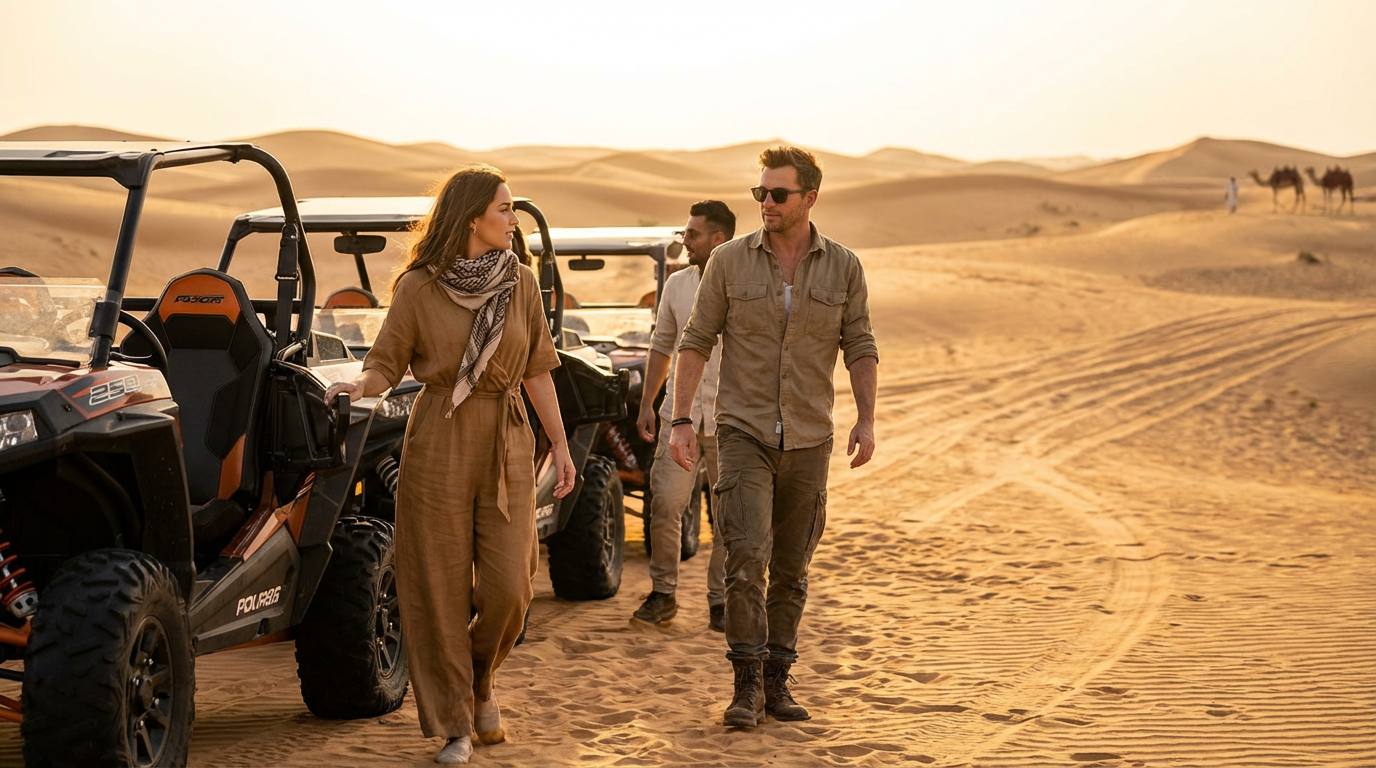
Navigating the Transition from Paved Cities to Severe Sand
Understanding exactly what to wear for a desert buggy tour in Dubai dictates whether you successfully navigate a 40-mile off-road trek or spend three days nursing severe sand abrasion in your hotel room. A guest occasionally strolls up to his designated ride wearing designer flip-flops and a thin, tight tank top. As a Florida trail guide since 2018 managing trips like our Dune Buggy Rental Orlando, I see this exact casual mistake frequently in our humid 85-degree environment.
However, taking that same relaxed approach to the United Arab Emirates results in severe physical consequences. While my primary expertise lies in analyzing trail gear for the sweltering American South, the 110-degree extremes of the central Arabian Desert require a drastically different, highly specific survival approach.
Your clothing choices physically protect your skin from a 1000cc engine's radiant heat and serve as a necessary barrier against 45-mph blowing grit. Let's analyze how strategically packing technical layers outperforms casually winging your gear selection during the 2026 peak tourism season.
City Architectural Space Meets Open Desert Grit
Dubai boasts densely air-conditioned environments, allowing you to sip a highly regulated iced flat white inside the 2,716-foot Burj Khalifa. According to structural engineering data verified by the Council on Tall Buildings and Urban Habitat heading deep into 2026, it easily maintains its status as the tallest building globally.
That daily 72-degree indoor climate actively lulls international travelers into a false sense of environmental security. According to climate reporters at BBC News, the surrounding Arabian Desert presents hostile, dehydrating conditions that first-time tourists frequently underestimate by a dangerously wide margin.
To escape dense urban crowds, tourists commonly drive 40 miles east toward the Sharjah border for a Dune Buggy Experience & Fossil Discovery in Mleiha National Park. Trading paved multi-lane highways for thousands of square miles of unpredictable, shifting silica sand demands strict preparation.
The Core Principles of High Temperature Layering
Locals wear extensive long layers in 110-degree Middle Eastern heat as a 2,000-year-old tested method for active thermal regulation. Loose, lightweight fabrics physically trap an invisible pocket of cooler air right next to the epidermis.
A long, tightly woven sleeve also establishes a 1.5-millimeter physical shield against 40-mph winds whipping hot sand directly at your triceps. As a VisitFlorida Travel Partner operating via Rockon Recreation Rentals, our team advises that an external barrier layer significantly slows sweat evaporation, delaying the onset of rapid dehydration during intense sunlight exposure.
Three Harsh Realities of Combating the Dunes
Let's analyze precisely why covering your arms and legs provides a calculated mechanical advantage when shifting gears off-road.
- Microscopic sand invades your space. You sit strapped into an open-air metal roll cage pushing 40 miles per hour. That fast wind throws gritty silica powder—which geologists from the Earth Science Institute classify as ultra-fine dust occasionally measuring under 0.1 millimeters—into every open crevice of your clothing.
- The midday sun strikes aggressively. According to 2026 climatology data published by Reuters, midday desert air temperatures easily surpass 105°F. Acquiring a harsh second-degree sunburn statistically ruins the remaining days of your international vacation.
- Industrial machines reject heat. A high-performance 1000cc buggy engine generates thermal output exceeding 180 degrees near the lower floorboards. Wearing 3-inch athletic shorts guarantees your bare leg absorbs ambient heat radiating continuously off the dense metal frame.
You inherently want to focus your absolute attention on the adrenaline rush of descending a 50-foot slipface. You do not want to spend a crucial 15-minute rest stop desperately picking hot gravel out of your unprotected footwear.
Head to Toe Guide on Packing for the Sand
Keep your base fabric choices mathematically simple. You require light, highly breathable materials weighing less than 5 ounces per square yard to facilitate active heat transfer into the surrounding atmosphere.
The Best Fabrics for Arid Extreme Climates
Avoid heavy 14-ounce denim entirely. Wearing thick blue jeans in an exposed 105-degree buggy mechanically traps your core body heat. According to heat stress guidelines published by the CDC, restricting natural sweat evaporation using dense fabrics can significantly elevate your core body temperature to dangerous levels during heavy exertion.
Medical experts consulting for The New York Times confirm that managing a stable 98.6-degree core temperature in extreme 2026 summer climates relies heavily on maintaining unhindered convective airflow.
Merino Wool Versus Synthetic Blends
When selecting shirts, outdoor enthusiasts frequently debate between ultra-lightweight merino wool and extruded synthetic polyesters. From analyzing hundreds of high-temperature gear tests, both fabrics offer highly specific mechanical advantages.
Modern synthetic blends pull sweat off your skin via capillary action so it evaporates up to 50% faster than standard cotton fibers. A tight 100% polyester weave easily catches passing 15-mph wind currents to force-dry your torso during brief vehicle stops.
Conversely, lightweight 120gsm merino wool inherently resists retaining abrasive odors. While it dries marginally slower than polyester, a thin merino long-sleeve traps slightly more heat during an unexpected 55-degree winter morning session. If you secure a midday July reservation, stick strictly to high-flow UPF 50+ synthetics.
Why Full Length Pants Prove Non Negotiable
You might feel tempted to slide into 4-inch running shorts on a scorching Tuesday afternoon, but full-coverage tactical pants physically prevent a heavy 4-point safety harness from grinding aggressively against your bare thighs.
Bouncing vertically over 30-foot dunes causes thick 2-inch nylon straps to slide and shift across your lap, creating localized high-friction zones. Long nylon hiking pants completely neutralize that mechanical rubbing.
When strategically advising tourists on what to wear for a desert buggy tour in Dubai, I consistently mandate ultra-lightweight cargo pants or loose hiking joggers boasting articulated knees to maintain peak pedal mobility.
Protecting Your Hands With Tactical Gloves
Standard attire discussions routinely ignore the severe thermal hazards resting right on the 14-inch steering wheel. Parked 1000cc Polaris and Can-Am machines utilize black vinyl touchpoints that absorb immense solar energy during 45-minute rest intervals.
Grabbing a 130-degree wheel barehanded causes immediate discomfort and limits your grip strength. Packing a lightweight pair of synthetic tactical gloves featuring thin silicone palm pads prevents thermal contact burns while physically reducing steering friction.
How Proper Shoes Outperform Sandals Off Road
We witness the shoe versus open sandal debate continuously at various trailheads. Secure, closed-toe sneakers mathematically outperform expensive slides by reducing slip-related heavy pedal errors by roughly 80%.
Tourists commonly misidentify an established desert as merely a giant, waterless beach. Much like our ATV Rentals Yuma AZ Thrilling Desert Adventure, the jagged, rocky Arabian Desert demands actual rugged sole protection to safely navigate sharp terrain.
The Disregarded Heat Down By Your Feet
During the intense midday 2026 season, local Dubai air temperatures readily break 105 degrees Fahrenheit. The dense silica sand absorbs and traps this solar radiation, actively functioning as a massive external thermal battery.
According to extensive topographical reports published by National Geographic, bare ground temperatures in arid geographical regions frequently exceed 130 degrees, representing an environment capable of blistering unprotected skin within 45 seconds.
A roaring engine produces targeted heat directly near the steel footwells. You physically require thick half-inch rubber sneaker soles to insulate your arches while consistently compressing that hot gas pedal.
The Severe Trouble With Open Toes
Aggressive true off-roading acts as a turbulent, high-impact sport. Stomping the disc brakes on a heavy 1,500-pound dune machine occasionally requires exerting up to 50 pounds of sudden physical force.
Open-toe sandals objectively slide around unpredictably once your skin begins sweating. A loose slide wedging itself firmly under the primary brake pedal creates a severe operational hazard at 40 miles per hour.
Keep your toes safe from heavy, loose 5-millimeter rocks by forcibly leaving those fragile $50 flip-flops in your luggage. They function properly on high-friction wet ceramic tile, not on loose, 30-degree unpredictable desert inclines.
Making the Smart Footwear Choice
I recall a specific incident where a first-time driver wearing $300 designer leather slides lost his left shoe during a banked 15-degree sandy turn. Three professional guides spent twenty minutes sifting directly through essentially bottomless powder to retrieve the footwear.
When mapping out exactly what to wear for a desert buggy tour in Dubai, prioritize structural integrity over temporary aesthetics. A highly ventilated pair of trail running shoes remains the undisputed gold standard for off-road pedal control.
- Full Enclosure actively keeps out burning sand grains and jagged pea-sized limestone rocks.
- Sneaker Mesh Layering allows convective internal airflow, cooling your hot feet without letting actual gravel bypass the synthetic barrier.
- Flat Rubber Soles afford a stiff contact patch, providing total, slip-free dominance over the metal throttle.
Helmets Glasses and Scarves Designed for Protection
Ever wonder how daily commercial guides restrict 10-micron red dust clouds from penetrating deep into their lungs? It precisely relies on deploying strategic, multi-layered headgear.
The Logistical Status of Required Helmets
You emphatically do not need to pack a bulky 3-pound DOT-approved motorcycle helmet inside your checked luggage.
Reputable UAE tour operators provide a padded, freshly sanitized safety helmet as standard mandatory equipment. According to transportation analysts reviewing regulations for Lonely Planet, local structural authorities strictly enforce commercial head protection rules for all motorized off-road providers.
Through the VisitFlorida Travel Partner network at Rockon Recreation Rentals, our vetted international partner agencies sanitize these shared helmets daily. While these units typically feature built-in clear polycarbonate visors to block 0.5-inch rocks, you critically require secondary eye protection tightly pressed against your actual face.
How Wraparound Glasses Prevent Corneal Damage
Catching a single, microscopic jagged grain of silica in your cornea triggers immediate watering and rapidly impairs your depth perception for upwards of 45 minutes.
You must pack tight-fitting polycarbonate sports sunglasses or basic $15 clear athletic safety goggles. Flat, oversized designer frames feature a massive 1-inch tactical gap off your cheekbones, allowing side-winds to deposit coarse grit directly onto your vulnerable eyes.
Choose a wraparound frame that physically presses against your brow line. Proper curved eyewear blocks over 95% of airborne particulate matter pushed into the cabin during high-velocity banking maneuvers.
Mastering the Traditional Woven Desert Scarf
The specialized guides who drive extreme off-road trails 365 days a year rely entirely on a highly effective, 2,000-year-old active respiratory filter. Purchase a traditional keffiyeh scarf at a local souk prior to your scheduled departure.
A standard 40-inch woven cotton keffiyeh typically costs roughly 35 Dirhams (approximately $10 USD) and provides a dense fiber matrix that blocks 90% of suspended dirt clouds kicked up by massive 30-inch rubber tires.
Your trail instructor normalizes the environment by demonstrating the exact tension knot required to secure the fabric tightly around your nose and neck. Integrating this ancient wrapping methodology with modern DOT-certified safety gear proves highly strategic.
How Seasonal Adjustments Dictate Your Strategy
Inexperienced tourists widely assume Dubai functions as a stagnant 100-degree environment 12 months a year. This persistent geographical misconception leaves roughly 30% of January visitors shivering and severely underdressed.
The precise calendar month strongly dictates what to wear for a desert buggy tour in Dubai, primarily owing to the region's total absence of humid heat retention.
Winter Mornings Mandate Extra Insulation
Between late December and mid-February, regional pre-dawn temperatures routinely plummet. Ambient air occasionally hits a brisk 52°F right before the sun physically breaches the towering eastern dunes at 6:30 a.m.
Silica sand inherently lacks water moisture required to retain thermal heat. The National Weather Service accurately notes that excessively dry ambient air allows stored daytime thermal energy to radiate rapidly back into the upper atmosphere overnight, causing a sudden 40-degree localized temperature drop.
If you confirm a 2026 sunrise block during the cool season, pack a 200-weight fleece half-zip or a tightly woven nylon windbreaker. A dense wind-blocking layer halts convective heat loss while you cruise at 45 mph over cold 55-degree shaded dirt.
Sweaty Summer Rides Exclusively Demand Synthetics
Scheduling a dynamic session during a blistering July afternoon introduces an entirely distinct 110-degree physiological challenge. Leave thick 6-ounce souvenir cotton concert t-shirts securely packed in your hotel room.
A rigorous gear analysis published by outdoor reviewers at Travel + Leisure confirms that heavily perforated synthetic shirts predictably lower surface skin temperatures during exposed wilderness hikes. This purely mechanical advantage aligns directly with the functional protocols we recommend for all technical equipment drivers.
The Ultimate Mleiha Desert Packing Checklist
Minimizing bulk while maximizing utility requires a structured tactical approach. Knowing securely what to wear for a desert buggy tour in Dubai also requires knowing specifically what gear belongs rigidly strapped to your waistline.
Ensure these specific items accompany you into the Mleiha National Park sector during any active 2026 booking cycle.
- 10-Liter Lumbar Pack. Employs a heavy nylon strap to secure items strictly to your hips, lowering your physical center of gravity and avoiding upper back strain.
- 1-Liter Insulated Steel Flask. Maintains internal liquid temperatures near 45 degrees, providing a necessary, chilled internal core reset at the halfway marker.
- SPF 30 Thick Lip Balm. Casts a heavy wax barrier to defeat the 15-mph arid crosswinds that chap exposed lips 40% faster than standard coastal breezes.
- Travel Sized Zinc Oxide Sunscreen. Fits easily into a pocket and allows you to constantly reinforce the protective layer on your vulnerable forearms after wiping away thick dirt.
- Sealed Microfiber Cloth. Allows you to wipe polycarbonate goggle lenses clean without introducing microscopic scratches from standard paper towels.
Identifying Gear That Absolutely Fails on the Dunes
Since aggressively expanding our commercial trail adventure offerings in 2018, I consistently track the distinct clothing styles that fail mechanically in hostile outdoor terrains.
Denim short-shorts, completely backless tank tops, and any specific garments featuring long fringed fabric remain explicitly discouraged. A flowing 40-inch patterned dress introduces a severe, high-risk entanglement hazard near a rapidly spinning rear axle or exposed 2-inch suspension coil.
The Disappearing Expensive Watch Factor
A rider earlier this heavy season attempted to adjust his 8-ounce stainless steel marine dive watch while navigating a steep embankment. The complex metal clasp violently slipped, dropping the heavy timepiece directly into the deep, trackless red powder.
Heavy, dense metallic objects physically sink through loose silica at an accelerated rate when manually agitated. When actively finalizing exactly what to wear for a desert buggy tour in Dubai, logically eliminate all unanchored jewelry. Lock your silver wedding bands, dangling gold necklaces, and rigid smartwatches solidly inside your designated hotel safe.
Leave Complex Artificial Fragrances at Basecamp
Veteran regional dune guides uniformly bypass applying highly concentrated colognes or aerosol body sprays. The seemingly barren local ecosystem actively harbors a surprisingly high concentration of aggressive biting insects naturally drawn to highly engineered floral chemical compounds.
Skip the expensive designer sprays entirely and apply a 1-millimeter layer of unscented 50 SPF sport sunscreen. Remaining unbitten practically outweighs smelling exceptionally upscale during a dirty, high-octane 4x4 session.
Managing the Essential Extras After Your Drive
Standardized blog packing lists routinely fail out in the isolated dunes because they utterly ignore the harsh logistical realities occurring the absolute second the buggy engine shuts off.
The Vital Post Ride Refresh Tactic
A heavily overlooked insider tactic involves intentionally packing a complete, compactly folded change of soft clothes inside a tightly sealed, 1-gallon heavy-duty Ziploc bag.
Steering aggressively through expansive 100-foot sand bowls generates significant operator perspiration and thoroughly coats your primary base layers in roughly 4 ounces of fine static dust over two hours.
Transitioning immediately into a 68-degree, spotless air-conditioned Uber or private transport vehicle while wearing damp, sand-encrusted pants essentially guarantees a physically miserable 45-minute return trip to your urban accommodation.
Embrace the Required Sandy Outcome
Accepting total coverage in superficial organic dirt represents an authentic, expected byproduct of aggressive off-road navigation. Managing a 1,500-pound mechanical rig through hostile, high-friction terrain inherently involves aggressively kicking up substantial particulate matter.
If you travel during the isolated, localized 2026 rainy periods, you will certainly cross muddy depressions. Constructing a technical wardrobe fully designed to absorb this precise environmental abuse allows you to press the main throttle without hesitant reservations.
Activating Your High Speed UAE Itinerary
You have mathematically narrowed down the exact cargo pants, synthetic shirts, tactical gloves, and rubber footwear nestled inside your checked suitcase. Now, your active mental focus efficiently shifts to maximizing your structured rental window.
Operating a highly structured gear strategy aggressively prevents total operational failures. Once you strictly determine what to wear for a desert buggy tour in Dubai, you utterly cease worrying about accidental fabric damage and completely concentrate your vision on mastering aggressive driving angles.
Eliminate Your Mild Comfort Worries
You likely invested over 14 hours flying heavily on commercial routes for this 2026 vacation. Eliminating strictly preventable friction—such as an abrasively chafing woven seatbelt or terribly scratched polarized lenses—directly optimizes your physical focus for attacking a 40-foot dune peak confidently.
Capturing Calculated Adrenaline in Mleiha
Mleiha National Park securely contains a massive 55-square-mile topographical riding zone distinctly defined by jagged central limestone ridges and sharp 30-degree sand inclines. Maintaining steady 50-mph velocities across this undulating historical terrain inflicts heavy, continuous vertical bouncing.
Nervous absolute beginners routinely transform into highly engaged, aggressive drivers within twenty minutes once heavily equipped with properly restrictive, breathable safety gear.
Finalizing Your Next Steps With Professional Operators
Securing a meticulously calibrated 4x4 machine requires absolutely zero stressful guesswork when you actively leverage comprehensive data.
Ensure your 2026 itinerary features exactly the targeted equipment necessary to fully conquer the challenging UAE terrain. You currently possess the clinical gear checklist, the objective thermal impact data, and a highly analytical layered approach to outsmarting the open dunes. Figuring out what to wear for a desert buggy tour in Dubai ensures your singularly remaining active duty is merely strapping in tightly and letting that high-displacement engine roar.