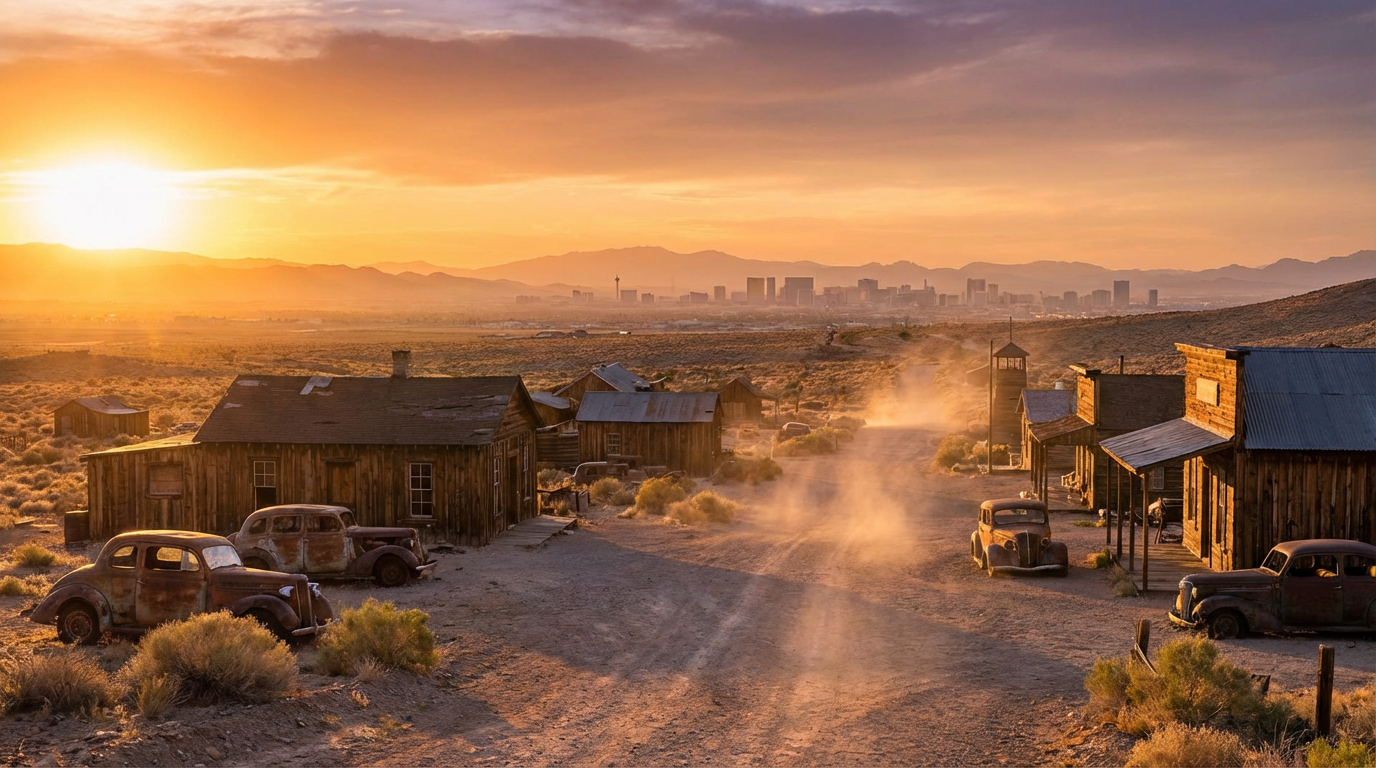
Ditching the Casinos for Desert History
If you genuinely want to explore the best ghost towns in Nevada near Las Vegas, swapping crowded 2026 casino floors for actual 1890s mining ruins provides a stark historical contrast. When average tourists map out a modern Nevada vacation, they budget roughly $250 per night for a standard Strip hotel room. However, long before those 4,000-room integrated monoliths existed, determined prospectors flocked strictly to the dry El Dorado mountain ranges. They manually chiseled through solid quartz in the blazing 110-degree July sun, chasing highly speculative dreams of striking raw silver and gold veins.
Planning a half-day itinerary to explore these abandoned 19th-century settlements drastically upgrades your baseline understanding of the Silver State. While purchasing a single resort cocktail drains your budget rapidly, these preserved mining camps sit frozen in time, requiring only a fraction of that cost in vehicle fuel to reach. According to The New York Times, over 600 recognized mining camps exist across the state, waiting for adventurous travelers willing to navigate the washboard dirt roads.
The Original Boomtowns Were Built on Silver
Surviving in this harsh arid landscape required sheer physical grit, and the rapid influx of wealth brought undeniable operational challenges to the region. According to documentation by historians at the National Park Service, the famous Eldorado Canyon strike of 1861 quickly scaled into one of the top-producing precious metal regions in the territory. The canyon eventually output millions in silver and gold ore, but it concurrently earned a documented reputation for harsh vigilante justice.
The dusty camp operated completely outside federal jurisdiction for years, creating a volatile environment where claim jumpers routinely resolved territorial disputes with Colt revolvers. Standing on the original wooden floorboards of these reconstructed cabins today provides a uniquely grounded look at 19th-century isolation. Last November, our Las Vegas guiding team—leveraging over 20 years of remote Mojave operations—took a couple from Boston out past the Clark County limits. Thirty minutes after dropping their tire pressure for the dirt trails, they spent a full hour photographing heavily rusted 1930s Ford truck chassis parked near collapsed, timber-framed mine shafts.
Trading Pool Parties for Pioneer Tales
Swapping a 100-decibel day club for authenticated pioneer history adds undeniable cultural value to your vacation routing. You effectively trade recycled casino air conditioning for 15-mph Mojave Desert crosswinds. Furthermore, the verified historical accounts you uncover at local general stores rival highly dramatized fictional cinema. Historical records detail legendary gunfights over 1890s vein claims and organized outlaws utilizing the narrow limestone slots to hide stolen commercial freight shipments.
Getting out there to trace those exact escape routes firsthand is exactly why we prioritize these paths at Rockon Recreation Rentals. Physically driving the historic terrain permanently shifts your perspective on how early European settlers navigated this arid basin. It requires active participation rather than just passive observation.
A Quick Local Mojave Survival Tip
Here is an edge-case weather scenario most urban tourists drastically underestimate during off-road excursions. The ambient air temperature routinely drops up to 30 degrees within 45 minutes of the sun dipping below the Spring Mountains. Always pack a heavy flannel shirt if you plan to navigate ghost towns in Nevada near Las Vegas during the highly sought-after dusk photography window. The long, high-contrast shadows offer excellent visual depth, but that sudden 55-degree evening chill reliably catches unprepared travelers off guard during virtually every guided twilight tour we operate.
Comparing The Best Ghost Towns In Nevada Near Las Vegas
We actively prioritize hitting the rugged outbound trails to document these hidden desert outposts. After successfully logging over 4,000 off-road miles on our custom suspension vehicles since 2018, our guiding roster carries genuine, localized topographical knowledge. When you specifically seek the top historical settlements, three distinct locations successfully dominate the travel lists due to their structural preservation and accessibility.
Here is a vital logistical point that deters many rental car drivers entirely unnecessarily. You rarely require a 4x4 high-clearance truck to access the main designated parking perimeters for the most popular sites. The three primary outposts we profile below—Nelson, Goodsprings, and Rhyolite—all feature direct access via well-maintained, two-lane asphalt routes like Nevada State Route 165 and 161.
Exploring Nelson and the Famous Techatticup Mine
If your tightly scheduled 2026 itinerary only permits visiting one specific historical zone, Nelson easily ranks as the most visually dense option available. Situated precisely 45 miles south of the Strip via US-95 and Route 165, the settlement provides a highly curated visual playground for architectural historians and amateur photographers. Those heavily filtered, sepia-toned desert portraits frequently circulating on travel blogs typically originate right here at the Nelson historic site.
Where Hollywood Magic Meets Pioneer Dust
As you actively navigate the half-mile loop trails, you pass heavily oxidized 1920s Bowser gas pumps and weathered Dodge commercial trucks. You will undoubtedly notice a massive, severed aircraft fuselage resting vertically in the compacted alkaline dirt. Rather than an authentic historic aviation disaster, production crews positioned this large prop for a 2001 heist thriller and subsequently abandoned it.
Despite strictly lacking historical 19th-century origins, the aluminum wreckage provides a harsh, angular contrast against the smooth, wind-eroded Mojave rocks. It serves as a prime focal point for wide-angle landscape photography while surveying these sprawling ghost towns in Nevada near Las Vegas.
Stepping Inside the Techatticup Mine Shafts
We highly advise purposefully allocating the roughly $20 entry fee for the subterranean guided mine tour (pricing accurately maintained for the 2026 travel season). Descending into the ventilated quartz tunnels accurately demonstrates the brutal physical labor required to extract raw silver ore manually. Certified guides safely lead you 500 feet into the hillside where prospectors historically utilized simple black powder and heavy hand drills.
The ambient air temperature immediately drops to a highly consistent 65 degrees inside the heavy rock shafts. That atmospheric shift provides highly effective natural cooling during a typical 105-degree afternoon. According to state historians at Travel Nevada, this specific patented claim operated as the oldest and richest producing mine in the southern half of the state.
The private operational property officially borders massive National Park Service recreation tracts. The claustrophobic tunnels historically harbored intense documented conflicts involving displaced Civil War deserters and highly aggressive Colorado River steamboat operators fighting over local freight monopolies.
Practical Logistics for Your Nelson Visit
Optimizing your comprehensive desert excursion requires verified logistical planning to actively prevent severe delays. Here are the exact operational parameters we continually outline for guests navigating the area:
- Bring physical currency The managing general store currently mandates a flat $2 photography fee per visitor for non-commercial shoots. Carrying exact change entirely bypasses the frequently congested credit card terminal.
- Secure advance reservations The required underground mine tours cost exactly $20 for adults ($15 for children) and operate strictly at 20-person group capacities. Calling 48 hours ahead reliably secures your preferred entry window.
- Equip proper trail vehicles Interested in actively conquering the adjacent high-grade dirt paths? Reserve a fully insured side-by-side through Rockon Recreation Rentals. Our specialized cross-country fleet fundamentally excels at handling highly abrasive Nevada terrain. Additionally, integrating the Las Vegas Valley of Fire Tour provides access to heavily contrasted red Aztec sandstone formations nearby.
Evaluating the Historical Goodsprings District
Goodsprings accurately projects the vintage visual aesthetic of a highly funded western film set, except the foundational architecture remains strictly authentic to the 1910s. When compiling an itinerary of the most accessible ghost towns in Nevada near Las Vegas, this functioning municipality inherently introduces an interesting logistical variable through its active micro-population.
Located safely 38 miles southwest of the modern entertainment corridor via Interstate 15, this settlement rapidly achieved maximum economic output around 1916. Roughly 200 permanent residents still actively maintain properties along the unpaved grid today. According to the state-sponsored tourism board at Travel Nevada, Goodsprings reliably supplied critical zinc and lead yields heavily required during the early operational stages of World War I.
The Legendary Pioneer Saloon Infrastructure
A structured visit to Goodsprings strictly requires a scheduled stop at the globally recognized Pioneer Saloon. Constructed professionally in 1913, it officially commands the title as the oldest actively operating bar within Clark County. Pushing forcefully past the heavy, weather-sealed wooden doors immediately exposes you to century-old rural construction techniques that successfully survived the elements.
The original contractors resourcefully fabricated the saloon's exterior utilizing stamped corrugated tin panels directly manufactured by Sears, Roebuck and Co. This modular architectural technique proves exceptionally rare within the highly alkaline Mojave Desert. Astute visitors can physically trace three officially documented bullet perforations directly through the eastern wall, remnants of a fatal territorial dispute from 1915.
Analyzing History Over Local Menus
Securing seating at the authentic 1860s Brunswick cherrywood bar proudly offers direct access to local oral histories. You can comfortably order their signature half-pound Ghost Burger (averaging $16 in 2026) while staff recount decades of unverified local folklore. Rather than entertaining supernatural claims regarding sudden cold spots near the poker tables, our structural guides attribute the frequent temperature drops to the 113-year-old building's inherent lack of modern, zoned HVAC systems.
To maximize your Goodsprings excursion, ensure you locate the formally designated perimeter near the vintage potbelly stove. Historical aviation records conclusively confirm Hollywood actor Clark Gable occupied this precise footprint for three consecutive days in 1942, awaiting official United States military recovery reports regarding his wife's tragic aircraft crash at nearby Mount Potosi.
Navigating Concrete Architecture and Art at Rhyolite
Executing a dedicated visit to Rhyolite inherently requires actively committing to a 120-mile, two-hour transit northwest from central Las Vegas near the town of Beatty. While the required mechanical fuel burn greatly exceeds closer alternatives, the architectural visual density at the final destination strictly justifies the extended drive time. If you are specifically seeking the most structurally impressive ghost towns in Nevada near Las Vegas, this specific Nye County site uniquely features unparalleled concrete preservation.
What most casual day-trippers fail to realize is the profoundly deep acoustic isolation completely achieved once you finally surpass the mountain ranges dividing the valley from the Amargosa Desert. Back in 1907, roughly 5,000 to 8,000 registered laborers and merchants populated this dusty basin. Unlike earlier temporary boomtowns heavily reliant on untreated pine lumbers that inevitably deteriorated, Rhyolite's municipal founders heavily invested in poured concrete.
Documenting the Concrete Ghosts of the Desert
Navigating the overgrown, unpaved residential grid system closely mirrors formally touring an active archaeological dig site. According to historical briefs consistently provided by the National Park Service, this robust municipality actively maintained a pressurized municipal water system, a dedicated electrical grid, three intersecting rail lines, and an astounding 40-piece symphony orchestra before abandoning the site entirely by 1920.
Currently, sustained 20-mph valley winds rapidly flow directly through the reinforced concrete thresholds. The remaining heavy architectural footprints distinctly include a highly detailed 1906 Las Vegas and Tonopah railroad depot and the three-story Cook Bank building. Photographers should specifically locate the Tom Kelly bottle house, a residence creatively constructed entirely from roughly 50,000 discarded glass liquor bottles held together by adobe mud.
The Open Air Museum Installation
Directly adjacent to the municipal ruins officially sits the Goldwell Open Air Museum property. This non-profit outdoor installation heavily features massive, hollow silhouettes exclusively created by wrapping industrial plaster fabric over human subjects temporarily positioned in the dirt. Under direct noon sunlight, the sculptures visually appear as fascinating technical achievements. However, when navigating the area during the dim twilight hours, the statues project distinctly unsettling elongated shadows against the highly elevated Grapevine Mountains.
Accessing this highly remote installation strictly mandates absolute adherence to modern overland travel protocols. Ensure you calculate heavy water requirements; commercial utility pipelines simply do not exist within a 15-mile radius, meaning visitors must bring a strict minimum of 2.5 gallons of potable water per vehicle. Furthermore, cellular tracking towers become severely restricted once you push 10 miles past Beatty. To avoid critical logistical failures, actively force an offline download of a 500MB Google Maps radius prior to leaving your Strip resort.
Compiling Your Wild West Equipment Loadout
Based firmly on extensive localized recovery data actively gathered critically spanning back to 2018, the Mojave biome swiftly and strictly penalizes logistical negligence. This high-consequence natural environment predictably escalates minor mechanical inconveniences into immediate medical emergencies if continually ignored by tourists. Attempting to foolishly navigate 140-year-old collapsed mining infrastructure proudly wearing casual resort slip-ons strictly introduces severe bodily liability. You currently operate strictly within hyper-aromatic native habitats entirely devoid of commercially maintained pathways.
Aggressive Hydration Management
You strictly must actively overload your liquid fluid carrying capacity. Counterintuitively, this concrete rule highly applies strictly during mid-winter excursions actively spanning January and February. The prevailing 20-mph desert crosswinds rapidly evaporate dermal perspiration, completely masking total fluid loss until clinical dehydration symptoms physically manifest.
We explicitly mandate packing strictly no less than 128 fluid ounces (one liquid gallon) of purified water per adult, per 24-hour cycle. Reviewing published public health search protocols thoroughly maintained by the National Park Service, severe hyponatremia and sustained dehydration definitively remain the primary catalysts for remote localized search and rescue deployments.
Operating Off Road Protocols
Lacking prior motorized off-road experience strictly should not arbitrarily deter active participation on the surrounding trail networks. We currently process daily reservations from entry-level resort drivers who successfully transition from zero mechanical knowledge to independently maintaining 20-mph trail speeds within a heavily focused 15-minute training block. Standard 2026 fleet models dependably employ highly responsive continuously variable transmissions (CVTs).
For independent travelers demanding strict schedule autonomy, our Las Vegas ATV Adventures – Self-Guided Rentals entirely eliminate complex manual clutch operations. Tactical engagement successfully requires only basic ignition cycling, formally selecting a forward gear, and precisely applying linear thumb-throttle pressure. If fully managing emergency wilderness logistics highly deters your active participation, permanently transfer operational tactical control to our expert guides. Effectively transferring navigational responsibilities allows you to dedicate absolute mental focus to actively executing proper camera framing for your expansive photo sets.
Related Experiences
- Half Day Colorado River Kayak Tour - Cool off from the hot Nevada desert with a relaxing float down the beautiful Colorado River.
- Horseshoe Bend Plane Tour from Las Vegas - Take to the skies for breathtaking aerial views of nature's most dramatic sandstone canyon.