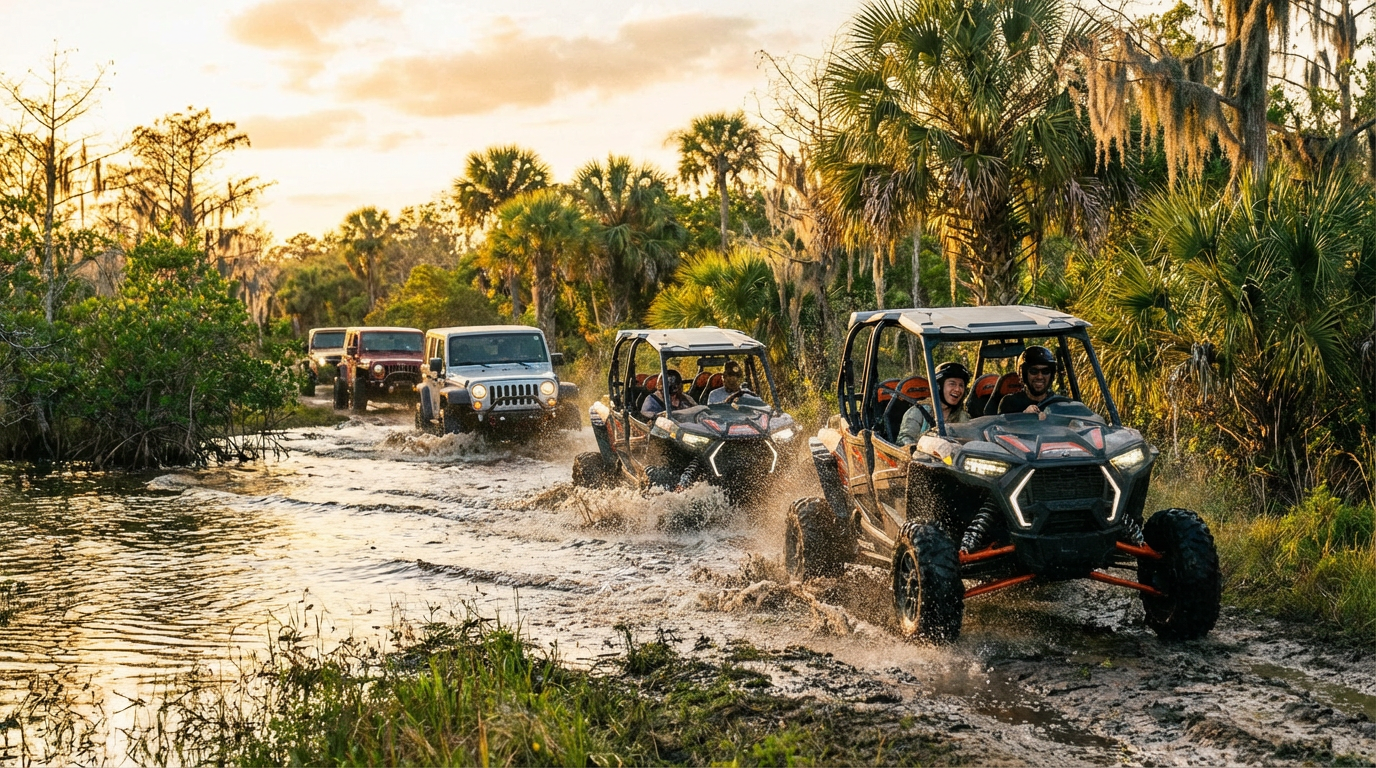
Having navigated the muddy tracks of Homestead and the limestone quarries near Miami since 2018, I have watched the market for south florida off road tours undergo a massive commercial transformation. By 2026, the landscape of Miami-adjacent ATV offerings has largely shifted from rugged, self-guided exploration to highly orchestrated tourist attractions. A common misconception among vacationers is that these heavily marketed excursions take place deep within the untamed Everglades. In reality, the majority of massive operations utilize flat, repurposed agricultural plots in the Redland district. These environments are mechanically graded to remove genuine off-road obstacles, artificially inflating venue capacity to seamlessly accommodate absolute beginners. This structured sterilization presents a stark contrast to authentic trail riding, leaving eager thrill-seekers searching for a legitimate motorsport alternative.
Reason 1 Genuine Skill Development Over Controlled Pacing
When analyzing the value of standard tourist activities, it is crucial to understand the vast mechanical disconnect between a mass-market quad ride and formal motorcycle training. By the peak of the 2026 winter season, the standard Miami ATV experience typically puts riders directly onto entry-level, 250cc automatic quad bikes. These utility machines are frequently equipped with rigorous mechanical governors, securely restricting top speeds to a sluggish 15 or 20 miles per hour. As a recognized VisitFlorida Travel Partner, Rockon Recreation Rentals constantly fields inquiries from travelers wanting far more than a dusty follow-the-leader loop. Behind the scenes, the reality is that traversing a flat agricultural field at 15 miles per hour on an automatic quad requires practically zero skill acquisition, functioning more like an amusement park ride than an active motorsport.
The Constraints of Rigid Group Formations
One of the most significant drawbacks of high-capacity outfitter operations is the absolute restriction of personal freedom on the trail. Commercial operators reliably maximize their daily revenue by grouping 15 to 25 riders into a single, tightly controlled timeslot, creating what experienced local guides refer to as the "slinky effect." According to the National Park Service guidelines for Off-Road Vehicle use at Big Cypress, proximity rules are primarily meant to ensure wilderness safety; however, commercial guides strictly enforce single-file lines to prevent unpredictable tourists from straying off-route. Local riders know that this defensive proximity policing completely eliminates any room for spontaneous geographical discovery or personal momentum management.
Deciphering Commercial Insurance Limitations
At an average premium ticket price of $150 to $220 for a mere 45-minute idle, visitors are essentially paying for an outfitter's massive commercial liability overhead. According to safety protocols published by the Consumer Product Safety Commission, operating heavy ATVs in crowded, poorly spaced formations dramatically increases the statistical likelihood of low-speed, distraction-based collisions. Because guides must immediately cater their pace specifically to the undeniably least experienced rider within a massive pack, critical off-road techniques like weight transfer mounting and effectively reading deep mud ruts are completely ignored in favor of maintaining strict, slow-moving order.
Reason 2 Active Biomechanical Engagement Defeats Passive Riding
There exists a profound biomechanical chasm between passively sitting on a heavy, four-wheeled utility quad and actively mastering a proper two-wheeled dirt bike. Most general south florida off road tours utilize automatic 300cc ATVs equipped with basic thumb throttles, systematically creating a remarkably passive physical experience. According to the Motorcycle Safety Foundation, authentic two-wheeled riding forces the forward operator to actively engage their core, aggressively shift body weight for varied tire traction, and utilize incredibly precise manual clutch-and-throttle coordination. Properly riding a dirt bike is an intense, active athletic pursuit that rapidly exposes the comparatively stagnant physical engagement found in a standard commercial four-wheeler vacation package.
The Fluorescent Night Ride Gimmick
One of the most pervasive local powersports trends in 2026 is the immense surge of the nighttime "glow ride," where modern operators deliberately outfit standard ATVs with expensive aftermarket lighting. Outfitters frequently utilize $300-plus LED whip kits from utility brands like Kemimoto alongside highly synchronized Bluetooth sound systems. While visually striking and undeniably tailored for social media video feeds, these large group excursions act essentially as a clever entertainment gimmick. Many novices fail to grasp that flashing neon lights heavily serve to distract riders from the complete lack of terrain complexity, successfully blinding them to the reality that they are merely driving in circles on perfectly flat, packed dirt.
Mastering the Dynamic Friction Zone
Structured dirt bike classes rigorously demand active physical and cognitive engagement from the precise moment you decisively swing a leg over the saddle. According to extensive off-road safety data published by the National Highway Traffic Safety Administration, mastering exact manual inputs—such as successfully feathering the clutch within the delicate "friction zone"—drastically reduces dangerous rider fatigue and subsequent rollover risks. Exerting exact, calculated command over a manual transmission across unpredictable, heavily rutted environments offers an incredibly empowering sensation that a guided quad trek inherently lacks due to its fully automatic, simplified nature.
Reason 3 Geographically Superior Topography Confined North
When travelers directly complain to me regarding the incredibly rigid limitations of standard south florida off road tours, my immediate recommendation is always a calculated, strategic road trip straight up the Florida Turnpike. Having made the grueling 250-mile drive from Miami to Hernando County countless times since 2018, I can confidently assert that shifting your geographic focus toward Central Florida effectively unlocks the state's most highly regarded riding topography. Bypassing the flat coastal limestone routes safely allows you to transition into rolling terrain that truly demands active driver skill.
Unlocking the Withlacoochee State Forest
An overlooked geographical truth about Florida's specialized geological makeup is that the central peninsula rests upon heavily ancient, elevated sand dunes known explicitly as the Brooksville Ridge and Lake Wales Ridge. According to the authoritative Florida Department of Agriculture and Consumer Services, the neighboring Withlacoochee State Forest safely encompasses over 160,000 acres of genuinely varied wooded elevations. A crucial insider tip is that by traveling just under four hours north from Miami, you happily trade flat, monotonous farmland for rolling sandhills and brutal patches of localized "sugar sand." This specialized loose aggregate strictly requires deliberate, aggressive weight transfer, fundamentally outperforming the densely packed, featureless routes situated down south.
Environmental Architecture for Progressive Learning
The distinct baseline advantage of booking a Central Florida training facility securely lies in its highly purposeful design for measured, incremental learning. Rather than tossing outright beginners blindly onto chaotic, mixed-use state trails where highly advanced local riders aggressively push upwards of 45 miles per hour, premium locations carefully utilize a tiered topographical layout. Instructors efficiently allow riders to systematically practice smoothly approaching a berm and holding vital forward momentum through deep sugar sand profiles within a highly controlled space. Savvy adventure travelers understand that this specific purposeful architecture allows you to actually conquer distinct landscape obstacles, a stark contrast to heavily marketed coastal tours where operators simply govern the engine to avoid terrain challenges altogether.
Reason 4 Immediate Professional Feedback Outpaces Liability Briefings
Having embedded myself deeply into the regional powersports community for nearly a decade, I have noticed a remarkably striking pattern among newly minted off-highway vehicle (OHV) enthusiasts. Many riders who boldly attempt to transition from basic tourist excursions to legitimate public trail riding ultimately struggle immensely simply because they severely lack foundational mechanical instruction. Learning to safely pilot a 600-pound machine over uneven terrain without an experienced teacher typically results in incredibly rigid, permanent postural habits.
Real Pedagogy Versus The Pre Ride Briefing
On the vast overwhelming majority of heavily marketed south florida off road tours, the mandatory pre-ride instruction effectively focuses solely on bare-minimum start/stop mechanical operation, ultimately acting as a rapid five-minute insurance liability briefing rather than an educational moment. By stark contrast, a proper beginner riding course intentionally utilizes structured learning pedagogy specifically designed by authoritative organizations like the ATV Safety Institute. In these comprehensive dirt bike class formats, the strict 2026 curriculum prioritizes immediate hazard recognition and precise braking dynamics on loose gravel long before a rider ever tentatively shifts beyond second gear.
Correcting Unsafe Habits in Real Time
The true, highly quantifiable value of formative off-road instruction lies firmly in the immediate, individualized feedback loops that only an accredited, highly observant professional can deliver. In a massive tourist group, a distracted novice rider can inadvertently "death grip" their vibrating handlebars—an incredibly dangerous tension habit that severely limits steering input—without ever once being corrected by a frantic guide. When properly connecting travelers with authentic trail training options, Rockon Recreation Rentals heavily emphasizes specialized programs explicitly capped at a rigorous 4-to-1 student-to-teacher ratio. This exact structural ratio strictly ensures that if you enter a dirt berm with your upper body leaning incorrectly, a certified coach definitively flags you down to dissect and correct the complex root cause immediately.
Reason 5 Financial Return on Investment Favors Lifelong Autonomy
As an avid outdoor enthusiast, I routinely watch enthusiastic visitors impulsively sink hundreds of dollars into briefly governed, strictly single-file excursions without ever actually learning tangible vehicle control. In 2026, a standard two-hour guided ATV excursion in the crowded Miami-Dade area steadily averages roughly $150 to $220. By distinct comparison, a highly comprehensive, entry-level dirt bike course typically runs merely $250 to $300 and securely delivers up until six hours of rigorous, incredibly personalized hands-on mechanical instruction. The long-term return on monetary investment unequivocally favors securing foundational education over purchasing fleeting, low-speed tourism.
Shifting from Passenger to Autonomous Explorer
Once you thoroughly understand highly advanced riding concepts like tactical target fixation and proper counter-balancing, the incredibly restrictive nature of generic coastal ATV tours becomes glaringly obvious. Masterfully learning the foundations of off-highway vehicle operation instantly transforms you from a dependent, passive customer into a highly autonomous rider fully capable of independently exploring state-managed public lands. Verified riding skills confidently grant you future access to sprawling locations like the 2,600-acre Croom Motorcycle Area in Brooksville or the endless technical trails of the robust Ocala National Forest, massive regions that explicitly prohibit the intensive commercial sightseeing tour operations prominently found in coastal municipalities.
Booking Highly Capable 2026 Orlando Excursions
Proper, certified training permanently shifts your strategic overall approach to local Florida powersports, directly granting you the tactical autonomy to safely handle significantly higher-performance equipment entirely on your own terms. If you are genuinely ready to trade Miami's highly artificial quad tracks for Central Florida's highly authentic, rolling topography, expertly coordinating your beginner technical training is incredibly straightforward. You can easily trust properly vetted platforms to confidently secure a world-class instructor and highly forgiving beginner equipment, specifically like an approachable, fuel-injected Honda CRF125F.
I strongly advise prospective riders that heavily replacing a single afternoon of strictly scripted outdoor entertainment with a profound lifetime of independent, highly capable riding consistently represents the single most valuable vacation upgrade you can possibly execute. Simply browse the professionally certified coaching packages readily available on Rockon Recreation Rentals to successfully ensure you decisively transform your 2026 Florida visit into an exceptional milestone of permanent mechanical mastery.