Navigating the Legal Requirements for Renting a Boat in Florida
Before you picture yourself cruising toward the horizon, remember that renting a boat in Florida requires navigating a specific regulatory landscape unlike any other state. Unlike renting a car where a valid driver's license from any state suffices, Florida operates under a distinct set of rules enforced by the Florida Fish and Wildlife Conservation Commission (FWC).
The most common misconception I encounter with visitors is the belief that boating is a "hop on and go" activity. However, Florida law is strict, particularly regarding safety education. There is technically no "boating license" in Florida. Instead, the state issues a "Boating Safety Education Identification Card." If you were born on or after January 1, 1988, and plan to operate a motorboat of 10 horsepower or more, you are legally required to carry this card along with a valid photo ID.
According to FWC regulations, this applies to both residents and visitors. If you were born before 1988, you are exempt from the course requirement, though you must still carry a photo ID.
Mandatory Boating Safety Education Rules
The "born on or after January 1, 1988" rule is a hard line. While many travelers assume their out-of-state driver's license covers them, it does not. If you fall into the age bracket and are stopped by the FWC or a County Sheriff—patrols are frequent near popular spots like Crab Island in Destin or the sandbars of Key West—without proof of education, you face a non-criminal infraction with fines typically starting around $90.
More importantly, reputable rental liveries (the industry term for rental companies) will simply refuse to hand over the keys without this documentation because their insurance liability is on the line. A crucial distinction exists between operating and renting. While Florida law allows individuals as young as 14 to operate a vessel if they have completed the safety course, the contract for renting a boat in Florida almost universally requires the signer to be at least 18 years old.
In many high-traffic tourist areas, rental companies voluntarily increase this minimum to 21 or even 25 years old to mitigate risk. Always check the specific livery's policy before booking, as the state minimums are merely a baseline, not a guarantee of service.
Obtaining Your Temporary Boating Certificate
If you don't have a lifetime Boating Safety Education ID Card (which is NASBLA-approved and takes hours to complete), most vacationers opt for the Temporary Boating Safety Education Certificate. This is a practical solution designed specifically for tourists. The temporary certificate is valid for 90 days and is not transferable to other states.
You can obtain this certificate by passing a short exam regulated by the state. While many rental locations offer kiosks to take the test on-site, I strongly advise against waiting until you arrive at the dock. Here is the reality most visitors miss: The test takes about 15 to 30 minutes, and if you fail, you have to wait 24 hours to retake it in some systems. This can cause you to stress yourself out while your paid rental time ticks away.
The smart move is to take the exam online through state-approved vendors like Boat-Ed a few days before your trip. The exam typically costs between $3 and $10. Once passed, you must keep a physical or digital copy of the certificate on board. Remember, this certificate alone is invalid without a corresponding photo ID.
Selecting the Perfect Vessel from Pontoons to Yachts
With your boating safety credentials secured, the next major decision shifts to the vessel itself. Seasoned Florida skippers know that reliability and geography should dictate your choice, not just aesthetics. Florida's waterways are incredibly diverse, ranging from the calm, tea-colored waters of the tannin-stained rivers to the choppy, turquoise swells of the Atlantic inlets.
Renting the wrong hull type for your specific location can turn a relaxing afternoon into a bone-rattling endurance test. When renting a boat in Florida, you are mentally matching a tool to an environment, not just picking a vehicle.
Most rental fleets in the state are dominated by three primary categories: pontoons (and tritoons), center consoles, and deck boats. Detailed hydrographic data from the National Oceanic and Atmospheric Administration (NOAA) highlights that much of Florida's inshore navigable water is surprisingly shallow—often less than four feet deep outside of dredged channels. This reality makes draft—the vertical distance between the waterline and the bottom of the hull—the single most important technical specification to consider before booking.
Benefits of Choosing a Pontoon Boat
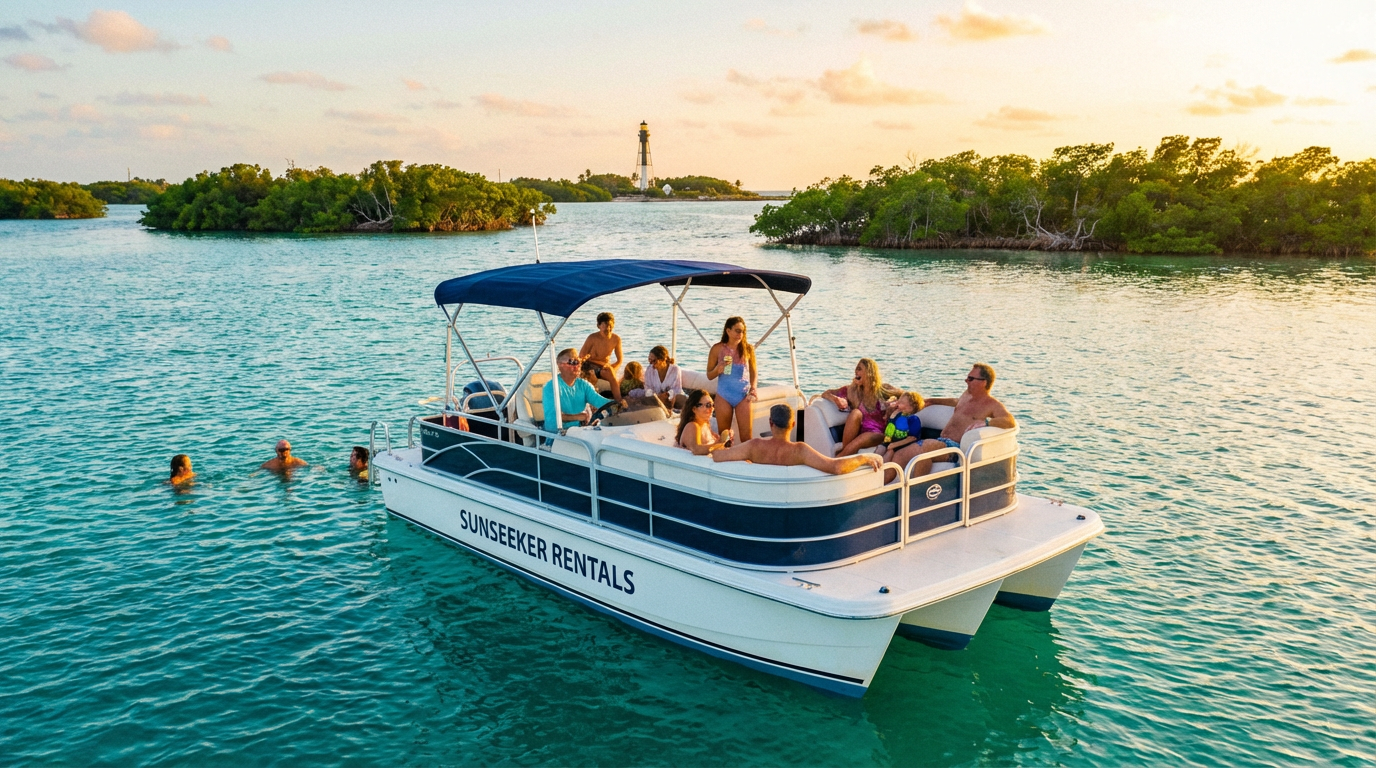
If you have driven past any marina from Destin to Cape Coral, you have likely noticed that pontoon boats make up roughly 70% of rental inventories. There is a practical reason for this ubiquity. Pontoons utilize two (or three, in the case of tritoons) aluminum tubes for buoyancy, creating a wide, flat deck that sits high on the water. For families, this design offers unmatched stability and interior volume.
The primary advantage of a pontoon is its shallow draft. A standard 24-foot pontoon draws only about 12 to 16 inches of water. This is critical if you plan to navigate areas like the Caloosahatchee River or the sandbars of Islamorada, where water levels fluctuate significantly with the tide. In my experience guiding groups near Fort Myers, pontoons are the only vessels I recommend for multi-generational trips.
The high railings and lack of varied floor elevations make them the safest option for toddlers and seniors who might struggle with the tripping hazards common on other boat types. However, visitors often underestimate the speed limitations. A standard two-tube pontoon with a 60hp or 90hp engine—common in rental fleets—will cruise comfortably at 15 to 18 mph.
If you intend to cover long distances or want to tow a tube, you must specifically request a "tritoon" (three tubes) with at least 150hp. According to Discover Boating, the third tube adds buoyancy and structural rigidity, allowing the hull to plane effectively and handle choppy water that would splash over the bow of a standard pontoon.
When to Opt for a Center Console Fishing Boat
While pontoons are floating living rooms, center consoles are utility vehicles designed for action. If your itinerary involves fishing in open water or navigating the often-turbulent inlets of the Atlantic coast (such as Jupiter or Haulover), a pontoon is dangerous and often contractually prohibited by rental agreements.
You need a V-hull design, such as a 21ft Mako Boat Rental Cape Coral, which is specifically built to handle these conditions. A center console features a deep-V hull that cuts through waves rather than riding over them, smoothing out the ride in chop generally exceeding one foot. The layout allows anglers to walk around the entire perimeter of the boat—vital when fighting a running tarpon or kingfish.
When renting a boat in Florida for fishing, verify that the rental includes essential "fishing package" add-ons. Look for live wells for bait, rod holders, and a GPS/fishfinder combo, which are standard on privately owned vessels but often removed from base-model rentals to reduce liability. The trade-off is comfort. Center consoles have limited seating, usually restricted to a leaning post and a bench at the stern.
Balancing Group Size and Weight Capacity
The most common friction point at the dock occurs when a renter confuses "passenger capacity" with "weight capacity." Every vessel operated in U.S. waters under 20 feet must display a capacity plate, a requirement enforced by the U.S. Coast Guard. This plate lists a maximum number of people and a maximum weight in pounds (persons, motor, and gear).
Here is what rental listings rarely tell you: The "max passengers" number is often calculated based on an average human weight of 150-160 lbs. If you have a group of 10 adults bringing three heavy coolers filled with ice and beverages, plus fishing gear, you will likely exceed the safety limits of a "10-passenger" deck boat.
Overloading a boat lowers its freeboard (the distance from the water to the lowest point where water can enter), increasing the risk of capsizing, especially in increasing wake. For groups of 8 to 12 who want speed but need space, a deck boat is often the perfect compromise. It combines the V-hull of a runabout with the flared bow of a pontoon. Always buffer your capacity estimates: if you have 10 people, rent a boat rated for 12 to ensure performance and safety remain intact.
Exploring Top Waterways Like Cape Coral and Beyond
Your choice of vessel is inextricably linked to where you plan to launch. While the neon lights of Miami and the megayacht culture of Fort Lauderdale draw millions, the Gulf Coast offers a distinctly different nautical experience. Renting a boat in Florida is not a monolithic experience; the skills required to navigate the deep, swift currents of the Atlantic Intracoastal Waterway differ vastly from the shallow, winding estuaries of the Gulf of Mexico.
Miami demands high alertness for heavy commercial traffic and choppy wakes, whereas the Gulf Coast—particularly Lee County—requires an acute awareness of tides. For those seeking a blend of residential exploration and open-water freedom, the southwest region stands out. According to Visit Florida, this area is renowned for its nature-first approach to boating, offering easier access to barrier islands than the urbanized east coast.
Cruising the Canals of Cape Coral
Known as a "Waterfront Wonderland," Cape Coral boasts over 400 miles of navigable canals—more than any other city in the world, including Venice, Italy. However, navigating this labyrinth requires more than just a GPS. A detail most rental listings omit is the significant travel time required to reach open water. Because much of the canal system is designated as "Idle Speed/No Wake" zones to protect manatees and seawalls, a rental home that looks close to the ocean on a map might actually be a 45-minute idle-speed crawl to the Caloosahatchee River.
When piloting a rental here, pay close attention to the intersection of canals. Unlike standard road grids, these waterways often look identical from the waterline. I always advise renters to mark their starting dock on a dedicated marine navigation app like Navionics or savvy navvy rather than relying on Google Maps, which lacks depth contour data.
One specific highlight regarding waterfront living here is the "dock-and-dine" culture. You can pull your Cape Coral Pontoon Boat Rental up to places like Runrunners at Cape Harbour or the Boat House Tiki Bar and Grill, but be prepared for strong tidal currents when docking. The current in the Caloosahatchee can rip at 2 to 3 knots, making stationary maneuvering difficult for inexperienced captains.
Venturing Out to the Gulf of Mexico
Leaving the protected canals for the open Gulf of Mexico introduces a new set of dynamics. As you exit the Caloosahatchee River and head toward the Sanibel Causeway, the water transforms from the tannic brown of the river (colored by mangroves and freshwater runoff) to the turquoise green of the Gulf. This transition point is critical for safety.
The channel markers switch orientation here, and confusion regarding the "Red Right Return" rule is the primary reason renters run aground near Punta Rassa. For those renting a boat in Florida to find seclusion, the Gulf Coast offers superior options compared to the Atlantic. Picnic Island, located near the entrance of the Caloosahatchee, is a favorite local sandbar accessible only by boat.
Further out, Cayo Costa State Park provides nine miles of undeveloped shoreline that feels worlds away from civilization. Navigating the Gulf requires distinct attention to depth. Unlike the Atlantic, where the depth drops off quickly, the Gulf serves as a shallow shelf.
You can be three miles offshore and still be in only 15 feet of water. Always monitor your depth sounder, especially around low tide. Shoals shift frequently after storms, and what was a clear channel last season might now be a sandbar. Responsible renters should cross-reference their visual charts with the National Weather Service Marine Forecast for wind patterns.
Breaking Down Pricing and Rental Durations for Florida Boat Rentals
With your vessel type and destination selected, the next step is navigating the projected costs of renting a boat in Florida. Prices in the Sunshine State are dynamic, fluctuating based on location, vessel type, and time of year. A standard pontoon rental in a quiet region like Crystal River will cost significantly less than a performance center console in South Beach or a Jet Ski Rental South Beach.
From my experience managing rentals since 2018, visitors often underestimate the "out-the-door" price because they focus solely on the advertised base rate, ignoring necessary surcharges and operational costs. Seasonality plays a massive role in pricing. The peak season—spanning from early March (Spring Break) through August—sees rates at their highest.
During holiday weekends like Memorial Day or the Fourth of July, demand surges so aggressively that prices can increase by 20% to 30%, and availability vanishes weeks in advance. Conversely, renting in October or November can yield lower daily rates and more flexible cancellation policies. According to Visit Florida, shoulder seasons offer a distinct value proposition for travelers looking to maximize their budget without sacrificing weather quality.
Typical costs for half day versus full day
In the Florida rental market, the vast majority of liveries operate on two primary time blocks: a "half-day" (typically 4 hours) and a "full-day" (typically 8 hours). While 2-hour rentals exist, they are generally poor value due to the time lost in the checkout and safety briefing process—you typically lose 30 minutes just doing paperwork and dockside instruction.
A standard 20-to-24-foot pontoon boat, which is the most popular vessel family for groups and families, generally follows this pricing structure:
- Half-Day (4 Hours): Ranges from $250 to $450 depending on the luxury level of the boat.
- Full-Day (8 Hours): Ranges from $450 to $700.
The "full-day discount" is a real economic factor. While a full day is double the duration, it is rarely double the price; it is usually priced at about 1.6 to 1.7 times the half-day rate. If you plan to visit spots like Crab Island in Destin or the sandbars in Islamorada, a 4-hour window often feels rushed once you account for transit time to and from the dock.
The full-day rental allows you to anchor, swim, and cruise without constantly checking your watch to avoid late fees, which can be as steep as $50 for every 15 minutes you are overdue. Speedboats and deck boats command higher premiums due to higher maintenance costs and insurance liabilities. Expect to pay between $500 and $900 for a full-day rental of a fiberglass deck boat capable of pulling a tube or wakeboarder. According to industry data from Statista, recreational boating costs have risen alongside general inflation.
Budgeting for fuel and additional fees
The advertised rental price is rarely the final amount charged to your card. The most common point of friction I see at the dock is the misunderstanding of fuel policies. Unlike a rental car where you top off the tank before returning, most Florida boat rentals operate on a "pay for what you use" consumption model handled at the marina.
Fuel Costs: Marinas charge a premium for fuel, often $1.00 to $2.00 per gallon higher than roadside gas stations. If you run a pontoon boat at cruising speed (around 3,500 RPM) for a full day, you might burn 15 to 20 gallons, adding roughly $80 to $120 to your bill. However, if you rent a dual-engine center console and run it hard, fuel costs can easily exceed $300 for a day trip.
Security Deposits: You must have a credit card available for a security deposit. This hold typically ranges from $500 to $2,500, depending on the deductible of the livery's insurance policy. Debit cards are often discouraged because the hold freezes actual funds in your checking account for 3 to 7 business days.
Sales Tax and Booking Fees: Florida state sales tax (6%) plus discretionary county surtaxes apply to rentals. Additionally, online booking platforms and marinas may attach a 3% to 6% "booking fee" or "service charge." When renting a boat in Florida, it is prudent to budget an additional 15% on top of the base rate to cover taxes and fees.
Cleaning Fees: While standard wear needs no extra payment, returning a vessel in "excessively dirty" condition—think crushed chips ground into the carpet, fish blood on the upholstery, or trash left on deck—will trigger a cleaning fee usually ranging from $50 to $100.
Checking Included Amenities and Service Options
Before committing your credit card, you must look beyond the base model specifications to the specific load-out of the boat. A common mistake I see among first-time visitors is assuming all rental fleets are maintained to the same standard. In reality, the difference between a budget skiff and a premium deck boat can drastically alter your experience.
When you are renting a boat in Florida, verifying the included equipment is essential for both safety and comfort. Florida’s unique marine environment—characterized by intense UV exposure, rapidly changing weather, and intricate shallow-water networks—demands specific amenities. A "bare-bones" rental might save you $50 up front, but the lack of shade or navigation tools can ruin a day on the water.
Essential On-Board Equipment and Tech
The most non-negotiable amenity for any Florida boating trip is the Bimini top. Unlike boating in cooler climates, the Florida sun is relentless, particularly between 12:00 PM and 3:00 PM. A Bimini top provides an overhead canvas shade structure that protects passengers from direct UV exposure and heat exhaustion.
I advise against renting any vessel that lacks this feature unless you are planning a very short, early morning fishing trip. Check specifically for "extended" or "double" Bimini tops if you have a large group, as standard tops often only shade the captain and the rear bench.
Navigation technology is equally critical. While many locals can navigate by sight, visitors should insist on a functioning GPS chartplotter—typically brands like Garmin or Simrad. Florida’s waterways, especially in areas like the Biscayne National Park, are notoriously tricky due to shifting sandbars and seagrass beds protected by state law. A chartplotter prevents you from running aground, a mistake that causes significant environmental damage and can cost you your security deposit.
Luxury Add-Ons and Captain Services
Beyond the basics, comfort amenities define the quality of your day. High-end rentals often include upgraded Bluetooth sound systems (Fusion or JL Audio are industry standards) and localized cooler storage. A trade-off to consider is onboard refrigeration versus cooler space; mostly, onboard fridges drain batteries quickly, so a high-quality Yeti-style cooler provided by the livery is often the superior, more reliable option for keeping drinks cold in 90-degree heat.
Perhaps the most significant service decision you will make is between a "bareboat" rental and a captained charter.
- Bareboat Rental: You (the renter) act as the captain. This offers maximum privacy and flexibility but places 100% of the liability and navigation stress on you.
- Captained Charter: You hire a USCG-licensed captain to operate the vessel. According to United States Coast Guard regulations, anyone paid to transport passengers must hold a valid Merchant Mariner Credential (often called a "6-pack" license or higher).
While a captained charter is more expensive—typically adding $30 to $50 per hour plus tip—it removes the risk of navigation errors and allows everyone in your party to consume alcohol responsibly. Finally, ask about concierge delivery services. In canal-heavy cities like Cape Coral or Fort Lauderdale, some premier rental companies will deliver the boat directly to the dock of your vacation rental, saving you the drive to the marina.
Evaluating Rental Companies via Reviews and Testimonials
While specifications and price narrow the field, reliability should drive your final decision. In the digital age, checking a star rating is second nature, but when renting a boat in Florida, a superficial glance at a Google score isn't enough. The marine environment is harsh—saltwater, intense UV rays, and high humidity accelerate mechanical wear significantly faster than with rental cars.
A boat fleet that was pristine in January can be mechanically tired by August if the operator cuts corners on maintenance. Through my years of vetting partners for Rockon Recreation Rentals, I have learned that the devil is in the details of the written narratives, not the aggregate score. When analyzing platforms like TripAdvisor or Google Maps, you must filter for "Recency" rather than "Relevance."
Interpreting Customer Feedback Patterns
Smart renters treat reviews like a forensic investigation. You are looking for specific keywords that indicate structural issues versus one-off user errors. When renting a boat in Florida, particularly in high-traffic areas like Miami or Destin, search the review timeline for terms like "hidden fees," "fuel charge," and "deposit."
A common friction point I see involves fuel policies. Reputable companies operate transparently: you leave with a full tank and pay for what you use upon return, often verified by a flow meter or visual gauge inspection. Predator operators often bury a flat "refueling service fee" in the fine print, which past customers will almost always flag in their testimonials. According to the Federal Trade Commission (FTC), undisclosed fees are a primary target for consumer protection.
Furthermore, distinguish between "weather disappointments" and "service failures." Florida weather is volatile; afternoon thunderstorms are clockwork in the summer. A negative review complaining that "the company wouldn't let us go out because of lightning" is actually a sign of a safety-conscious, responsible operator.
Spotting Consistent Service Quality Citations
Beyond avoiding scams, you want to identify operators who invest in the guest experience. Since many renters are navigating Florida waters for the first time, look for mentions of the "safety briefing" or "chart orientation." A high-quality testimonial will often say, "The dockhand showed us exactly where the sandbars were on the GPS."
Pay close attention to how the business owner responds to negative feedback. This is a tactic I use constantly. If an owner responds to a complaint about a broken radio with defensiveness or aggression ("You just didn't know how to use it"), it suggests a rigid culture that won't help you if you encounter legitimate trouble on the water. However, a response that offers context and a solution ("We apologize the Bluetooth failed; we have replaced the head unit as of Tuesday") indicates active management.
Beware of the "Bait and Switch," a practice unfortunately common in unregulated peer-to-peer markets. This occurs when a review mentions, "We booked the 2023 Pontoon but were put on the older 2018 model." Reliable reviews on established travel forums like Lonely Planet often highlight these consistently reliable operators versus the bait-and-switch opportunists.
Prioritizing Safety Procedures and Insurance Policies
With the booking confirmed and the deposit paid, the focus shifts to the dockside reality of renting a boat in Florida. While signing paperwork feels like a formality standing between you and the open water, treating the rental agreement and safety briefing as a checklist rather than a chore is critical. In my years navigating Florida's waterways—from the busy Intracoastal of Fort Lauderdale to the quiet rivers of Crystal River—I have seen vacations derailed not by bad weather, but by misunderstood liability clauses and skipped safety checks.
Unlike rental cars, where insurance is standardized and mechanical failure is a minor inconvenience, boating carries inherent risks that the Florida Fish and Wildlife Conservation Commission (FWC) regulates strictly under the recently updated Livery Act. Understanding precisely what you are responsible for regarding the vessel's condition and your passengers' safety is the final, most crucial step before leaving the dock.
Reviewing the rental insurance agreement
The most dangerous assumption a renter can make is believing that "full coverage" on a boat rental operates the same way it does for a car. In the marine industry, liability waivers are comprehensive. Most Florida liveries (rental companies) require you to sign an "Assumption of Risk" waiver, which typically places the financial burden of equipment damage squarely on you.
When reviewing your agreement, pay specific attention to the Consequential Damages and Propeller Policy clauses. Florida’s shallow waters—particularly the seagrass beds near the Florida Keys and the mudflats of the Gulf Coast—are notorious for damaging propellers. A standard "security deposit" (often ranging from $500 to $2,500) acts as a hold on your credit card, but if you run aground and destroy a lower unit, your liability can easily exceed that deposit.
Some reputable liveries offer an optional Damage Waiver for an additional daily fee, which can cap your out-of-pocket expenses for accidental damage. I strongly recommend purchasing this if available. However, be aware that these waivers almost never cover negligence, such as operating under the influence or entering restricted "No Motor" zones. According to the Florida Senate Bill 606 (The Boating Safety Act of 2022), liveries are now legally required to carry their own insurance, but this protects them and third parties, not necessarily the renter against hull damage costs.
Essential pre-departure safety checks
The "check-out" process is your only opportunity to document the vessel's condition before you take responsibility for it. Do not let the dockhand rush this process. Legitimate operators, such as our vetted Travel Partners at Rockon, are trained to walk you through a detailed vessel inspection.
Your pre-departure routine should always include a visual inspection of the propeller. Ask the livery staff to trim the engine up so you can see the blades. If there are existing nicks, dings, or bends, take a time-stamped photo with your phone and ensure it is noted on the departure form. If you return with a damaged prop that wasn't documented, you typically buy it.
Beyond damage inspection, Florida law mandates that the livery provides pre-rental instruction covering:
- Operational Characteristics: How to start/stop the engine, use the trim, and operate the bilge pump.
- Local Waterway Characteristics: Identification of channel markers (Red Right Return), manatee zones, and shallow water hazards.
- Safety Equipment location: Verification that there is a Coast Guard-approved life jacket (PFD) for every person on board, plus a throwable device (Type IV) if the boat is over 16 feet.
Finally, clarify the emergency protocols. In the event of engine failure, your first call should usually be to the rental company, not the Coast Guard (unless there is an immediate threat to life). Ask specifically if the boat is covered by a commercial towing membership like TowBoatUS or Sea Tow. A commercial tow without membership can cost upwards of $300 per hour.
Charting Your Course for a Memorable Florida Day
Transforming your vacation plans from a simple itinerary into a tangible memory requires more than just a credit card; it requires preparation and respect for the environment. While the process of renting a boat in Florida may seem bureaucratic at first glance—with its specific age requirements, safety certifications, and navigation rules—these regulations exist to ensure that your time on the water remains a highlight rather than a hazard.
Through my years of exploring Florida's waterways, from the mangrove tunnels of the Ten Thousand Islands to the emerald sandbars of Destin, I have found that the most successful trips are always those rooted in preparation.
A Final Pre Departure Checklist
To ensure a seamless experience when you arrive at the marina, run through this final mental checklist. These are the logistical friction points where I see most visitors struggle:
- Secure Your Credentials Early: Do not wait until you are standing on the dock to address the boater safety education requirement. If you were born on or after January 1, 1988, having your FWC-issued ID card or a temporary certificate ready on your phone creates a smoother handover.
- Master the "Float Plan": Even for a simple afternoon rental, tell a reliable person on land where you are going and when you plan to return. This is a standard safety protocol recommended by the U.S. Coast Guard.
- Pack for the Elements: Florida's sun is deceptive. Local boaters essentially require polarized sunglasses to read the water depth—color changes from deep blue to pale turquoise indicate shallow shoals. Without polarization, that glare can hide a propeller-destroying sandbar.
- Timing is Everything: Arrive at the livery at least 30 to 45 minutes prior to your reservation. The check-out process involves a safety briefing and vessel inspection that cuts into your rental time if you are late.
Responsible Stewardship of Our Waterways
When renting a boat in Florida, you become a temporary steward of one of the most fragile aquatic ecosystems in the United States. New boaters often underestimate the environmental impact of improper anchoring or navigating outside marked channels.
According to the Florida Department of Environmental Protection, scarring seagrass beds with boat propellers is a major threat to the state's fisheries. If you run aground, do not try to power off the flat using the engine; this digs a trench that can take a decade to heal. Instead, shut off the engine, trim the motor up, and push the boat to deeper water physically.
Furthermore, respect "Manatee Zones" and "No Wake Zones" strictly. These are not suggestions; they are federal and state protections enforced with heavy fines to protect slow-moving wildlife and shoreline integrity.
Safety is the Ultimate Luxury
Finally, treat the water with the seriousness it deserves. Florida's weather can pivot instantly; a clear blue sky at 11:00 AM often builds into a violent thunderstorm by 2:00 PM in the summer months. Always check the National Weather Service marine forecast rather than a standard weather app, as marine conditions (wind chop and swell) differ from land forecasts. Additionally, recognize that operating a vessel under the influence carries the same penalties as driving a car, with a 0.08 BAC limit strictly enforced by the FWC and local Sheriff's officers.
By following the legal guidelines, choosing the right vessel for your skill level, and navigating with ecological awareness, you set the stage for an adventure that is both thrilling and safe. The water is waiting—get out there and enjoy it responsibly.