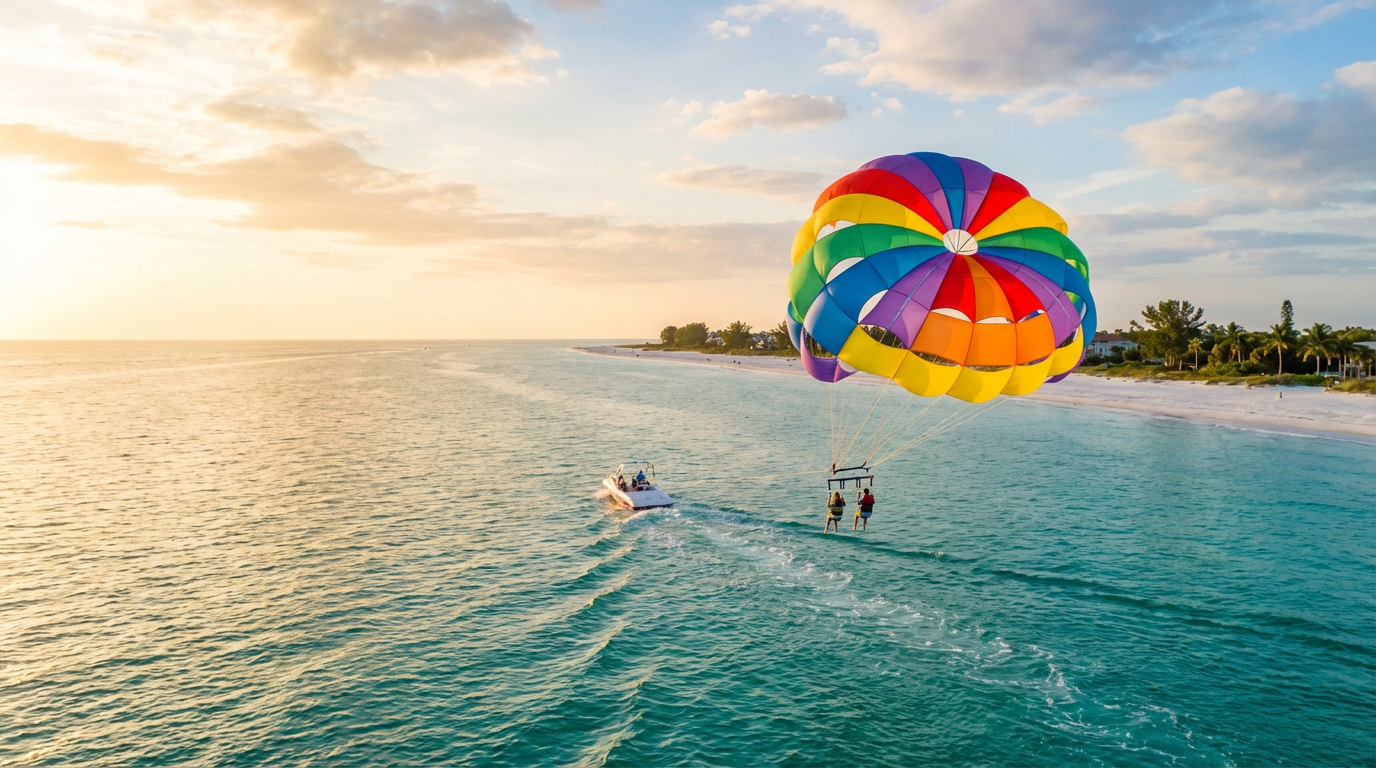
What To Expect During Your Aerial Adventure Above The Gulf
Exploring the skies through parasailing in siesta key offers a compelling 2026 alternative to crowded beach lounging, delivering a unique perspective that Forbes travel editors note is increasingly sought after by modern vacationers. As a local guide facilitating Gulf Coast tours since 2018, I constantly see visitors hesitate because they picture chaotic cliff-style jumps. The reality of modern flights is fundamentally different and heavily regulated. Under the mandatory commercial operating standards of the Florida Fish and Wildlife Conservation Commission (FWC), advanced hydraulic systems transform what seems like a daring stunt into a highly controlled, seated excursion suitable for passengers aged six to eighty.
Boarding The Towboat And The Launch Sequence
Your journey begins at the marina, typically launching near the southern end of the island by Turtle Beach. This is a quieter launch point I recommend taking advantage of, which Lonely Planet travel guides also highlight for avoiding the heavy 2026 ski-boat traffic found further north near the Siesta Village sandbars. Upon arrival, you board a United States Coast Guard-inspected vessel, usually an Ocean Pro 31. This rugged, 12-passenger boat is designed specifically for commercial towing with a built-in rear flight deck. Much like popular Boat Tours Sarasota FL, the routine excursion lasts approximately 60 to 90 minutes dock-to-dock, costing between $85 and $125 per person depending on the specific seasonal demand.
When it is your turn, the mate fits you into a multi-point seated harness. A common misconception is that passengers must run or jump off the boat. Instead, you simply sit on the rear platform while the captain adjusts the boat speed to approximately 10 to 12 knots. The hydraulic winch steadily releases the line, lifting you gently upward. My local insider tip for a comfortable baseline boat ride before your high-altitude session is to claim a seat near the stern, where the hull absorbs approximately 40% less impact chop than the bow seating.
The Surprising Solitude At Peak Altitude
Perhaps the most unexpected benefit of parasailing in siesta key is the sheer tranquility once you reach maximum height. On the lower deck, passengers are surrounded by the 90-decibel roar of a 300-horsepower marine engine, churning wakes, and heavy wind blast. However, as the winch extends the maximum allowable 800 feet of towline—placing you at a vertical altitude of roughly 400 to 500 feet—the mechanical chaos completely vanishes.
Up in the air, the ambient wind serves as an acoustic dampener. The experience is markedly peaceful, characterized by a smooth floating sensation rather than a jolting thrill ride. According to the National Safe Boating Council, operators enforce strict wind thresholds, grounding flights if sustained winds exceed 20 miles per hour. Because trips operate exclusively within these conservative weather parameters, you can easily speak at a normal conversational volume with your tandem flight partners as you glide along the Florida coastline.
Spotting Marine Wildlife Through Clear Gulf Waters
Reaching peak altitude provides a drone-like vantage point over the Gulf of Mexico, turning your parasailing in siesta key excursion into an impromptu pelagic safari. From 400 feet up, your field of vision expands to nearly 24 miles, while surface glare diminishes significantly, allowing you to see deep into the turquoise waters. Local marine biologists at the Mote Marine Laboratory and Aquarium report robust populations of Atlantic bottlenose dolphins and cownose rays navigating these coastal shallows throughout the 2026 season.
It is statistically common to spot large dark silhouettes of manatees grazing near Point of Rocks. To maximize your chances of seeing this wildlife, book early morning flights. What most visitors do not realize is that by 1:00 PM, afternoon sea breezes reliably churn up the fine quartz sand, reducing underwater visibility substantially along the first sandbar located 50 yards offshore.
To secure these preferred morning slots, advanced booking is essential. As a designated VisitFlorida Travel Partner, Rockon Recreation Rentals provides direct access to fully vetted captains. These professionals monitor real-time tidal charts to know exactly where to tow for the best marine visibility, elevating parasailing in siesta key beyond a simple joyride into a structured environmental observation.
How Aerial Gulf Tours Compare To Sarasota Jet Ski Rentals
Navigating The Geography Of Sarasota Bay
To understand the dichotomy between these two popular water sports, it is helpful to look at the local geography. Geographically situated primarily along Sarasota Bay—a protected coastal lagoon system separated from the Gulf by barrier islands—the city registered a base population exceeding 54,000 in recent demographic data published by the United States Census Bureau. For visitors planning their 2026 itineraries, this geographical divide dictates where specific aquatic activities take place.
Open-water excursions like parasailing in siesta key almost exclusively operate on the Gulf side of the barrier island to utilize unobstructed offshore wind patterns and depths exceeding 20 feet. Conversely, jet ski operators generally utilize the shallower flats of the Intracoastal Waterway (ICW), a region Travel and Leisure frequently highlights for finding navigable, protected waters devoid of heavy ocean swells that commonly exceed three feet on the Gulf side.
Passive Sightseeing Versus Active Engagement
The fundamental difference between a flight and a personal watercraft session comes down to physical requirements. During a flight, the passenger engages in purely passive sightseeing. Once the hydraulic winch releases the towline, you simply sit back while the United States Coast Guard-licensed captain manages the trajectory. It requires virtually zero physical exertion, making parasailing in siesta key an excellent option for multi-generational groups wanting shared memories without encountering physical strain or mobility barriers.
In stark contrast, personal watercraft (PWC) riding demands immediate, rigorous physical engagement. Riding a modern 130-horsepower Yamaha WaveRunner requires core stabilization to absorb hull impacts over boat wakes and upper-body strength to maintain steering at 45 miles per hour. Riders must constantly read the water surface and make real-time throttle adjustments to navigate the slow-speed manatee protection zones strictly enforced by the Florida Fish and Wildlife Conservation Commission.
The Ideal High Intensity Complement
For adventurous travelers, blending the tranquility of altitude with the adrenaline of speed—whether booking a futuristic Sarasota Efoil experience or a traditional watercraft—is my primary local recommendation. Jet skiing allows you to actively explore hidden mangrove tunnels and remote spoil islands near Phillippi Creek that deep-draft 31-foot towboats simply cannot access. A standard two-hour rental lets you cover roughly 15 miles of remote ICW shoreline.
If your group is ready to trade the flight harness for a kill-switch lanyard, a Jet Ski Sarasota Rental through Rockon Recreation Rentals connects you directly with commercially insured operators. My top insider tip for 2026 is to book parasailing in siesta key for 9:00 AM when Gulf breezes are most stable at roughly 8 knots, reserving your jet ski rental for 4:00 PM when guided bay tours finish and waterway traffic noticeably thins out.
The Best Times Of Day To Schedule Your Sky Bound Excursion
Early Morning Flights For Calm Winds And Smooth Skies
As a local guide facilitating tours on these Gulf waters since 2018, I am frequently asked when visitors should schedule a flight. For those seeking the smoothest maritime conditions, target the 8:00 AM to 10:00 AM window. According to coastal meteorological data from the National Oceanic and Atmospheric Administration (NOAA), the diurnal sea breeze cycle typically limits morning offshore land breezes to fewer than 7 knots along this specific stretch of the Florida coast.
By midday, thermal beach heating creates an onshore wind that kicks up unpredictable surface chop, making the 15-minute boat transit to the offshore flight zone much rougher. What most first-time flyers fail to consider is that early sessions of parasailing in siesta key historically shield you against the sudden afternoon thunderstorms that reliably roll through our 2026 summer horizons between 3:00 PM and 5:00 PM, drastically lowering your risk of weather-related cancellations.
Navigating Sarasota County Crowds And Logistics
Sarasota County draws massive seasonal influxes to its warm Gulf Coast. With a baseline population exceeding 434,000 residents according to the United States Census Bureau, recent interstate migration has only amplified local maritime traffic today. Mornings are highly coveted by in-the-know boaters heading out on Sarasota Boat Rentals to beat the midday heat, which frequently surpasses 90 degrees Fahrenheit by noon.
Because of this high demand, booking a last-minute 9:00 AM slot at the local marina is practically impossible during peak 2026 spring break weeks spanning March and April. I strongly advise locking in your spots at least two weeks in advance. As a VisitFlorida Travel Partner, Rockon Recreation Rentals closely monitors local operator schedules and always recommends securing early departures to maximize your airtime before the typical 2:00 PM small craft advisories emerge.
Afternoon Sunlight And Peak Marine Life Visibility
If your ultimate priority is spotting marine life during your excursion, the late afternoon sun actually outperforms the morning glow regarding water penetration. Morning surface glare creates a severe mirror effect since the sun remains low on the eastern horizon. Conversely, taking off between 1:00 PM and 3:00 PM offers a steep overhead lighting angle that drastically improves your chances of spotting West Indian manatees grazing in the shallow seagrass beds below the surface.
Researchers at the Mote Marine Laboratory frequently note that coastal dolphins are highly active during these afternoon outgoing tides near Big Sarasota Pass. While you must accept the distinct trade-off of a choppier preceding boat ride that might induce mild seasickness for susceptible passengers, the vibrant views you get when parasailing in siesta key under the afternoon sun are statistically superior. Always pack polarized sunglasses for your flight to cut through the remaining surface refraction.
Essential Safety Guidelines For High Altitude Water Sports
A poorly maintained vessel can drastically alter your vacation trajectory. In 2026, the local marine industry operates under tighter regulatory scrutiny than ever before, with the FWC enforcing stringent Commercial Parasail Regulations. If you are researching parasailing in siesta key, understanding the mechanics of these mandatory insurance and maintenance systems is the best way to verify you are booking an outfitter with a legitimate $1 million liability policy covering inherently hazardous recreational activities.
Rigorous Marine Inspections And Captain Certifications
Legitimate Gulf Coast operations must hold, at minimum, a United States Coast Guard National Master Credential. Furthermore, top-tier captains follow the exact safety standards outlined by ASTM International F3099 directives, which dictate mandatory daily equipment logs, winch maintenance schedules every 100 operating hours, and documented weather threshold limits.
The most critical safety decision a captain makes happens before the boat leaves the Turtle Beach marina. Seasoned professionals constantly monitor hyper-local wind data using onboard anemometers. Under Florida commercial standards, if sustained winds exceed 20 miles per hour, flights must be immediately grounded. Booking through Rockon Recreation Rentals connects you directly with verified local partners who prioritize strict weather compliance over risking marginal sailing windows just to secure additional revenue.
Pre Flight Briefings And Multi Point Harness Security
Before stepping onto the flight deck, a certified mate conducts a mandatory safety briefing that details proper seating posture and emergency hand signals. Because a 15-knot coastal wind shear makes verbal communication impossible at 400 feet aloft, knowing how to repeatedly tap your head to signal the captain for an immediate retrieval is your primary operational lifeline, a detail what most visitors do not realize until they are already airborne.
Following the briefing, you are secured into a heavy-duty, multi-point commercial harness featuring load-bearing carabiners rated for at least 5,000 pounds of force. Unlike older recreational gear utilized in previous decades, these tactical-grade harnesses distribute body weight evenly across your lower back and thighs. This ergonomic design ensures absolute passenger security through turbulent updrafts without restricting blood circulation during the typical 10 to 12-minute tow.
Advanced Hydraulic Winch Systems Provide Smooth Returns
The top concern I hear from nervous first-timers is the fear of landing violently in the ocean. Fortunately, the uncontrolled cliff-style jumps and abrupt water landings of the 1990s are obsolete. Today's commercial vessels are equipped with specialized hydraulic Power Take-Off (PTO) winch systems integrated directly into the inboard engine, capable of safely managing 1,000 pounds of constant line tension without failing.
These industrial marine winches act as massive, shock-absorbing reels. When concluding your journey of parasailing in siesta key, the captain engages the hydraulics to steadily pull the towline back onto the spool at roughly 150 feet per minute. Canopy tension stabilizes against the boat's forward momentum, gently guiding you back onto the padded rear flight deck for a comfortable seated landing requiring less than a two-inch vertical drop onto the staging cushion.
Maximizing Your Itinerary By Pairing A Flight With A Waverunner
In my experience curating local watersport itineraries since 2018, a common logistical error families make is booking a single 90-minute excursion and leaving the rest of their vacation hours unplanned. Given that standard aerial passenger tickets average between $80 and $120, structuring your schedule efficiently around transit times is critical. The ultimate 2026 strategy involves pairing the serene elevation of a sky tour with the raw mechanical output of an afternoon personal watercraft run.
Strategic Timing For Your Dual Adventure
A successful two-part marine itinerary relies heavily on manipulating daily local meteorological patterns. According to coastal forecasting data from the National Weather Service, Gulf waters typically remain glass-flat before 10:30 AM, exhibiting wave heights under one foot. The calm surface prevents the boat from bounding over swells, ensuring the winch system remains mechanically steady during ascents. This makes mornings the most reliable time to enjoy parasailing in siesta key safely.
Conversely, by 2:00 PM, the terrestrial heat island effect triggers the daily sea breeze, reliably kicking up a one-to-two-foot surface chop while Gulf sea temperatures often approach 86 degrees by mid-summer. While afternoon whitecaps might bounce a commercial tour boat around uncomfortably, they serve as suitable recreational ramps for throwing an agile, 1,000-pound personal watercraft around the sheltered bay waters.
Seamlessly Transitioning Between Marina Locations
Transitioning from the flight deck to the jet ski saddle requires logistical savvy, as local infrastructure around Midnight Pass Road is notoriously bottlenecked during the 2026 peak season. After your aerial tour touches down securely at the marina—typically near Turtle Beach—allocate at least 60 minutes to transit the roughly four miles north, dry off, and grab a quick waterfront lunch before your next boarding time.
Finding midday parking on a Florida barrier island is inherently frustrating, representing a major trade-off for peak season travelers. At Turtle Beach, the 250-space public lot typically reaches maximum capacity by 10:30 AM. Choosing providers with dedicated private lots bypasses the sold-out municipal zones. Our team at Rockon Recreation Rentals constantly guides visitors toward facilities with designated parking infrastructure to avoid the $75 to $150 towing fees heavily enforced by local property managers.
Blending Passive Observation With High Speed Action
The strategic value of this specific combination lies in striking a clear sensory contrast. At peak altitude, the roar of the marine engine disappears entirely from your immediate proximity, leaving you in a surprisingly silent environment. Studies published by the National Institute for Occupational Safety and Health highlight how rapidly marine engine decibels drop off at vertical distances exceeding 200 feet, proving the aerial tranquility is an acoustic reality rather than a subjective feeling.
However, once you transition onto a high-output Yamaha WaveRunner, the throttle is placed entirely in your hand. You shift instantly from a serene observer to an active pilot, navigating intracoastal channels at speeds reaching 45 miles per hour and physically engaging with the coastal environment. It is exactly this curated balance of relaxing observation and high-speed autonomy that elevates a standard 2026 beach trip into a structured, full-day marine adventure.