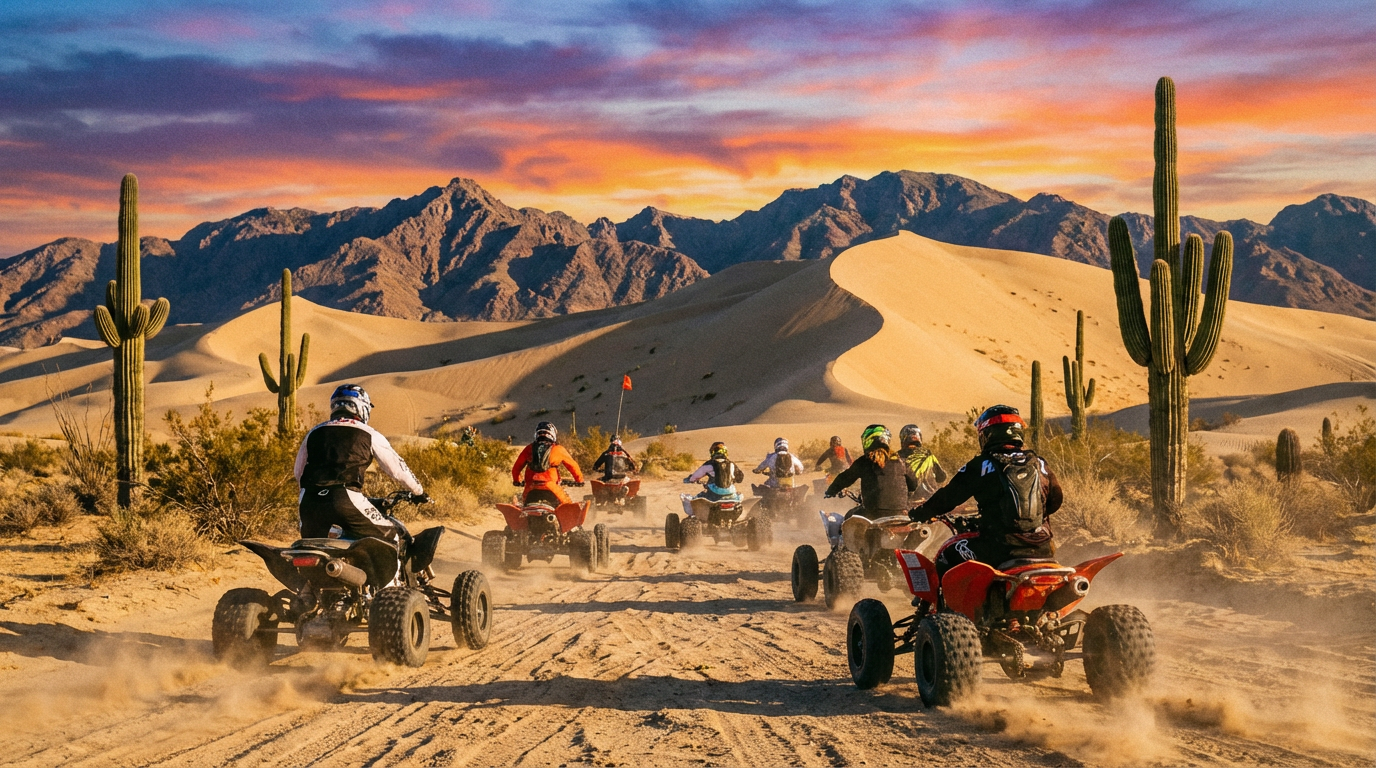
The Draw And Reality Of Dirt Trails
Since I began guiding outdoor tours through Florida's humid wetlands in 2018, the adventure tourism sector has shifted significantly leading into the 2026 season. Operating as a verified VisitFlorida Travel Partner at Rockon Recreation Rentals, I routinely consult with travelers planning cross-country itineraries. A major demographic always asks about atv riding in california, actively envisioning vast desert landscapes and unbridled horsepower.
The initial focus invariably centers on commanding raw mechanical force. A standard high-performance sport quad, like a Yamaha YFZ450R, weighs approximately 405 pounds wet and delivers roughly 40 horsepower directly to the rear tires. This aggressive thrust-to-weight ratio provides an intense adrenaline rush for operators navigating the expansive, 85,000-acre Ocotillo Wells State Vehicular Recreation Area down south.
However, the highly edited digital highlight reels on social media rarely capture the grueling physical realities of these arid environments. While whipping up eight-foot sand plumes looks highly compelling on a screen, fighting a 400-pound machine through deep, rutted washboards requires aggressive, sustained upper body strength. The ambient afternoon temperatures in the Mojave Desert throughout July 2026 consistently hover around 105 degrees Fahrenheit, accelerating operator dehydration at a rapid pace.
The Hidden Physical Toll Of Heavy Machinery
Most casual vacationers drastically underestimate the immense core engagement necessary to stabilize an off-road chassis. Unlike sitting passively in a leveled passenger seat, standing on the footpegs of a quad to absorb relentless track shocks taxes the quadriceps and lower lumbar spine heavily within the first ten miles of a trail loop.
The intense, high-frequency vibrations transferred directly from a combustion engine through the steering column almost always induce a clinical issue riders call arm pump. In this state, the forearm fascia becomes engorged and highly restricted from the mandatory, continuous grip on the thumb throttle and brake levers, significantly reducing hand dexterity.
This physical degradation directly correlates to inevitable operator errors. According to the official safety database managed by the Consumer Product Safety Commission at cpsc.gov, driver fatigue and loss of spatial control are primary variables in non-collision off-road incidents. In my professional guiding experience, a first-time rider's stamina typically plummets precisely 45 minutes into a two-hour rental block, often forcing a premature end to their planned backcountry excursion.
Vacation Time Lost To Tedious Logistics
Beyond acute physical exhaustion, the heavy logistical time sink of motorized tours remains a largely unspoken reality within the powersports industry. While the fantasy of atv riding in california suggests grabbing a helmet and immediately peeling out into the coastal dunes, actual commercial onboarding operates under heavily regulated protocols to mitigate severe liability risks.
A standard half-day rental block easily burns 45 to 60 minutes strictly on administrative tasks and safety outfitting. Participants must complete lengthy multi-page digital liability waivers, sit through mandatory 15-minute operational safety videos, and undergo highly supervised gear-sizing sessions before anyone approaches an ignition switch.
Securing properly fitted DOT-approved full-face helmets, adjusting shatter-proof polycarbonate goggles, and strapping into hard-shell chest protectors is completely non-negotiable for legit commercial operators. By the time your group actually initiates the start buttons in the designated dirt staging zone, you have already surrendered a massive fraction of your $200-per-person rental window to stationary prep work.
Analyzing Cost And Group Dynamics For 2026 Travel
Moving past the steep physical barriers, travelers planning their 2026 West Coast excursions must critically evaluate the fiscal math surrounding off-road powersports. Traditional motorized quad rentals routinely average between $150 and $225 per person for a standard two-hour unguided trail window during the peak summer months.
What outfitters rarely advertise forthrightly on their introductory booking pages is the required security deposit process. Because powersports equipment is highly susceptible to trail damage, operators routinely place a $500 to $1,000 credit card hold per vehicle. A simple steering misjudgment that binds a tie-rod on a hidden granite boulder instantly forfeits a massive chunk of your liquid vacation budget.
In sharp contrast, booking a pedal-powered railbike excursion comprehensively bypasses these fiscal anxieties. A standard two-seat railbike on the historic Fort Bragg tracks runs approximately $250 total, splitting the direct cost effectively to $125 per person. Because these heavy-duty carts glide on a fixed steel trajectory, operators do not require massive damage deposits, keeping your travel capital fully available.
Multi Generational Family Accessibility
The fixed-rail design fundamentally solves the rigid age and accessibility restrictions that typically fracture family holiday itineraries. California state law mandates strict age limits on public lands, explicitly dictating that children younger than 16 generally cannot legally pilot adult-sized ATVs. This forces families into cramped side-by-side UTVs or leaves younger members completely excluded from the core driving activity.
Railbikes intentionally democratize the outdoor experience. The custom-built aluminum rigs traversing the Mendocino county lines accommodate specialized child harnesses and baby carriers safely, allowing toddlers to tag along securely. Simultaneously, the supplemental 750-watt electric pedal-assist motors mean a 75-year-old grandfather can easily match the 10-mile-per-hour cruising speed of a seasoned 25-year-old cyclist without facing cardiac overexertion.
Sharing the exact same physical vehicle layout radically improves immediate group cohesion. Off-road quads force a rigid, single-file formation where communicating requires screaming over a 90-decibel engine block. Railbikes arrange passengers in a side-by-side format, allowing couples and families to quietly discuss the 300-foot Redwood canopies passing overhead without requiring expensive $300 Bluetooth helmet intercom relays.
The Ecological Downside Of Motorized Quad Excursions
Analyzing off-road impacts since my 2018 guiding debut in Florida's fragile wilderness corridors, the environmental degradation caused by heavy recreational machinery cannot be overstated. The sheer mechanical force required to propel a 400-pound quad up a steep, sandy incline inherently displaces massive volumes of loose topsoil, accelerating trail erosion far past the point of natural seasonal recovery.
The auditory footprint poses an equally severe threat to highly sensitive wildlife habitats. According to the acoustic monitoring divisions at the National Park Service via nps.gov, sustained mechanical sound waves broadcasting at levels strictly above 60 decibels actively scramble the auditory tracking abilities of local predators, directly impacting hunting efficiency.
Given that a standard 450cc four-stroke engine idles near 85 decibels and frequently spikes past 95 decibels under hard acceleration, driving these machines into a delicate coastal biome virtually guarantees a localized wildlife evacuation. If your specific goal with atv riding in california was to view native animals in their natural element, the piercing mechanical racket effectively sabotages that entire objective before you even arrive.
Wildlife Disruption And Convoy Realities
Opting for commercially guided motorized tours introduces the highly restrictive reality of convoy positioning. Due to stringent commercial liability insurance policies, tour operators force recreational groups into a mandatory single-file line directly behind the lead guide, fiercely maintaining a strict 30-foot spacing gap for collision prevention.
Riders unfortunately assigned to the rear of this formation spend an agonizing two hours choking on a continuous thick cloud of uncombusted hydrocarbon exhaust fumes and aerosolized trail dirt. PM10 particulate matter suspended in the turbulent air drastically reduces visual clarity and immediately irritates respiratory tracts, effectively turning what should be a fresh-air excursion into a literal endurance test.
The historically dry stretches affecting the lower Sierra foothills during this 2026 season have only amplified this severe dust hazard. Unless guiding operators mandate heavy N95 respirators or specialized wet buffs, dragging a dozen aggressive knobby tires over dry silica sand guarantees the trailing riders will end their tour spitting grit.
The Cognitive Load Of Trail Navigation
The most insidious drawback of open-trail backcountry riding is the intense cognitive load operators must sustain. Safely commanding an independent vehicle over unpredictable terrain forces a biological stress response; you fundamentally cannot relax and passively absorb the surrounding 360-degree panoramic vistas.
Navigating dynamic trail hazards like deep washout ruts, concealed limestone boulders, and aggressive off-camber slopes requires focusing 90 percent of your mental bandwidth on the immediate 15 feet of dirt squarely in front of your front bumper. According to sports psychology data verified by the American Psychological Association via apa.org, this high-stress maneuvering triggers target fixation, severely narrowing your peripheral awareness to immediate physical threats.
The stark irony of selecting atv riding in california for sightseeing purposes is that the driver rarely gets to actually see the distant sights. When you dismount a vibrating quad after an intensive 30-mile loop, the dominant memory is usually the grueling terrain obstacles you successfully dodged, completely overshadowing the sweeping Mojave sunsets or towering coastal cliffs you originally paid to observe.
Discovering The Untouched Splendor Of The California North Coast
Breaking away from the arid, sun-baked environments of the southern dirt trails unlocks a drastically different and far more hospitable travel experience. When plotting out itineraries for out-of-state clients during the busy 2026 peak season, I consistently steer them toward the rugged, temperamental beauty of the California North Coast.
Geographically, this distinct 350-mile stretch of maritime seaboard runs north from San Francisco Bay up to the Oregon state border, bypassing the heavy coastal smog and punishing heat indexes highly characteristic of traditional southern atv riding in california. By July, when interior valleys routinely boil at 100 degrees, the coastal city of Fort Bragg comfortably averages a highly tolerable 65 degrees Fahrenheit thanks to the persistent influence of the Pacific marine layer.
This localized cooling fog directly sustains the region's absolute crown jewel: the Sequoia sempervirens. These coastal redwoods represent an ancient biological lineage and formally stand as the tallest living organisms on the planet. Navigating through a heavily shaded old-growth grove harboring 300-foot-tall timber towers provides a profound sense of scale simply unavailable in the flattened scrub-brush badlands.
The Statistical Advantage Of Low Impact Eco Tourism
Replacing the aggressive roar of a combustion engine with the near-silent hum of solid polyurethane rail wheels creates highly tangible ecological benefits. The dense, sponge-like layer of discarded redwood duff constantly blanketing the forest floor naturally absorbs and dampens ambient sound, creating a highly optimal whisper-quiet microclimate designed for low-impact recreation.
According to comprehensive environmental impact studies archived by the California Department of Fish and Wildlife at wildlife.ca.gov, sharply reducing localized anthropogenic noise directly encourages delicate native species to return to heavily trafficked human corridors. Railbike passengers quietly pedaling over the Pudding Creek estuary frequently report highly intimate, visually undisturbed sightings of nesting osprey, migratory river otters, and endangered Coho salmon runs.
Operating a strictly 100-percent emission-free pedal vehicle allows you to ethically traverse these protected ecological zones without introducing toxic hydrocarbon runoff into pristine coastal watersheds. In an era where conservation heavily influences travel choices, selecting an eco-friendly rail excursion legally supports the ongoing protection of these coastal habitats while delivering exactly the immersive outdoor thrill vacationers actively seek.
How A Clever Bicycle Concept Revolutionized Forest Exploration
Tracing the evolution of customized recreational trail equipment since my early 2018 guiding days, the leap from traditional mountain biking to fixed-gauge rail cycling represents a masterful engineering pivot. Traditional two-wheeled off-road bicycles struggle profoundly in unpredictable wilderness topographies, heavily limiting deep forest access strictly to physically elite athletes.
The modern railbike ingeniously bypasses these stringent physical gating mechanisms. By custom-fitting a lightweight, four-wheeled aluminum chassis directly onto standard 4-foot-8.5-inch decommissioned logging railway tracks, the design utterly eliminates the complex physics of trail balance and ongoing steering micro-corrections.
The rigid steel rails forcefully impose a completely safe and highly predictable trajectory, allowing riders to safely abandon the handlebars without fearing a sudden loss of directional control. The Rails-to-Trails Conservancy continuously advocates for making wild spaces universally accessible, and these fixed-track platforms flawlessly execute that specific mission by granting individuals with severe mobility constraints direct access to deep wilderness expanses that would be medically impossible to hike.
Effortless Electric Assistance Built Right In
A highly prominent hesitation surrounding pedal-driven excursions is the looming fear of mid-trail physical exhaustion. Most casual riders incorrectly assume they will be forced to manually propel a 250-pound quadricycle up steep, miles-long mountain inclines entirely under their own isolated leg power.
However, heading into the core of the 2026 touring season, leading commercial railbike operators have universally integrated sophisticated e-bike technology into their proprietary fleet. Supplemental 500-watt electric hub motors silently engage the absolute moment pedaling rotational resistance increases, automatically flattening out subtle two-percent track gradients.
This seamless mechanical advantage essentially means riders completely dictate their own physical exertion levels. You can strategically choose to pedal vigorously to raise your heart rate or lean entirely on the thumb throttle to effortlessly coast through the redwood canopy. It effectively provides all the rapid forward momentum of atv riding in california without the agonizing next-day muscle soreness or crippling joint fatigue.
Strategic Planning For Your Mendocino Woodland Journey
Orchestrating a successful railbike excursion requires pivoting your packing strategy entirely away from the heavy-duty requirements of traditional motorsports. If you book an atv riding in california package at the active Oceano Dunes, California State Parks via parks.ca.gov heavily advises outfitting your personal group in protective chest roost deflectors, reinforced over-the-ankle boots, and padded motocross pants to actively guard against severe exhaust pipe burns and flying gravel wash.
Because railbikes are fundamentally locked into a heavy fixed steel grid and electronically governed to a safe maximum cruising speed of 10 to 15 miles per hour, the statistical risk of vehicle rollovers or high-speed driver ejections is essentially eliminated. Passengers can comfortably complete the entire 7-mile Pudding Creek loop wearing standard supportive athletic shoes and lightweight breathable cotton shorts.
The primary logistical hurdle on the Mendocino Coast is strictly managing the highly unpredictable marine climate. According to localized statistical tracking by the National Weather Service at weather.gov, morning baseline temperatures in Fort Bragg regularly dip to 54 degrees, enveloped by a thick, damp coastal fog that severely limits early visual range.
Securing Your Spot And Understanding The Fixed Trail Trade Offs
Local coastal guides strongly advocate for a modular clothing layering system. Initiating a standard 9:00 AM track departure requires a mid-weight fleece or synthetic windbreaker, which can easily be stripped off and stowed securely in the railbike’s rear cargo basket once the heavy marine layer burns off around 11:30 AM and track temperatures rise toward a highly comfortable 70 degrees.
Transitioning to sustainable historic rail tours does mandate accepting one critical operational trade-off: the total forfeiture of steering autonomy. Because you are strictly bound to historic logging routes laid down exactly a century ago, you cannot suddenly jerk the handlebars to chase an unexpected scenic overlook or carve an impromptu path through an adjacent meadow.
Yet, as a seasoned guide evaluating modern 2026 travel trends, I constantly remind guests that this specific mechanical limitation is precisely what makes the experience uniquely restorative. The total absence of manual steering completely eliminates the exhausting cognitive burden of trail navigation, allowing you to tilt your head back, breathe in the rich, unpolluted scent of ancient redwood bark, and genuinely engage with the extraordinary coastal wilderness safely surrounding you.