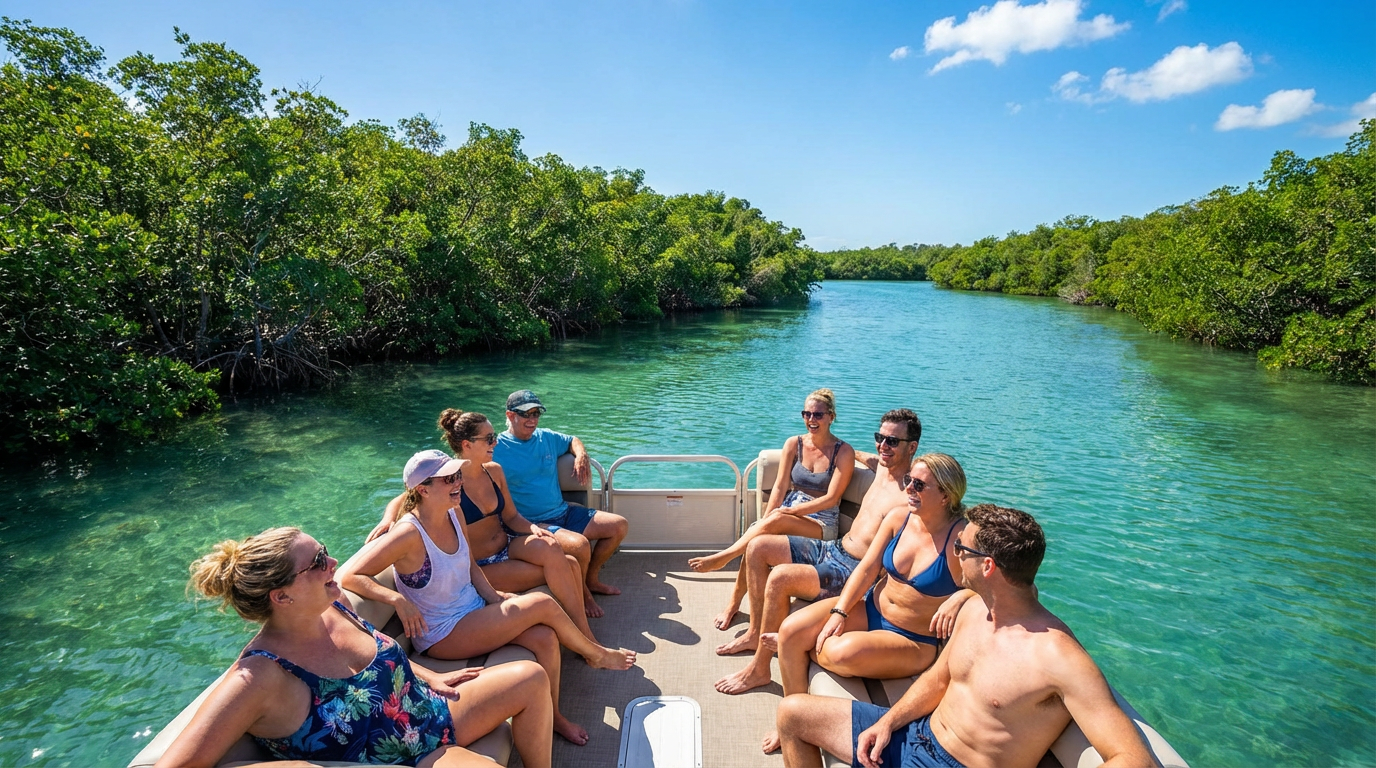
Comparing Different Types of Pontoons Available
Selecting the right vessel is the single most critical decision you will make when planning a pontoon rental Crystal River excursion. While many first-time visitors assume typical boats are all the same, the specific hull limitations and layout configurations drastically alter your day on Kings Bay. Drawing from years of navigating these tidal waters since 2018, I have seen families struggle to fit snorkel gear on fishing-oriented decks and anglers frustrated by the lack of live wells on luxury cruisers. The clear waters of Citrus County demand different specs depending on whether your goal is scalloping, manatee viewing, or simply anchoring at "The Cove" for a sunset socializing session.
Standard Cruising Pontoons
The 20 to 24-foot standard pontoon is the workhorse of the Nature Coast. These vessels typically feature a "bifoil" (two-log) design, which offers a shallow draft ideally suited for the fluctuating tides of Kings Bay. According to local bathymetric data, depths in parts of the bay can drop to under 3 feet at low tide. The standard pontoon's ability to float in as little as 12 to 16 inches of water makes it the safest choice for general exploration.
For families targeting Three Sisters Springs, this is your best option. While you cannot drive motorized vessels into the springs—a common misconception that can lead to fines from the U.S. Fish and Wildlife Service—these boats are easy to anchor just outside the spring run boundaries. Most local fleets configure these with wraparound "L-lounge" seating, maximizing social space. If you plan to visit during the busy manatee season (November 15 – March 31), the standard pontoon offers the best visibility for spotting the 100+ manatee protection zones where you must maintain idle speed, a cause supported by organizations like the Save the Manatee Club.
Local Tip: While standard pontoons are listed for 10-12 people, the real-world comfort limit is usually 8 adults plus gear. If you overload the bow, you risk "plowing" water, which wastes fuel and makes steering heavy.
Double Decker Fun Ships
If your group includes teenagers or active children, double-decker pontoons (often called "slide boats") provide a distinct advantage. These vessels feature a second level accessible by a ladder, typically equipped with a mounted water slide off the stern. This transforms the boat from a mere transport vessel into a stationary swim platform. They are particularly popular for groups heading to the open areas of the bay to anchor and swim.
However, these floating playgrounds come with handling trade-offs. The upper deck acts as a sail, significantly increasing wind resistance. On breezy afternoons when winds on the Gulf side exceed 15 mph, piloting a double-decker requires more attention to drift and docking momentum. For those who find piloting a large vessel stressful, a guided alternative like the Marvelous Manatee Public-Boat Tour (3-Hr) lets you enjoy the water without the responsibility of captaining. Similarly, when booking through Rockon Recreation Rentals, check the passenger capacity specifically for the upper deck—usually, only a few people are allowed "upstairs" while the boat is in motion for safety reasons.
Fishing Specific Vessels
Anglers targeting Snook, Redfish, or Spotted Seatrout along the grass flats need a layout that prioritizes utility over lounging. Fishing-specific pontoons sacrifice the plush, wraparound couches for open deck space and specialized hardware. These boats generally come equipped with:
- Swivel Angler Chairs Mounted on the bow and stern corners (the "four-point" layout) to allow 360-degree casting without obstruction.
- Live Wells Essential for keeping shrimp or pinfish lively in the Florida heat.
- Rod Holders Vertical or gunwale-mounted storage to keep expensive tackle off the floor.
- Trolling Motor Mounts Some premium rentals include trolling motors, allowing you to creep silently along the mangrove lines without spooking shallow-water game fish—a tactic that is also critical on dedicated Scalloping Tours Homassasa.
While a standard pontoon rental Crystal River package might suffice for casual line-dropping, dedicated fishing pontoons often feature vinyl flooring instead of carpet (easier to wash off fish slime) and a bimini top that covers only the center console, leaving the casting decks open. This design distinction is crucial; nothing ruins a cast faster than snagging a lure on a canvas canopy. For tips on landing Redfish in these shallow waters, Take Me Fishing offers excellent guides on gear and tactics.
Luxury Tritoon Options
For those venturing beyond the sheltered bay toward the Gulf of Mexico, luxury tritoons are the superior choice. The third center log provides increased buoyancy and allows the hull to slice through chop rather than riding over it, resulting in a significantly smoother ride. While standard pontoons often utilize 40-60 HP engines, tritoons frequently accommodate 115 HP or higher, offering the speed necessary to reach scalloping grounds efficiently. According to Boating Magazine, the tritoon design also improves stability in turns, banking widely like a v-hull runabout rather than leaning outward. This stability is worth the premium price if you have passengers prone to motion sickness.
Understanding Pontoon Rental Crystal River Prices and Duration
Once you have determined which vessel configuration suits your crew, the next step in planning involves navigating the nuances of pricing and rental duration. Unlike standard lake rentals where pricing is static, the costs associated with a pontoon rental Crystal River excursion depend heavily on seasonality, tide-dependent timing, and additional operational costs that many first-time visitors overlook. Drawing from data across the Nature Coast, renters should expect base rates to fluctuate between $250 and $450 per day depending on the season, but the base rate is rarely the final cost.
Half Day vs Full Day Rates
Most outfitters in Kings Bay classify rentals into two strict categories: half-day (4 hours) and full-day (8 hours). While saving $100 by choosing a half-day slot often appeals to budget-conscious families, I frequently advise visitors to reconsider—especially if your itinerary involves anything beyond a quick dip at Hunter Springs.
The geography of Crystal River creates a logistical reality that surprises many: speed zones. The majority of Kings Bay is a designated "Idle Speed/No Wake" zone, strictly enforced by the Florida Fish and Wildlife Conservation Commission (FWC). Traversing from a marina on the south side of the bay to the Three Sisters Springs area can take 30 to 45 minutes each way at idle speed. On a 4-hour rental, you may spend up to 90 minutes simply commuting, leaving less than three hours for swimming or wildlife viewing.
Local Recommendation: If you are visiting specifically for scalloping or hoping to anchor near the Gulf to avoid crowds, a full-day rental is mandatory. The transit time to the scalloping grounds (roughly 3 to 6 miles offshore depending on the grass beds) captures too much of a half-day window to be viable.
Seasonal Price Variations
Supply and demand in Citrus County follow two distinct peaks that drive pricing surges. It is critical to book well in advance during these windows, as walk-up availability is virtually non-existent.
- Manatee Season (November 15 – March 31): While water temperatures drop, this is the premier time for wildlife viewing. Prices generally hold steady at standard rates, but strict adherence to idle zones is critical.
- Scallop Season (July 1 – September 24): This is the absolute peak for Rockon Recreation Rentals partners. During these months, expect daily rates to increase by 20% to 30%. Because availability is so tight, many visitors also look into booking specific Florida Scallop Charters to ensure they don't miss out on the season's main attraction.
Hidden Costs to Watch For
The advertised sticker price typically covers the boat and safety equipment, but the final checkout price will likely include several variable costs that you must budget for.
Fuel Consumption Policies
Unlike a rental car where you top off the tank before returning, marine fuel logistics work differently. Most vendors send you out with a full tank and charge you for consumption upon return. A standard 24-foot pontoon with a 60hp to 90hp engine burns approximately 3 to 5 gallons per hour at cruising speed. If you spend the day idling in the springs, your fuel bill might be under $30. However, if you motor out to the Gulf for scalloping, battling tides and wind, do not be surprised by a fuel charge exceeding $60 to $80.
Boater Safety Education and Gear
According to Florida law, anyone born on or after January 1, 1988, must possess a Boating Safety Education Identification Card to operate a vessel of 10 horsepower or more. If you do not have a permanent card, you can take a temporary exam at most rental kiosks for a small fee (usually around $10), but this takes time away from your rental slot if not arranged beforehand via an approved online course.
Anchor and Propeller Liability
The bottom of Kings Bay and the Crystal River channel is a mix of limestone rock and dense sea grass. It is notoriously easy to get an anchor wedged in a rock crevice. If you cannot retrieve it, cutting the line is the only option, triggering a replacement fee that typically ranges from $75 to $150. Similarly, the shallow limestone shelves claim many propellers annually; prop damage fees start at $150 and can go up to the full cost of a lower unit repair if significant impact occurs.
Essential Amenities Included in Your Rental Package
When securing a pontoon rental Crystal River vessel, it is easy to focus solely on engine horsepower or seating capacity, but the specific onboard amenities often dictate the actual quality of your experience. Novice renters often assume all boats come fully equipped, but fleet standards vary significantly across Citrus County. Through my years of guiding excursions in Kings Bay, I have seen trips derailed because a boat lacked a functioning depth finder in low-tide zones or adequate shade during the sweltering July scalloping season. At Rockon Recreation Rentals, we vet our partners to ensure they provide the functional equipment necessary for a safe and comfortable day on the water.
Sun Protection Systems and Bimini Tops
The Florida sun is unforgiving, with the UV index in Crystal River regularly exceeding 11 ("Extreme") between May and September. A functional bimini top is not merely a luxury; it is a critical safety feature to prevent heat exhaustion and severe sunburn. Standard rental packages almost always include a retractable canvas bimini top covering the rear two-thirds of the deck.
However, what most visitors don’t realize is that these tops have specific operational limits. Local rental agreements typically restrict vessel speed to under 15-20 mph when the top is fully deployed to prevent frame damage from wind resistance. If you plan to cruise across the bay to The Cove or head out towards the Gulf specifically for speed, you will need to retract and secure the boot. For families with small children or elderly passengers, I always recommend keeping the top deployed and accepting a leisurely pace; the shade lowers the on-deck temperature by approximately 10 to 15 degrees Fahrenheit compared to direct exposure.
Water Access and Swim Ladders
Crystal River is a water-contact destination. Whether you are slipping in to view manatees at Three Sisters Springs or diving for scallops near the channel markers, you will be entering and exiting the water frequently. A robust swim ladder is arguably the most important mechanical feature on the boat for active groups. Standard rentals feature stainless steel 3-step or 4-step ladders mounted to the stern or rear swim platform.
From a practical standpoint, the depth of the ladder matters. A 4-step ladder that extends deeper below the waterline makes re-boarding significantly easier than a 3-step version, which requires more upper-body strength to hoist yourself up from the first rung. If your group includes seniors or guests with limited mobility, verify the ladder configuration before booking. Experienced scallopers know to never deploy the ladder while the engine is running—even in neutral—due to the proximity of the propeller, a safety rule strictly enforced by the Florida Fish and Wildlife Conservation Commission (FWC).
Digital Navigation and Depth Finders
Navigating Kings Bay requires more than just visual intuition. The bay is a complex estuary filled with shallow oyster bars, limestone shelves, and seagrass beds that are often invisible from the surface due to tannin-stained water or glare. High-quality pontoon rental Crystal River options come equipped with GPS navigation systems and depth finders (often Garmin or Simrad units).
These units are pre-loaded with local charts that clearly mark the safe channels versus the "local knowledge needed" shallow zones. Relying solely on a smartphone map app is a common mistake; cell service can be spotty near the Gulf transition, and phone maps rarely show real-time depth contours. A dedication to staying within the marked channels on the GPS will save you from the costly "prop damage fee" that most contracts include, which can range from $150 to over $300 depending on the severity of the impact.
USCG Required Safety Gear
Compliance with federal and state regulations is non-negotiable for commercial rental operators. Every legal rental vessel must carry a specific inventory of safety equipment mandated by the U.S. Coast Guard. This includes:
- Wearable Life Jackets (PFDs) There must be one U.S. Coast Guard-approved Type II or Type III PFD for every person on board. Note that while adults are not required to wear them while the boat is anchored, Florida law requires children under 6 years of age to wear a CG-approved life jacket at all times while the vessel is underway.
- Sound-Producing Device Usually a whistle attached to the boat key lanyard or stored in the console. This is essential for signaling in blind turns or emergencies.
- Visual Distress Signals Required if you venture into coastal waters towards the Gulf.
- Fire Extinguisher A Type B-I extinguisher is standard on vessels under 26 feet. Resources like Discover Boating provide excellent checklists to review before you head out.
Before leaving the dock, the livery staff will perform a safety walkthrough. Pay close attention to the location of the throw cushion (Type IV device), which is distinct from the wearable vests. In a man overboard situation in the current of the Crystal River, being able to instantly locate and throw this cushion can be a lifesaver.
Navigating the Booking Process and Required Documentation
Securing the right vessel goes beyond simply selecting a date on a calendar. The logistical side of a pontoon rental Crystal River adventure often catches visitors off guard, particularly regarding state-mandated legal requirements. From my experience managing launches on busy Saturday mornings, nothing delays a departure faster than an unprepared captain trying to take a safety exam on a smartphone while the rest of the group waits on the dock. To ensure your time is spent exploring Kings Bay rather than filling out paperwork, you must address documentation and reservations well before you arrive at the marina.
Boating Safety Course Requirements
Florida requires boat operators to meet specific educational standards, and enforcement on Crystal River is strict due to the high density of protected wildlife zones. According to the Florida Fish and Wildlife Conservation Commission (FWC), anyone born on or after January 1, 1988, must have a valid Florida Boating Safety Education Identification Card to operate a motorboat of 10 horsepower or greater. This is a non-negotiable state law, not just a rental company policy.
For residents, this is usually a lifetime card. However, for most visitors, the practical solution is the Temporary Boating Safety Education Certificate. This exam is approved by the National Association of State Boating Law Administrators (NASBLA) and is valid for 90 days. Here is the operational reality regarding this test:
- Time Investment The course and exam typically take 30 to 45 minutes to complete. Do not attempt to do this 10 minutes before your rental starts; you will lose paid time on the water.
- Cost Expect to pay roughly $10 for the temporary certification.
- Proof You must carry a physical copy or a digital screenshot of your passing certificate, along with a valid government-issued photo ID, while on the water. Marine patrol officers frequently check for both during routine stops.
If you are booking with Rockon Recreation Rentals, we highly recommend completing this course at least 24 hours prior to your trip to ensure a seamless check-in process.
Deposit and Insurance Details
Rental operators in Citrus County require financial security against potential hull damage or propeller strikes—which are common given the rocky limestone bottom of the local springs. A valid credit card is mandatory for check-in. While some outfits may accept debit cards, seasoned travelers know to avoid using debit cards for deposits. A debit card hold removes actual cash from your checking account, and banks can take 3 to 7 business days to release these funds after the hold is lifted. A credit card authorization simply reduces your available credit line temporarily without affecting your vacation cash flow.
Depending on the vessel's value, security deposits typically range from $500 to $1,000. This protects the operator against propeller damage (standard replacement costs often exceed $300), upholstery tears, or lost equipment like anchors and safety equipment. Additionally, liability waivers are legally required. Unlike in the past where only the captain signed, most insurance underwriters now require every passenger to sign a liability release. To expedite your departure, request digital waivers when you book your pontoon rental Crystal River package and forward them to your group members so they can sign on their own devices before driving to the marina.
Securing Reservations During Peak Seasons
Crystal River operates on two distinct "high seasons" that create immense demand for rental inventory. Recognizing these windows is vital for trip planning:
- Scallop Season (July 1 – September 24) This is the busiest time of year on the Nature Coast. During these months, recreational scalloping draws thousands of visitors. It is not uncommon for every pontoon in the county to be booked solid for weekends three weeks in advance.
- Manatee Season (November 15 – March 31) While slightly less frantic than scallop season, the influx of international tourists hoping to swim with manatees tightens availability, especially for morning slots when wildlife is most active.
As a Travel Partner with Visit Florida, we advise booking at least 14 days in advance for summer weekends. While same-day rentals are occasionally possible on unpredictable weekdays or during the "shoulder season" (April/May and October), relying on walk-up availability during peak times usually results in disappointment.
Top Rated Insights on Pontoon Rental Crystal River Companies
Selecting an outfitter in Citrus County involves more than simply finding the lowest hourly rate. In my experience navigating the Kings Bay connection to the Gulf of Mexico, the quality of the operator can determine whether your day is a relaxing drift or a logistical headache. When analyzing customer feedback for a pontoon rental Crystal River excursion, seasoned boaters know to look past generic praise and focus on three critical operational factors: fleet maintenance, launch proximity, and the quality of the pre-ride briefing.
Prioritizing Launch Location Over Lowest Price
One specific detail often overlooked by first-time visitors is the geographical advantage of the rental company's dock. Kings Bay is approximately 600 acres, yet strictly regulated by the U.S. Fish and Wildlife Service with slow-speed and idle-speed zones. Reviews that mention "wasting time getting to the springs" usually come from renters who chose a remote launch point to save a few dollars.
Companies situated near Hunter Springs or the canals leading to Jurassic Springs offer a distinct time advantage. Because much of the bay is a strict "Idle Speed/No Wake" zone to protect manatees, traveling from a distant marina to the prime swimming spots can take upwards of 45 minutes each way. If you have booked a standard 4-hour half-day rental, a poor launch location could mean you spend 25% of your paid time simply putting along at 3 knots in a transit channel. I always advise renters to map the dock location relative to Three Sisters Springs or Hunter Springs before booking; paying a slight premium for proximity often yields an extra hour of actual swimming or scalloping time.
The Hidden Value of Dockside Education and Staff
While ease of check-in is frequently cited in five-star reviews, the content of that check-in is what truly matters. The most reputable operators, including the VisitFlorida partners found on Rockon Recreation Rentals, provide more than just a liability waiver. Top-tier reviews frequently highlight staff members who provide laminated maps marked with current hazards and wildlife hotspots.
Navigating Kings Bay differs sharply from deep open lake boating. The bay is tidal, and during low tide, rocky oyster bars near Shell Island can destroy a lower unit (propeller) in seconds. Verified testimonials often distinguish between companies that simply hand over the keys and those that offer a "local captain's briefing." This briefing should cover:
- The specific locations of the day's translucent manatee aggregations.
- Which color channel markers indicate safe depth for that specific tide cycle.
- How to properly anchor in soft mud requires a different technique than sand to prevent drifting into protected sanctuaries.
Interpreting Reviews on Fleet Condition
In the humid, brackish environment of Florida's Nature Coast, fleet degradation happens fast. When reading reviews for a pontoon rental Crystal River provider, look specifically for comments regarding upholstery and engine reliability. "Cleanliness" in this context is a proxy for mechanical maintenance. If a company neglects the visible mildew on vinyl seating, they are often neglecting the invisible service intervals of the outboard motor.
Experienced renters specifically look for mentions of "functional bimini tops" and "working swim ladders." In the summer heat, a broken bimini top can make a boat unusable by noon. Furthermore, clear testimonials regarding the ladder's stability are crucial for snorkelers and scallopers who will be entering and exiting the water frequently. A wobbly or broken ladder is a significant safety hazard when trying to board a pontoon from deep water.
Exploring Crystal River Archaeological State Park by Water
While the sapphire waters of Three Sisters Springs attract the vast majority of boat traffic, a distinct and often overlooked adventure lies along the northern edge of the river. Navigating your pontoon rental Crystal River vessel downstream toward the Gulf of Mexico reveals the Crystal River Archaeological State Park, a 61-acre National Historic Landmark that offers a profound contrast to the party atmosphere of the main bay. From the water, you gain the same perspective as the pre-Columbian people who inhabited this site for over 1,600 years, utilizing the river as their primary highway for trade and sustenance.
Viewing Ancient History from the Deck
Approaching the park from the water provides a vantage point that land-based visitors miss entirely. As you cruise along the northern bank, the imposing silhouette of Temple Mound A rises 28 feet above the flat coastal marsh. According to Florida State Parks, this site was a major ceremonial center and one of the longest continuously occupied sites in Florida (dating back to 800 B.C.).
From the deck of a pontoon, the logic of the settlement becomes immediately obvious. Unlike the interior springs, this location sits right on the transition zone between fresh and saltwater, providing early inhabitants with easy access to immense aquatic resources. What appears to be a simple grassy hill from a distance is actually a massive feat of engineering built from shells and sand long before modern machinery. Please note that while viewing from the channel is encouraged, you cannot beach a rental boat on the park's shoreline; you must stick to the marked channel or designated docking areas if your rental agreement permits docking (always check with the livery first).
Escaping the Crowds for a Quieter Cruise
One of the best reasons to head toward the Archaeological Park is the immediate drop in vessel density. During peak manatee season or federal holidays, Kings Bay can feel like a parking lot. However, once you pass the confluence where the river widens and heads west, the traffic thins dramatically. This route offers a serene "Old Florida" atmosphere where the primary sounds are osprey calls rather than stereo systems.
Navigation here requires more attention to channel markers than in the protected bay. The river channel is well-defined, but the areas outside the markers can get extremely shallow, especially on a negative low tide. As a VisitFlorida Travel Partner, Rockon Recreation Rentals advises captains to keep a close eye on their depth finders and stay centered in the channel when cruising past the shell mounds. This area is less protected from the wind than the springs, so on breezy afternoons, the water can get choppier—a trade-off for the solitude.
Fishing Channels and Shell Middens
For anglers, the waters adjacent to the park are some of the most productive in the system. The underwater topography here is influenced by ancient history; eroding shell middens (ancient refuse heaps of oyster and scallop shells) create hard-bottom structures that attract baitfish and predators. Unlike the consistent shallow grass flats of the bay, the river channel here features significant depth changes, dropping from 3 feet to over 15 feet in designated areas.
This transition zone is a prime spot for catching Sheepshead and Mangrove Snapper, particularly near the rocky ledges and pilings. If you are planning a pontoon rental Crystal River fishing trip, focusing your drift along these channel edges—while respectful of the park boundaries—can yield better results than the over-pressured spots near the springs. Always ensure you possess a valid Florida Fishing License, as Florida Fish and Wildlife Conservation Commission (FWC) officers frequently patrol this corridor protecting both the archaeological site and the fisheries.
Safety Tips for a Stress Free Day on the Water
Navigating Kings Bay is significantly different than cruising a deep-water lake or the open Atlantic. As a VisitFlorida Travel Partner, Rockon Recreation Rentals emphasizes that safety in Crystal River is less about rogue waves and almost entirely about depth management and situational awareness. Since 2018, I have watched countless visitors forfeit their security deposits due to propeller damage that was entirely preventable. The waterways here are a complex network of shallow flats, rocky oyster bars, and narrow channels. Ensuring a stress-free experience requires active navigation, not just passive steering.
Mastering Tides and Shallow Water Navigation
The single most common mistake renters make is ignoring the tidal influence on the bay. Kings Bay is tidally influenced, meaning water levels fluctuate significantly—sometimes by as much as 2 to 3 feet—roughly every six hours. What looks like a clearly navigable shortcut at 10:00 AM might become a muddy trap by 2:00 PM. Before you depart, you must consult the NOAA Tide Predictions for Crystal River. Tides dictate where you can safely take a pontoon boat, particularly near the outskirts of the bay toward Shell Island.
When operating your pontoon rental Crystal River vessel, memorize this local adage: "Brown, run aground; White, you might; Green, nice and clean; Blue, run on through." In Crystal River, dark patches often indicate seagrass (good depth) or rocks (bad depth), but light-colored water almost always indicates a shallow sandbar. If your rental leaves a "mud trail" behind the motor, you are churning up the bottom. This is not only bad for the engine's cooling system intake but is also an environmental violation in protected aquatic preserves. Always trim your motor up heavily if you suspect shallow water, and never be afraid to turn around rather than forcing your way through a shortcut.
Adhering to Manatee Refuge Zones and Speed Limits
Crystal River is internationally famous as the "Manatee Capital of the World," but this designation comes with strict federal speed enforcement. The Crystal River National Wildlife Refuge manages these waters, and their officers, along with the Florida Fish and Wildlife Conservation Commission (FWC), patrol heavily. A significant portion of Kings Bay is designated as a "Manatee Refuge," where boaters are legally required to operate at specific speeds regardless of whether they spot a manatee.
Novice boaters frequently misunderstand the term "Idle Speed." According to Florida maritime definitions, simpler "No Wake" allows you to moving forward slightly faster than idle as long as the boat settles in the water. However, an Idle Speed zone requires the vessel to operate at the absolute minimum speed necessary to maintain steerage. If you are throwing any wake at all, or if the bow lifts even slightly, you are going too fast. During manatee season (November 15 through March 31), violating these zones can result in federal fines exceeding $125. Even in summer, adhering to speed zones prevents collisions with submerged rocks and protects the fragile eelgrass beds that act as the ecosystem's foundation.
Designating a Sober Skipper
The relaxed atmosphere of "The Cove"—a popular local sandbar gathering spot—often leads visitors to let their guard down regarding alcohol consumption. However, Florida has one of the strictest Boating Under the Influence (BUI) enforcement programs in the nation. Under Florida Statute 327.35, it is illegal to operate a vessel with a blood-alcohol level of 0.08 or higher—the same standard as driving a car. The penalties include heavy fines, potential jail time, and the loss of boating privileges.
Marine law enforcement officers do not need "probable cause" like a broken taillight to stop your boat; they can board for a safety inspection at any time. If the operator is found to be impaired, the vacation ends immediately. To ensure the safety of your passengers and compliance with the law, always designate a sober skipper before leaving the dock. If your entire group plans to indulge, the smartest move is to hire a USCG-licensed captain through Rockon Recreation Rentals. This allows everyone to relax while a local professional handles the navigation and liability.
Essential Communication and Safety Gear
While rental fleets provide USCG-mandated safety equipment like life jackets and fire extinguishers, you are responsible for your own communication lines. Many visitors assume cell service is flawless across the bay, but dead zones exist, particularly as you move west toward the Gulf of Mexico transition. A fully charged cell phone is your primary lifeline in a non-life-threatening emergency (such as engine failure or running out of fuel), but it is useless if it gets wet or overheated.
Invest in a high-quality floating waterproof bag for your electronics. Practical experience has taught me that standard Ziploc bags rarely survive a full day of humid, wet pontoon activity. Store this bag under the console or in a shaded glove box; leaving a phone on the dashboard in the Florida sun will often cause it to overheat and shut down just when you need to pull up a GPS map. For those venturing past the Salt River, carry a handheld VHF radio if possible, as it remains the gold standard for maritime distress calls to the Coast Guard.
Related Experiences
If you aren't sure about captaining a pontoon yourself, or want to explore Crystal River in a different way, consider these popular alternatives.
- Crystal River Manatee Snorkeling Adventure – A must-do experience for wildlife lovers wanting to get up close with the gentle giants.
- Homosassa Airboat Rides and Wildlife Encounters – Swap the slow pace of a pontoon for a high-speed thrill ride through the marshes.
- The Chassahowitzka "The Crack" Tour – Discover one of the region's hidden gems on this unique local tour.