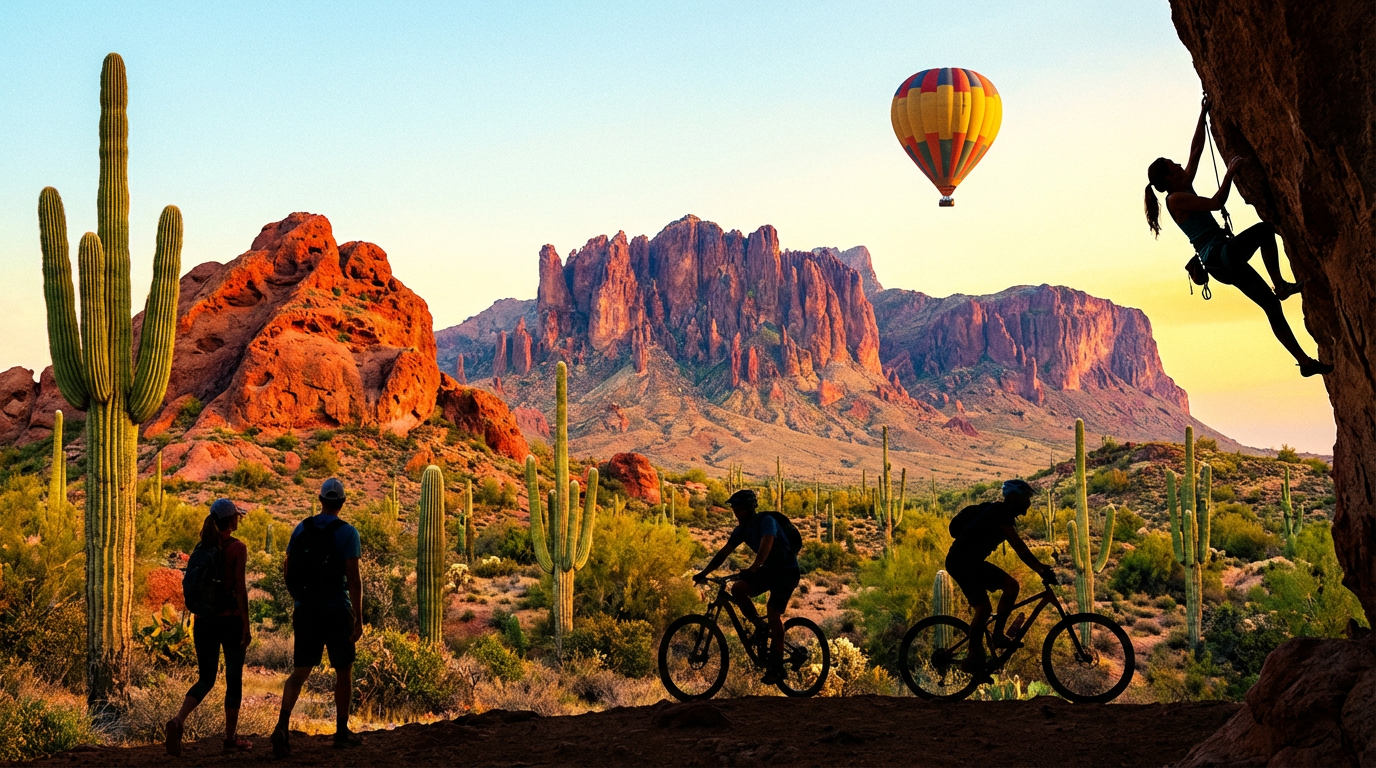
Reason 1 Why 70-Degree Winter Days Outperform Humid Climates
When evaluating your 2026 vacation itinerary, prioritizing outdoor activities in Phoenix yields a demonstrably higher cardiovascular return than remaining inside a climate-controlled hotel room. The immediate distinct advantage stems from January through April daytime highs consistently hovering between 67 and 82 degrees Fahrenheit.
When I began guiding ecosystem tours in Florida back in 2018 as a VisitFlorida Travel Partner, I navigated 80-percent humidity daily. Relocating to the Southwest introduced a completely different thermal dynamic; the sub-15-percent humidity here evaporates sweat instantly, altering how an athlete core-regulates temperature during exertion.
Instead of observing a Phoenix Suns basketball game on an indoor screen, engaging directly with the Sonoran topography engages stabilizing muscles you rarely use on flat pavement. The uneven terrain of the McDowell Sonoran Preserve alone features over 225 miles of rocky, varied trails.
Analyzing the 2000 Plant Species of the Sonoran Terrain
The Sonoran terrain extends far beyond mere silica sand and granite dust. It houses over 2,000 distinct native plant species, uniquely adapted to survive on fewer than 8 inches of annual rainfall.
Examining a mature saguaro cactus (Carnegiea gigantea) reveals a strict water storage mechanism. According to botanical data from the National Park Service, these columnar green giants typically mature at a mere one to two inches annually, meaning a 40-foot specimen has anchored the soil for well over 150 years.
To thoroughly evaluate the mechanics of outdoor activities in Phoenix, visitors must measure their energy expenditure against the terrain's friction. While a resort pool heated to 82 degrees provides sedentary relaxation, an afternoon traversing a 2-percent grade on the Quartz Trail requires active metabolic engagement that burns approximately 400 calories an hour for a 180-pound adult.
Comparing 36 Rainy Days Against 300 Days of Sustained Sun
Strategizing a visit in 2026 relies heavily on avoiding the 110-degree summer spikes. Focusing on the primary shoulder season—February through April—ensures maximum vitamin D exposure while maintaining core body temperatures during vigorous output.
Data emphasizes this geographic advantage. According to historical climatology reporting from Weather.gov, the valley registers precipitation on an average of only 36 days annually, vastly reducing the statistical probability of a rained-out excursion compared to coastal or Midwestern transit.
During a February expedition last year, a novice hiker expressed concern about navigating the arid conditions without shade. Upon completing a 2.4-mile loop at South Mountain Park, she noted the dry air felt significantly less oppressive than a typical 80-degree summer afternoon in a humid climate matrix.
At Rockon Recreation Rentals, our inventory management focuses on outfitting guests to maximize these stable weather windows. Utilizing properly calibrated suspension on ATVs or UV-resistant kayak hulls directly mitigates the environmental fatigue of the desert.
Implementing 3 Practical Tactics for Arid Climates
Prior to reserving your scheduled outdoor activities in Phoenix, calculating your physiological needs remains the most practical step. The logistical reality of arid recreation demands strict compliance with hydration metric standards.
- Calculate water consumption conservatively. Because sub-15-percent humidity rapidly evaporates surface perspiration, the Mayo Clinic and local park authorities advise consuming one liter of water per hour of moderate exertion.
- Monitor foot placement constantly. The Cylindropuntia fulgida (commonly called the jumping cholla) features barbed needles capable of penetrating standard canvas shoe fabric with mere grams of pressure applied.
- Modulate clothing configurations. Temperature differentials routinely span a 30-degree gap between a 6 AM trailhead arrival and a 12 PM summit push, necessitating a modular micro-fleece and windbreaker system.
Adhering to these functional benchmarks prevents the most common beginner errors. Applying appropriate friction-resistant footwear and layered insulation transforms an intimidating rocky ascent into a manageable three-hour cardiovascular session.
Reason 2 Why Sonoran Trail Systems Beat Treadmill Workouts
Substituting a mechanized gym routine for natural elevation gain ranks prominently among essential outdoor activities in Phoenix. According to trail management assessments from Lonely Planet, the municipal trail grid in 2026 includes highly structured route markers, though selecting an appropriate gradient defines your margin of safety.
Evaluating the 1200-Foot Climb of Camelback Mountain
For athletes desiring a maximal anaerobic threshold test, the localized geology of Camelback Mountain presents a strenuous 2,704-foot peak elevation. The verticality metrics here demand a high baseline cardiovascular capacity, vastly outperforming flat-surface indoor running.
Trail runners typically face two distinct ascents on this mountain feature. The Echo Canyon trajectory forces an aggressive 1,200-foot vertical gain compressed into a mere 1.2-mile distance, necessitating four-point contact—using both hands and feet to navigate the exposed granite boulders.
According to incident tracking by the City of Phoenix Parks and Recreation, rescue helicopters extract underprepared climbers multiple times per month during peak season, almost exclusively due to acute dehydration and heat exhaustion. Park rangers actively verify that visitors carry a minimum of two liters of water before allowing entry past the trailhead gates.
Executing this climb prior to 7 AM avoids the highest solar radiation exposure. The summit yields unobstructed 360-degree views of the sprawling Maricopa County grid, providing a highly visual reward for accumulated lactic acid buildup.
Choosing Papago Park for a Low-Impact 0.3-Mile Route
For groups encompassing varying athletic capabilities, substituting severe verticality with the horizontal stability of Papago Park mitigates injury risk significantly. The prominent Hole-in-the-Rock trail provides substantial sandstone architecture visualization without requiring specialized scrambling techniques.
The entirety of this specific route measures just 0.3 miles out-and-back. Traversing the compacted dirt path requires approximately seven to ten minutes at a casual 2.5 mile-per-hour walking pace, depositing visitors directly inside a wind-eroded tafoni cave structure overlooking the western horizon.
Capturing high-contrast photography during the 30-minute window before sunset remains a highly efficient utilization of this space. It ranks statistically as one of the lowest-exertion outdoor activities in Phoenix that still yields sweeping aerial-style topography views.
The municipal maintenance of this facility ensures zero parking tariffs at the centralized base lots. Consequently, visitors routinely factor this 45-minute excursion into their schedules immediately prior to executing nearby dining reservations in neighboring Scottsdale.
Reason 3 Why Botanical Hazard Navigation Beats Built Environments
Venturing off designated compacted paths introduces immediate botanical hazards, requiring a level of spatial awareness completely unnecessary on paved urban walking tracks. The indigenous flora utilizes aggressive reproductive and defensive mechanisms, most notably the deceptively fragile-appearing jumping cholla segments that accumulate heavily on trail shoulders.
Navigating this wild ecosystem demands active cognitive engagement. These dense clusters of barbed spines detach from the main stalk with practically zero resistance. When a hiker wearing inadequate leg protection brushes a segment, the microscopic barbs anchor solidly into the epidermis, mimicking a rapid jumping motion.
Implementing a specific extraction protocol is crucial for acute pain management in the field. According to desert safety protocols published by the National Park Service, victims must first use a rigid tool like a plastic comb to pry the bulk cactus segment off, then utilize precision metal tweezers to extract the remaining individual needles laterally.
Carrying a specialized hard-shell first aid kit containing these metal tweezers directly prevents minor trailside incidents from terminating a multi-hour hike. When scheduling your next verified excursion, reviewing local equipment recommendations at Rockon Recreation Rentals guarantees alignment with current baseline safety benchmarks.
Reason 4 Why Lower Salt River Kayaking Outperforms Pool Lounging
Positioning aquatic immersion securely on a list of outdoor activities in Phoenix often contradicts visitor assumptions regarding desert hydrology. Despite receiving minimal rainfall, the metropolitan perimeter contains millions of acre-feet of managed surface water.
The infrastructure of mountain-fed reservoirs and targeted river releases sustains robust riparian zones, a dual-environment contrast routinely verified by geospatial mapping on Tripadvisor. Substituting chlorinated hotel swimming facilities with naturally circulating river currents provides a strictly dynamic thermal relief mechanism.
I initially questioned the viability of consistent local paddle routes until charting flow rates near the Tonto National Forest boundary. Transitioning from stagnant water to a naturally propelled 3 mile-per-hour river current substantially alters metabolic cooling rates on unshaded days.
Navigating the 60-Degree Snowmelt of Saguaro Lake
Prioritizing the Lower Salt River for kayak deployment yields specific logistical advantages, namely continuous gravitational propulsion. Rather than battling Class III whitewater rapids, paddlers navigate a Class I flowing gradient flanked by 1,000-foot limestone and granite cliffs.
The aquatic volume originates largely from high-elevation snowmelt channeled through the Stewart Mountain Dam, resulting in a consistent surface temperature hovering near 60 degrees Fahrenheit even during peak spring warmth. According to habitat surveys by the USDA Forest Service, this exact temperature delta sustains vital nesting grounds for over 200 distinct avian species.
Allotting exactly 120 to 180 minutes allows paddlers to cover the primary multi-mile stretch from Water Users Recreation Site down to Phon D Sutton. The meandering topology forces visual transitions from dense mesquite bosquets to sheer vertical rock faces.
Transporting a rigid 40-pound polymer kayak on a rental vehicle adds unnecessary heavy-lifting logistics. Reserving pre-positioned maritime equipment via Rockon Recreation Rentals ensures highly visible personal flotation devices and stabilized watercraft strictly await your arrival at the launch zone.
Identifying Free-Roaming Horses at a 50-Foot Distance
The 2026 ecological baseline of the Lower Salt River includes a highly concentrated population of unbranded free-roaming horses. These specific ungulates exist completely independent of agricultural feed, sustaining themselves exclusively on riverbank forage.
These herds routinely wade entirely into the 60-degree channel to submerge completely and extract nutrient-dense eelgrass from the riverbed. During a deployment logged last month, a band of five mature adults crossed the channel precisely fifty feet parallel to my kayak's bowline.
Because these mammals acclimatized to human recreational transit decades ago, they display minimal flight responses. However, according to formal wildlife parameters released by Visit Arizona, paddlers bear the legal responsibility of maintaining a strict 50-foot minimum clearing distance and maneuvering paddles parallel to the herd to avoid agitation.
Reason 5 Why Motorized Off-Road Trails Outperform Paved Scenic Drives
Pedestrian locomotion limits terrain coverage to approximately 2.5 miles per hour, restricting the total geographical footprint of a single-day excursion. Deploying internal combustion engines solves this mileage barrier while introducing a variable friction coefficient.
During my initial mechanical testing in the Southwest, analyzing the suspension travel of specialized off-road vehicles shifted my approach to backcountry transit. Engaging 4x4 drivetrains translates high-RPM torque into forward momentum across powdery, non-cohesive dirt. According to outdoor industry participation reporting from the Outdoor Industry Association, off-road motorized recreation securely outpaces traditional scenic pavement driving due to higher participant engagement.
Integrating these mechanical assets into your outdoor activities in Phoenix accelerates your deep-desert access, significantly decreasing the duration spent passively navigating congested paved highways.
Comparing Single Rider ATVs Versus Multi-Passenger UTVs
Evaluating vehicular options depends strictly on chassis preference and passenger volume. Commercial staging areas predominantly divide inventory between straddle-seated solitary All-Terrain Vehicles (ATVs) and bench-seated Utility Task Vehicles (UTVs) explicitly engineered with structural overhead roll cages.
Particulate matter generation constitutes an unavoidable byproduct of dry-weather motor transit. Operators uniformly accumulate a distinct layer of pulverized silica dust over all exposed surfaces, requiring dedicated post-ride decontamination.
Selecting an appropriately geared vehicle ensures maximum traction control on loose washboard grades. For travelers planning broader regional exploration, investigating parallel equipment like the Las Vegas ATV Adventures – Self-Guided Rentals provides consistent mechanical parity across state lines.
Selecting Proper Neck Gaiters and Goggles for Dust Protection
Focusing entirely on the vehicle's engine block often causes guests to completely overlook critical personal protective gear. Riding in a convoy formation directly subjects rearward drivers to concentrated airstreams of suspended dirt.
- Require sealed polycarbonate goggles over casual eyewear. Conventional sunglasses lack foam sealing gaskets, permitting high-velocity sand grains to bypass the frame entirely and risk corneal abrasion.
- Deploy a multi-layer synthetic neck gaiter. Filtering the heavy concentration of particulate matter through a tightly woven fabric mask prevents severe sinus and pulmonary irritation on dry multi-hour rides.
- Enforce strict closed-toe footwear protocols. Exposed toes risk acute trauma from kicked-up limestone debris; utilizing leather boots or reinforced athletic shoes provides the mandated minimum shielding.
Securing properly maintained gear directly correlates to ride longevity and physical safety. You can cross-reference operator safety records and secure state-permitted dirt trails via Rockon Recreation Rentals, systematically verifying your preferred excursion, like the highly regulated ATVS Grand Canyon Adventures.
Reason 6 Why Pre-Dawn Balloon Flights Beat Standard Helicopter Tours
Contrasting the high-decibel internal combustion of an ATV with absolute atmospheric silence offers a profound shift in altitude and auditory processing. Evaluating the top-tier outdoor activities in Phoenix requires acknowledging the stable variable atmospheric layers over the Maricopa basin.
Unlike rotary-wing aircraft that generate immense downwash and cabin vibration, a lighter-than-air envelope ascends using strict thermal buoyancy. The moment the propane burner cycles off, passengers experience zero physical cabin friction.
Analyzing the 5 MPH Wind Conditions at Sunrise
Commercial operators exclusively position flight schedules—such as the phx phoenix airport Hot Air Balloon Ride—within the 45-minute window surrounding operational sunrise. The meteorological rationale specifically targets the period of maximum atmospheric stability before solar ground-heating generates turbulent thermal updrafts.
According to real-time aviation telemetry monitored by the National Weather Service, surface velocities across the Sonoran grid between 5:30 AM and 7:00 AM routinely stabilize between a marginal three to five miles per hour.
This low-velocity drift ensures horizontal movement remains virtually imperceptible against the basket. Operating from an altitude spanning 1,000 to 3,000 feet Mean Sea Level (MSL) allows visual identification of local fauna, notably packs of Canis latrans (coyotes) navigating the mesquite scrubland visibly cast in high-contrast morning shadows.
Evaluating Post-Flight Traditions and Cost Trade-Offs
Customizing recreational itineraries requires acknowledging diverse exertion preferences. Balancing extreme lateral g-forces on dirt routes with vertically static aviation ensures robust engagement without risking adrenal fatigue.
Incorporating upgrades like the adventures phoenix Hot Air Balloon Ride with Bubbly and Charcuterie pairs historical aviation toasts with locally sourced prickly-pear artisan pastries, adding a structured culinary yield to the flight fee.
Validating the Federal Aviation Administration (FAA) credentials of your pilot is easily outsourced by booking specialized tours phoenix for Hot Air Balloon Rides exclusively via Rockon Recreation Rentals.
Reason 7 Why Purpose-Built Gear Outperforms Casual Activewear
Attempting to navigate 1,000 feet of vertical elevation wearing non-specialized traction inevitably leads to skeletal joint stress. Safely executing high-intensity outdoor activities in Phoenix dictates abandoning general gym apparel in favor of hyper-specific arid-climate gear.
During my initial 2018 guiding rotations in Florida's swamp ecosystems, loadouts focused entirely on DEET concentration and waterproof neoprene. Transitioning logistical outfitting to the Southwest required discarding water-retention layers completely in favor of high-UPF rating moisture-wicking synthetics.
Understanding Rapid Sweat Evaporation at 10 Percent Humidity
The central physiological trap in Maricopa County involves the absence of visible perspiration. Subjecting the human body to 10-percent relative humidity causes extruded sweat to convert into vapor instantaneously.
This rapid vaporization process interrupts the brain's standard sensory feedback regarding fluid volume loss. A hiker frequently functions at a 2-percent dehydration deficit—a clinical threshold causing massive reductions in muscular endurance—before consciously recognizing any acute thirst triggers. To offset this, guidelines from the National Park Service mandate consuming exactly one liter (approximately 33.8 fluid ounces) of water for every 60 minutes of active trail time.
Foremost, supplementing distilled hydration reservoirs with targeted sodium, potassium, and magnesium powder directly intercepts hyponatremia. Consuming excess volumes of purified water without replacing concurrent salt expenditures actively dilutes blood serum density, triggering severe cramping. Employing these exact physiological interventions confirms you are operating beyond the casual tourist capability, securely executing professional-grade transit in a hostile thermal climate.
Conclusion and 3 Steps to Structuring Your 2026 Desert Itinerary
Strategically arranging a sequence of outdoor activities in Phoenix dictates calculating strict muscular recovery interludes. Filling a 72-hour window exclusively with maximal-exertion events mathematically guarantees physiological burnout by the second operational day.
The distinction between an exhausted deployment and an efficient vacation relies primarily on modulating heart rates. Staggering energy requirements allows the parasympathetic nervous system adequate resetting time between heavy mechanical loads.
Balancing High-Exertion Drives With Low-BPM Recovery Floats
The single most consistent error observed in initial scheduling involves clustering heavy mechanical inputs. Specifically, gripping the steering column of a UTV for 120 minutes demands extreme localized grip strength and heavy trapezoid muscle engagement.
Optimal scheduling places a low-BPM (beats per minute) aerial drift at 6:00 AM, allocating the subsequent 24 hours for minor muscle fiber recovery. A highly aggressive 45-mile off-road traverse then safely anchors the subsequent day's itinerary.
During a mid-March logistics review last season, a party of four systematically avoided physical burnout by injecting a purely passive Class I river transit following an aggressive summit push. Tracking their biometric data indicated the 60-degree water immersion dramatically curtailed secondary muscle inflammation, validating the necessity of temperature differentials routinely applied across complex itineraries.
Solidifying these specific choices yields verifiable, quantifiable exposure to the raw Sonoran environment. Leveraging the centralized verification tools at Rockon Recreation Rentals rapidly converts preliminary research into heavily secured 2026 departure times, firmly outperforming any static domestic travel agenda.