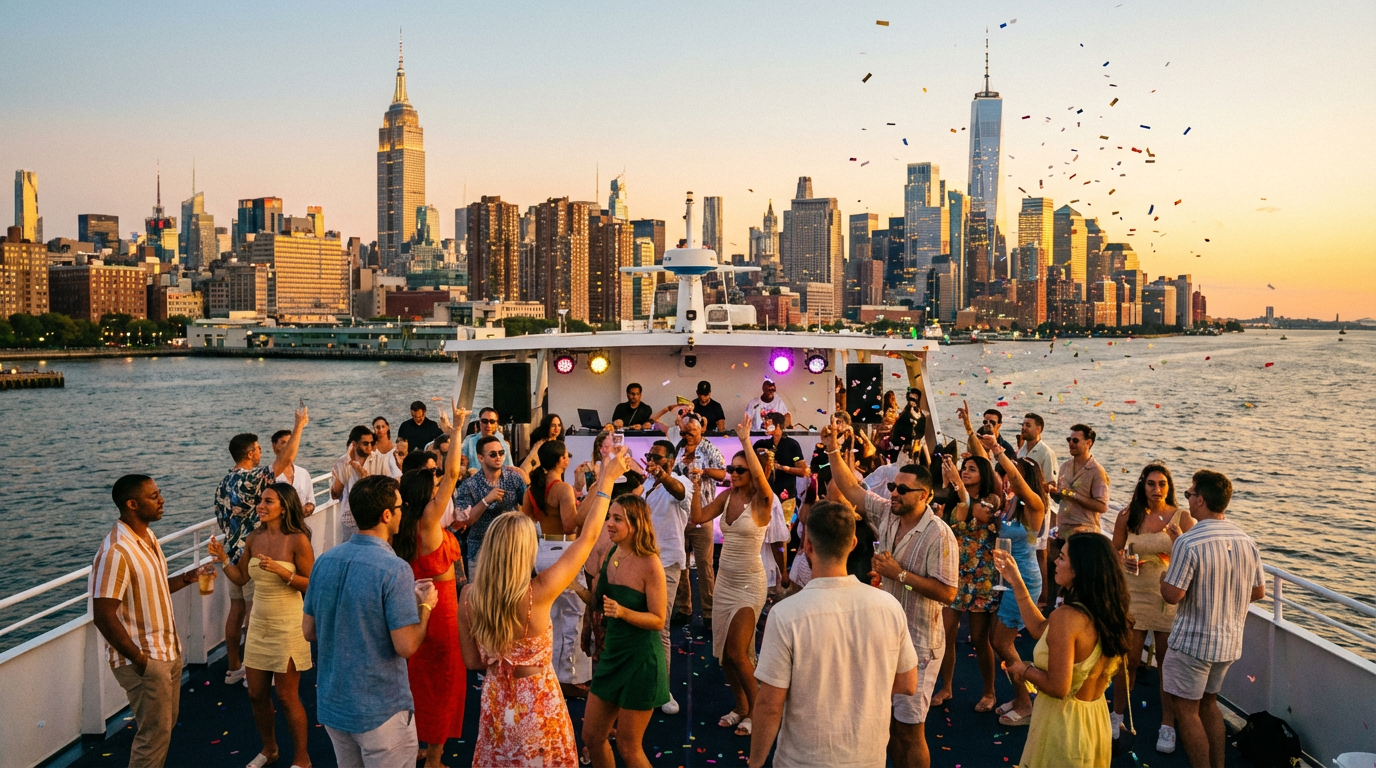
Planning a memorable nyc boat cruise party requires navigating a complex harbor of logistics, regulations, and hidden costs to ensure your event is a success. One of the most frequent missteps we encounter occurs before a single dollar is spent, which is searching for a general boat rental and assuming all results offer the same experience. The New York Harbor maritime scene is strictly divided into two distinct categories: public ticketed events and private charters. Confusing these two often leads to dissatisfaction—either a bachelorette party struggling to hear their own speeches over a public DJ's loudspeaker or a couple accidentally renting an entire yacht when they only wanted a romantic dinner for two.
Public ticketed cruises operate like floating nightclubs or restaurants. You purchase a "per person" admission to navigate a fixed route—usually departing from major hubs like Chelsea Piers or Pier 36—alongside hundreds of strangers. Conversely, a private charter grants you exclusivity over the vessel. As noted by Travel + Leisure, upgrading to a private charter allows for a bespoke itinerary that ticketed events simply cannot accommodate.
Failing to Distinguish Between Charter and Ticketed Events
The primary differentiator is privacy. On a public cruise, you share the amenities, the view, and the atmosphere with the general public. While many operators offer "VIP tables," you typically cannot control who sits at the adjacent table or the volume of the music. For groups prioritizing social mixing—like a casual birthday where meeting new people is a plus—ticketed events provide high energy at a lower entry price.
The Privacy Trade Off Between Sharing the Deck and Owning the Experience
However, for intimate milestones, the lack of control on a public cruise can be a dealbreaker. We have witnessed groups struggle to hear toasts because the ship's PA system was blasting top-40 hits. On a private charter, whether it is a 6-passenger sailboat or a 50-passenger motor yacht, you control the playlist, the volume, and the guest list. You are not just renting a boat; you are securing a private venue on the water.
Evaluating Customization and The Financial Tipping Point
Customization is practically non-existent on ticketed cruises. The menu is set (often a buffet or fixed-course meal), the departure time is rigid (the boat leaves exactly on time, often stranding latecomers), and the route is standard. Private charters offer flexibility that local guides value immensely. If the Hudson River is choppy, a private captain can pivot to the calmer East River. If your group is running 15 minutes late due to Manhattan traffic, a private charter can usually hold the lines (within reason), whereas a public ferry-class vessel cannot delay 300 other passengers.
From a financial perspective, there is a specific math equation—what we call "the tipping point"—where a private charter becomes comparable in cost to public tickets.
- Individual Tickets: High-end dinner cruises in NYC often range from $150 to $300 per person once taxes and gratuity are added.
- Private Charter: A mid-range private boat typically costs between $600 and $1,200 per hour, plus crew gratuity.
If you have a group of 12 people paying $200 each for a public dinner cruise, your total spend is $2,400. That same budget could secure a 3-hour private sunset sail where you are the only guests onboard. Failing to run these numbers is a common error; groups of 10 or more often pay premium prices for a public experience when they could have afforded a specialized New York Private Boat Experience for roughly the same cost.
Underestimating the Total Cost of an NYC Boat Cruise Party
Once you understand the charter model, the next friction point is often "sticker shock." A prospective renter often sees a listed rate of $600 per hour, does quick mental math for a three-hour event ($1,800), and sets their budget accordingly. However, the cost of your nyc boat cruise party is heavily dictated by operational fees that extend beyond the base rate. Unlike a standard hotel booking or a preset New York in One Day Guided Tour where taxes are the only major addition, chartering a vessel in New York Harbor involves a complex stack of operational costs that can increase the final invoice by 30% to 50% above the base rental rate.
Novice planners frequently overlook that a vessel is a mobile venue subject to maritime logistics, unlike a static banquet hall. Ignoring these legitimate operational costs leads to budget overruns or last-minute scrambles to collect extra cash from attendees.
The Hidden Line Items Beside the Hourly Rate
To budget accurately, you must account for the standard maritime fee structure. Almost every reputable charter agreement will separate the "Base Charter Fee" from the variable costs. Here is where the budget usually breaks for the unprepared:
- Mandatory Gratuity: In the US hospitality and maritime sectors, crew gratuity is rarely optional on private charters. It is typically written into the contract at 15% to 20% of the base rate. This ensures the captain and deckhands—who are responsible for your safety—are compensated fairly.
- Dockage and Repositioning Fees: This is a specific New York Harbor nuance. If a boat is home-ported at Liberty Landing Marina in Jersey City, but you want a pickup at Chelsea Piers in Manhattan, you will likely be charged a "repositioning fee" to cover the fuel and crew time to get the boat across the Hudson, plus a "dockage fee" charged by Chelsea Piers (which can range from $200 to over $600 depending on vessel size) just to touch the dock.
- Fuel Surcharges: While smaller vessels often wrap fuel into the hourly rate, larger motor yachts often charge for fuel based on consumption or a flat surcharge, particularly when diesel prices fluctuate.
- Sales Tax: Never forget the government's cut. In New York City, you must factor in the NY State and City combined sales tax of 8.875% on the total transaction.
Timing and Duration Impact Pricing Models
An often-ignored pitfall when booking a nyc boat cruise party is assuming that pricing is static. We consistently see clients surprised that a Saturday sunset cruise costs significantly more than a Tuesday afternoon voyage on the same vessel.
The Golden Hour Premium
Demand peaks during the "Golden Hour" (sunset), generally between 6:30 PM and 9:00 PM during the summer season. Operators maximize revenue during these prime windows. According to broad data from TripAdvisor listings and local market analysis, booking a sunset slot can command a 20-30% premium over daytime slots. If your group is budget-conscious, shift your departure to 1:00 PM or try a late-night "moonlight" cruise starting after 10:00 PM to yield significant savings.
Minimum Duration Requirements
Another logistical reality is the "minimum spend" regarding time. Because prepping a vessel, bringing on crew, and engine warm-up takes the same effort for a one-hour cruise as it does for a four-hour cruise, most private charters enforce a 3-hour or 4-hour minimum on weekends. Using an aviation analogy, unlike a New York City Private Helicopter Tour which is measured in minutes, boat charters are typically measured in half-days. If you see a boat advertising a low hourly rate but requiring a 4-hour minimum, that $500/hour boat is a $2,000 commitment before fees.
Overlooking Included Amenities and Essential Services
Leaving the budget spreadsheet aside, the next hurdle is physical expectations. Music is the heartbeat of any nyc boat cruise party, but reliance on cellular data for streaming is a gamble. First-time charterers often overlook the logistical reality that marine vessels operate on limited resources, including power, water, and waste capacity. We frequently see groups arrive with high-wattage hair dryers that trip the boat's breakers or elaborate frozen cakes that won't fit in a standard marine mini-fridge. To avoid awkward logistical failures mid-Hudson, you must rigorously audit the "Included Amenities" list before signing a contract.
Assessing Onboard Facilities When Not All Heads Are Created Equal
The term "restroom" is often used loosely in charter listings, but the difference between a marine head and a standard bathroom is significant. On smaller vessels (typically under 40 feet) and sailing charters, the facility is often a "wet head"—a combined shower and toilet area that requires a manual pump mechanism to flush. For guests unfamiliar with maritime plumbing, this can be intimidating or confusing.
Conversely, larger luxury motor yachts utilize vacu-flush systems similar to those on airplanes. If your guest list includes elderly relatives or you are hosting a formal event where attendees will be in gowns, verifying the head situation is crucial. According to Cruise Critic, understanding cabin and bathroom configurations is a primary factor in guest satisfaction, yet it remains one of the least asked questions during the booking process.
The Truth About Galleys and Refrigeration
Another common oversight involves food storage and preparation. While a 50-foot yacht may advertise a "full galley," this does not necessarily mean it offers residential-sized appliances. In the New York Harbor charter market, refrigeration is often limited to under-counter units or top-loading chest fridges that prioritize beverage cooling over food storage.
Insider Tip: Never assume ice is included in your charter fee unless explicitly stated. On many private charters, especially "bareboat" style rentals, the charterer is responsible for provisioning everything from ice cubes to bottle openers. If you plan to bring your own catering, ensure the platters fit the specific dimensions of the boat’s fridge, or bring high-quality coolers. Leaving sushi or dairy-based dips unrefrigerated on a humid July afternoon in the NY Harbor is a recipe for disaster.
Connectivity and Entertainment Systems
While 4G/5G coverage is generally reliable near Manhattan, dead zones exist as you cruise closer to the Verrazzano-Narrows Bridge or into the Long Island Sound. Do not rely on Spotify or Apple Music to stream seamlessly for three hours.
Furthermore, marine audio systems vary wildly. A "premium sound system" on a center console boat might just be two waterproof speakers that struggle to compete with wind noise at 20 knots. Verify if the boat supports Bluetooth connectivity (most modern vessels do) or if you need an AUX cable/Lightning adapter. We always recommend downloading your playlists for offline use to ensure the music doesn't cut out right as you pass the Statue of Liberty.
Understanding Service Inclusions vs Hidden Fees
Perhaps the most financially painful oversight is confusing a "bareboat charter" with an "all-inclusive" package. In the United States, strict maritime laws enforced by the US Coast Guard differentiate between these charter types.
- Demise (Bareboat) Charters: You are renting the hull. The captain's fee, fuel, crew gratuity, and sometimes even docking fees are often paid separately, directly to the crew or marina.
- All-Inclusive Charters: These typically bundle the crew and fuel, but almost never include a standard 15-20% gratuity.
It is standard industry practice for crew gratuity to be paid in cash at the end of the voyage. Failing to budget for an extra 20% on top of the charter fee can lead to an uncomfortable end to an otherwise spectacular trip. Always ask for a line-item breakdown: Does the price include the "cleaning fee" (often $100-$300)? Is there a fuel surcharge if you decide to cruise fast to the Sandy Hook beaches? Being proactive about these line items protects your budget and your relationship with the crew.
Choosing the Wrong Vessel for Your NYC Boat Cruise Party
Beyond amenities, the most technically complex mistake organizers make is selecting a vessel based solely on photos or price, without understanding the maritime regulations and physical dynamics of New York Harbor. Experienced local charterers know that a boat’s certified capacity often differs from its "comfort capacity," and the vessel type significantly dictates the stability and flow of your event. Choosing the wrong hull doesn't just dampen the vibe; it can lead to legal cancellations or seasick guests.
The Six Passenger Law and Capacity Realities
A frequent friction point we encounter involves groups of 7 to 12 guests attempting to book intimate luxury yachts, only to be told the limit is strict at six passengers. This is not the captain being difficult; it is federal law. If you are booking a nyc boat cruise party for 12 people, you cannot use a standard OUPV vessel. According to the United States Coast Guard, most recreational vessels available for charter operate under an OUPV (Operator of Uninspected Passenger Vessel) credential, colloquially known as a "6-pack" license. This limits the vessel to six paying passengers, regardless of whether the yacht is 30 feet or 80 feet long.
For any group larger than six, you must specifically seek out a "COI" (Certificate of Inspection) vessel. These boats have undergone rigorous Coast Guard safety inspections to carry larger groups. The trade-off is often aesthetic; COI vessels tend to look more commercial than the sleek, personal luxury yachts operating under 6-pack rules. Furthermore, just because a glossy brochure states a capacity of 12 does not mean 12 adults will be comfortable. In our experience on the Hudson, a boat rated for 12 is often best enjoyed by 8 to 10 people, ensuring everyone has a seat on the flybridge rather than taking turns standing.
Matching Hull Dynamics to Your Event Vibe
New York Harbor is an active estuary with strong tidal currents and significant wake from ferries, meaning the physical movement of the boat is a major factor in guest comfort for your nyc boat cruise party. Visitors often romanticize the idea of a sunset sail, but hull types vary drastically:
- Monohull Sailboats (Sloops): These classic sailboats are designed to "heel" (lean) under wind power. If you are envisioning a cocktail party where guests mingle freely with full martini glasses, a monohull sailboat is the wrong choice. As noted by sailing experts at Cruising World, heeling can be disorienting for inexperienced sailors, making simple tasks like using the marine head challenging.
- Catamarans: With their dual-hull design, massive stability, and wide beams, these are the premier choice for bachelorette parties or corporate networking where steady footing is paramount. They offer a wide, flat platform that drastically reduces rolling motion compared to single-hull vessels.
- Motor Yachts: These vessels prioritize speed and luxury interiors. They are excellent for covering distance—like cruising up to the George Washington Bridge and back—but can roll significantly if they stop in choppy water without stabilizers.
Layout Logistics Regarding Flow and Functionality
The layout of the deck dictates the social geometry of your nyc boat cruise party. We have seen groups book sport fishing boats for dance parties, only to realize the "cockpit" (rear deck) is dominated by a fighting chair, leaving no room to move. When evaluating a vessel, look beyond the square footage and assess the flow:
- The Bow vs. Stern Problem: Does the boat allow guests to move easily between the front (bow) and back (stern)? Some sleek express cruisers have narrow gunwales (walkways) that effectively trap guests in the back, segregating the party.
- Indoor/Outdoor Balance: New York weather is unpredictable. A pontoon boat might be fun in Miami, but in NYC, you need a vessel with a climate-controlled salon if you are booking in October or April. A sudden squall near the Statue of Liberty can drop temperatures by 15 degrees quickly.
- Food & Beverage Staging: If you plan on a buffet, does the boat have a dedicated table area protected from the wind? We have witnessed birthday cakes slide off tables on boats that lacked proper stabilizing fiddles (raised edges) on their surfaces.
Neglecting to Check Reviews and Safety Records
Even with the perfect boat selected, neglecting practical due diligence is a mistake that can compromise both the enjoyment and safety of your group. While the excitement of booking a nyc boat cruise party often leads organizers to focus on aesthetics and catering menus, a glossy website does not always equate to a compliant or well-maintained operation. Since 2018, we have seen numerous visitors blindsided by "bait and switch" scenarios where the vessel that arrives at the dock bears little resemblance to the promotional photos, or worse, the charter is abruptly cancelled by authorities for operating illegally.
Decoding the Digital Reputation
When evaluating potential operators, look beyond the aggregate star rating. A 4.5-star average can mask serious recent operational failures. You need to perform a "forensic audit" of the reviews from the last six months. Specifically, filter reviews for keywords like "cancellation," "refund," "smell," or "broken." This targeted approach reveals chronic maintenance issues—like malfunctioning marine toilets or broken air conditioning during a July heatwave—that a general overview might miss.
Furthermore, pay close attention to how the operator responds to negative feedback. According to data from the Better Business Bureau, a company's responsiveness to complaints is a key indicator of their reliability. An operator who dismisses legitimate safety concerns or argues with customers in public forums often displays the same lack of professionalism on the water. For a high-stakes event like an engagement or a corporate retreat, you want a crew that handles pressure with grace, not defensiveness.
Verifying Safety and Coast Guard Compliance
The most critical, yet frequently overlooked, step is verifying that the vessel is legally permitted to carry your group size. In the United States, the U.S. Coast Guard strictly regulates passenger vessels. For any group larger than six passengers (not including the crew), the vessel must possess a valid Certificate of Inspection (COI). This is not optional.
Here is what most visitors don't realize: There is a significant underground market of "illegal charters" in NYC. These are recreational boats that lack the rigorous safety inspections and licensed crew required for commercial operations. If an operator tries to put you on a recreational boat without a COI, or suggests you sign a "bareboat charter" agreement without fully explaining the legal liabilities you are assuming as the temporary "owner," you are entering a dangerous grey area.
Protect your group by asking these three questions before paying a deposit:
- For groups under 6: "Is the captain licensed by the USCG (OUPV/Six-Pack license)?"
- For groups over 6: "Does this specific vessel hold a current USCG Certificate of Inspection for the number of passengers we are bringing?"
- For all charters: "Can you provide proof of commercial marine liability insurance?"
Legitimate operators will provide this documentation immediately. If an operator hesitates or claims it isn't necessary, walk away. The Department of Transportation and maritime safety advocates consistently warn that illegal charters often lack essential safety gear, such as proper life rafts and fire suppression systems, which are mandatory on inspected vessels.
Misunderstanding Booking Procedures and Insurance Policies
The most administratively painful mistake prospective renters make is treating a maritime charter agreement like a standard hotel reservation or ride-share booking. The legal and logistical framework governing an nyc boat cruise party is significantly more complex due to U.S. Coast Guard (USCG) regulations and high-asset insurance requirements. In our experience facilitating thousands of rentals since 2018, we have seen parties grounded at the dock purely because the charterer skimmed over the "boring" documentation details.
Failing to thoroughly review these procedures doesn't just risk a forfeited deposit; it can lead to immediate cancellation without a refund mere minutes before your scheduled departure. To ensure your event launches smoothly, you must distinctively understand the paperwork, liability, and financial holds that precede untying the lines.
Non Negotiable Documentation and Identification
A frequent friction point occurs during the "check-in" phase at marinas like Chelsea Piers or ONE°15 Brooklyn Marina. Unlike a digital ticket on your phone, maritime charters often require physical verification of the primary charterer.
Legally, for a bareboat or demise charter—a common arrangement for private groups under 13 passengers—the charterer is taking on owner-like responsibilities. Consequently, operators strictly enforce identity verification to prevent fraud and comply with maritime security protocols. The individual whose name is on the booking contract must be present and typically must present:
- Physical Government-Issued Photo ID: A strictly digital photo of a license is often refused. Operators need to verify the physical security features of the ID.
- Matching Payment Method: The credit card used for the booking usually needs to be presented to verify it matches the ID. This is a crucial fraud prevention step for vessels worth hundreds of thousands of dollars.
According to the Department of Homeland Security, robust identification compliance is critical in transportation sectors, and the maritime industry is no exception. We caution organizers: ensure the person who booked the boat is not arriving late. If the contract holder is stuck in traffic, the boat cannot legally leave the dock with the rest of the group.
Interpreting Marine Insurance and Liability
Many renters assume the "charter fee" covers unconditional insurance. This is a dangerous misconception. While reputable operators carry commercial marine liability insurance—often known as "Protection and Indemnity" (P&I) insurance—this policy primarily covers the vessel owner against third-party liabilities, not necessarily the renter's negligence.
The distinction is critical when it comes to damage. If a guest in your nyc boat cruise party spills red wine on a custom teak deck or punctures a seat cushion with a stiletto heel (a common prohibited item), the cost of repairs comes out of your pocket, not the insurance company's. Insurance deductibles on commercial vessels are often substantial (frequently exceeding $2,500), so minor damages are almost always settled directly via the security deposit.
Furthermore, standard travel insurance purchased for flights rarely covers bareboat charter liabilities. For high-value rentals, we recommend clarifying if the operator offers a specific "Damage Waiver" add-on, which can cap your financial exposure for accidental damage.
The Reality of Cancellation Policies and Security Deposits
Understanding the "Captain's Call" is vital for managing expectations regarding weather. A common grievance arises when a group wants to cancel due to gray skies or light rain, only to be told the charter is proceeding. The standard maritime policy is "Rain or Shine."
Cancellations with refunds are typically triggered only when the Captain or operator determines conditions are unsafe—such as high winds, lightning, or Small Craft Advisories issued by the National Weather Service. If you choose not to show up because of a light drizzle, you will likely forfeit the entire charter fee. It is essential to communicate this to your group beforehand so guests dress appropriately for the marine environment rather than a nightclub.
Finally, prepare your banking for the security deposit. Unlike a $50 hold at a hotel, boat charter security deposits can range from $500 to over $2,000 depending on the vessel size. These are "pre-authorization" holds, meaning the funds are frozen in your account. While Rockon Recreation Rentals and most partners release these holds within 24–48 hours post-trip (assuming no damage), some banks take 3–5 business days to make those funds available again. Plan your cash flow accordingly to avoid being short on funds during your trip.
Waiting Too Long to Secure Your NYC Boat Cruise Party Date
Finally, the harshest reality of planning a maritime event in New York is the disconnect between the city’s immense population and the limited availability of commercial marina slips. Unlike booking a restaurant or a hotel room, where inventory is vast, the pool of high-quality, Coast Guard-certified vessels suitable for a private nyc boat cruise party is surprisingly small. From our experience operating in the harbor since 2018, we consistently see a surge of frantic inquiries in late May for June weekends, only for clients to discover that the premier yachts were secured back in February.
The "season" in New York Harbor is intense but short, effectively running from May through October. Because the operational window is so narrow, Saturdays are the gold standard. A single vessel has, at most, two prime slots on a Saturday: a daytime brunch cruise and a sunset evening cruise. Once those two slots are booked, that inventory is gone for the week. According to NYC Tourism, boat tours remain one of the top requested activities for visitors, meaning you are competing not just with other locals planning birthdays, but with millions of international tourists seeking the same iconic views of the skyline—views that rival those seen on an Empire State Building Tour.
Recommended Booking Windows for Prime Itineraries
To avoid the disappointment of settling for a Tuesday afternoon when you wanted a Saturday sunset, you must recalibrate your booking timeline based on the nature of your event. What most visitors don't realize is that "sunset" adds a premium to demand that vanishes once the sun goes down; a 7:00 PM slot in July is prime real estate, whereas the same slot in October is a night cruise. To ensure your nyc boat cruise party features the skyline views you envision, follow these targets:
- Major Holidays (July 4th, NYE): These dates command the highest demand of the year. It is standard for fleet operators to open these calendars in January. If you wait until May to book a Fourth of July charter, you will likely face surcharged rates or be left with vessels that have obstructed views. Target: 6 months in advance.
- Summer Saturdays (June – August): For a guaranteed 6:00 PM to 9:00 PM sunset slot on a specific weekend, early spring is the decision window. We typically see the highly desirable 12-to-20-passenger yachts sell out their summer Saturdays by late April. Target: 3 to 4 months in advance.
- Weekdays and Shoulder Season: If you have flexibility or are strictly looking for a casual outing, you typically have more breathing room. Weekday corporate outings or Tuesday evening gatherings can often be secured with just a few weeks' notice. Target: 2 to 3 weeks in advance.
Why Last Minute Deals Rarely Exist in Yachting
A common misconception is that waiting until the last minute will yield price drops, similar to how airlines or hotels might offload unsold inventory. In the private charter industry, the opposite is usually true. As the date approaches, logistics become more expensive and difficult to execute. Arranging catering permits, securing crew shifts, and organizing dockage fees requires lead time.
Furthermore, reliable operators would rather keep a boat at the dock than discount a premium Saturday night slot, as running a charter incurs significant variable costs (fuel, crew, wear-and-tear). Waiting often forces you into a "distressed inventory" situation—where the only boats left are either significantly more expensive than your budget allows or older vessels that lack modern amenities like Bluetooth sound systems or updated stabilizers. To ensure your event includes the skyline views and comfort you envision, treating the boat rental as the first priority in your planning process—not the last—is the only way to guarantee stability in both price and experience.