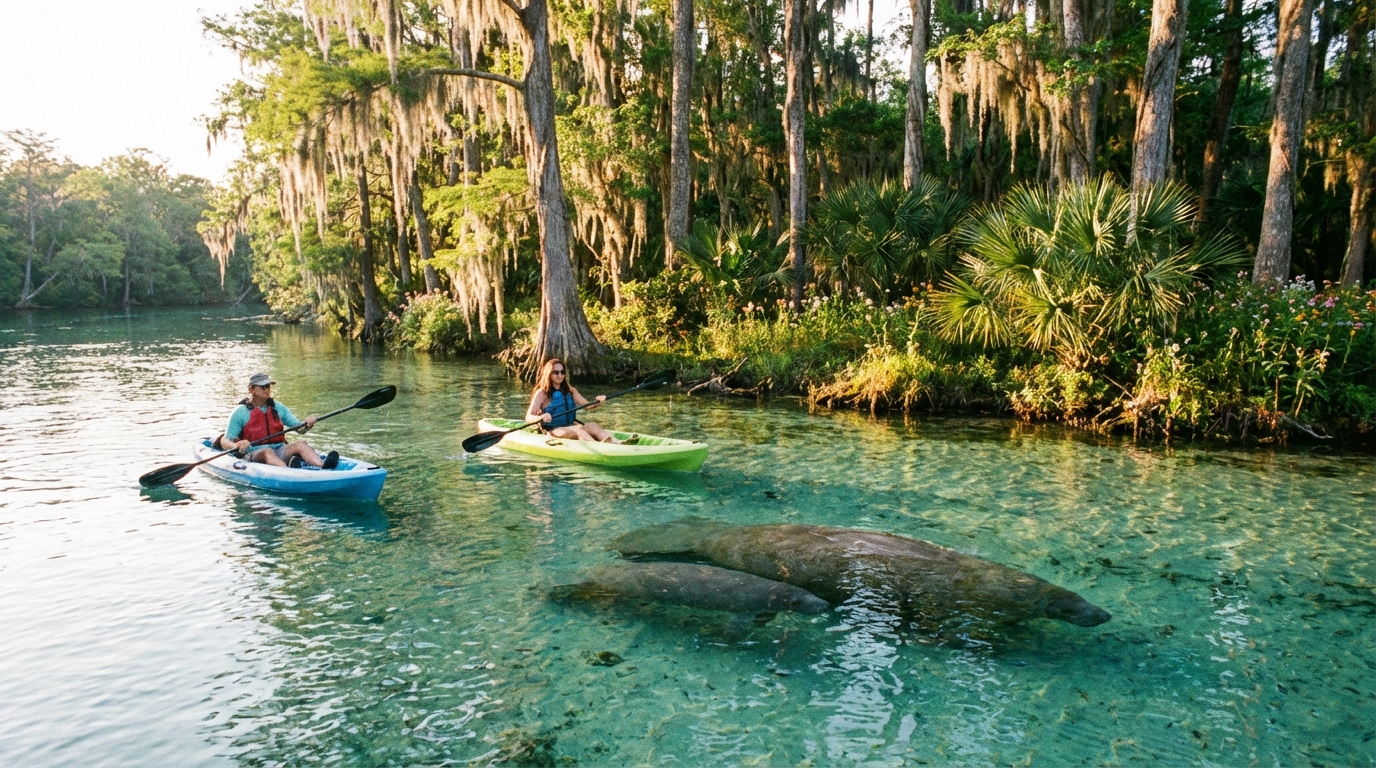
Planning a trip for kayaking with manatees in Florida requires understanding the delicate balance between adventure and conservation in the state's unique waterways. While the Florida manatee (Trichechus manatus latirostris) inhabits waterways throughout the state, successful viewing relies entirely on water temperature thermodynamics. When the Gulf of Mexico and Atlantic Ocean temperatures drop below 68°F (20°C)—typically from mid-November through late March—manatees must migrate to warm-water refuges to survive cold stress syndrome. For kayakers, this means your success rate is not about luck; it is about targeting specific springs and power plant outflows where steady 72°F water attracts these mammals in high concentrations. Identifying the best spot for kayaking with manatees in Florida depends largely on your preference for water clarity versus crowd levels.
Top Locations To Go Kayaking With Manatees In Florida
Finding the right location is the first step in your journey. Each designated sanctuary offers a distinct environment, ranging from the crystal-clear visibility of natural springs to the darker, tannin-rich waters of river outflows.
Crystal River National Wildlife Refuge
Widely recognized as the "Manatee Capital of the World," Crystal River is the only place in the United States where you can legally enter the water to swim with manatees, though kayaking remains the preferred method for those who want to observe natural behaviors without disturbing the animals. The centerpiece here is Kings Bay, fed by over 70 springs, including the famous Three Sisters Springs. For international travelers planning a trip, resources like Visit The USA highlight this unique interaction as a top North American wildlife experience.
What most visitors don't realize is that access to Three Sisters Springs by kayak is highly regulated. During extreme cold snaps, the U.S. Fish and Wildlife Service frequently closes the springs themselves to all vessels to protect the resting animals. However, the canal systems leading to the springs are often teeming with manatees. If you book a rental through Rockon Recreation Rentals in this area, plan to launch early—ideally before 8:30 AM. By mid-day, the silty bottom of Kings Bay often gets churned up by boat traffic, reducing visibility from "crystal clear" to murky. This is the trade-off for visiting the most popular site: you are guaranteed manatees, but you will be sharing the water with tour boats and swimmers.
Weeki Wachee Springs State Park
Located roughly 45 minutes south of Crystal River, Weeki Wachee offers a significantly different experience. Unlike the wide-open Kings Bay, the Weeki Wachee River is narrow, winding, and exceptionally clear. This location requires advanced logistical planning because the current is notably swift (often averaging 3-4 mph depending on tide levels), making an upstream paddle strenuous for novices. Most kayakers opt for a one-way downstream drift, launching from the state park and taking out at Rogers Park.
The manatee encounters here are typically transient; the animals use the river as a highway to the main spring head. Because the river is narrow and winding, you must be hyper-aware of your surroundings to avoid accidentally cornering a manatee against the bank. Launch reservations at the State Park are strictly capped and often sell out weeks in advance, so spontaneity is rarely an option here.
Tampa Bay and St. Petersburg Hotspots
For those seeking a quieter, more urban adventure without the heavy tourism infrastructure of Crystal River, St. Petersburg offers excellent opportunities. The premier location here is Coffee Pot Bayou. This protected waterfront area features a seawall where manatees congregate to graze on seagrass and retain heat from the sun-warmed shallow bottom. For a curated experience in this region, booking Kayak Tours St Petersburg FL ensures you navigate the local tides and protection zones correctly.
Local paddlers know that Coffee Pot Bayou requires strict attention to tide charts. At low tide, mudflats can trap novice kayakers, but an incoming mid-tide often brings clear water and active wildlife. Another key spot is the mangrove tunnels of Weedon Island Preserve. While manatee sightings here are less concentrated than in the springs, seeing a manatee in a wild mangrove tunnel is distinct from the curated spring experience. These encounters feel wilder, requiring a quiet paddle stroke and patience.
Blue Spring State Park Orange City
A critical distinction often catches visitors off guard at Blue Spring State Park: You cannot kayak within the spring run during manatee season. To protect the massive aggregation of manatees—which hit a record count of over 900 individual animals in early 2026 according to the Save the Manatee Club—the designated spring run is closed to all water activities from approximately November 15 to March 31.
However, kayaking is permitted in the St. Johns River adjacent to the spring run. This creates a unique "waiting room" scenario where kayakers can float near the boom barriers at the mouth of the spring run. As manatees leave the protected area to feed in the river, they pass directly underneath paddlers. The water in the St. Johns is dark and tannic (tea-colored), meaning you often won't see the manatees until they surface for air near your boat. Since the park is centrally located, many travelers combine a day trip here with local Orlando attractions.
Fort Myers and Manatee Park
In Southwest Florida, the viewing dynamic changes from natural springs to industrial warm-water outflows. The Orange River, specifically near the Florida Power & Light (FPL) plant, is the primary draw. Manatee Park is a non-captive refuge designed specifically for viewing this phenomenon. This type of rugged wildlife viewing is similar to what you might find on an Everglades Boating Kayaking and Walking Ecotour further south, where tannins stain the water dark brown.
The water here is brackish and dark, heavily stained by tannins from upstream vegetation. Do not expect to see manatees swimming underwater here; the visibility is usually less than two feet. Instead, this location is about volume. During cold fronts, hundreds of manatees cluster in the canal, creating a "walking on water" effect where their backs break the surface in every direction. Kayak rentals launch directly into the Orange River. A vital tip for this location: arrive when the facility opens. By 11:00 AM on weekends, the parking lot frequently reaches capacity, and the launch canal can become deadlocked with inexperienced paddlers.
Choosing The Right Vessel From Types Of Boats Available
Selecting the right watercraft is arguably as critical as picking the right location when planning an excursion. While the engine of your experience is your own paddling effort, the hull design dictates your stability, maneuverability, and ultimately, your visibility of the wildlife. When specifically kayaking with manatees in Florida, the primary goal differs from recreational paddling; you are not trying to cover distance, but rather to maximize observation time in specific spring runs. Most first-time visitors focus heavily on the "clear" aspect of boats, but experienced local guides know that hull displacement and vantage points play equally significant roles in how much marine life you actually see.
In Florida's shallow spring environments, where water depth often ranges from just 3 to 10 feet, your vessel acts as your viewing lens. According to the Florida Fish and Wildlife Conservation Commission, paddlecraft are classified as vessels and must adhere to specific safety requirements, but the functional differences between a paddleboard, a clear kayak, and a rotomolded sit-on-top kayak can dramatically alter your interaction with the environment.
Clear Kayaks vs Standard Kayaks
In recent years, clear kayaks have become the most requested rental item for visitors hoping to capture the perfect social media shot. Constructed from 100% virgin polycarbonate (the same material used in bulletproof glass), these vessels act essentially as a giant swim mask, magnifying the underwater world below you. This is distinct advantage in areas like Silver Springs or the clearer canals of Crystal River, where you can watch a manatee glide directly beneath your seat without getting wet. However, there is a distinct trade-off that rarely appears in marketing brochures: tracking and heat.
Clear kayaks generally lack the "chines" (sharp edges on the hull) found on standard vessels, causing them to "waddle" or drift more in currents. They also act as greenhouses; on a sunny 75°F day, the interior can become surprisingly warm. Conversely, standard sit-on-top kayaks—typically made of durable rotational-molded polyethylene—offer superior maneuverability and comfort. They are practically indestructible and feature scupper holes that make them self-bailing, meaning if you tip over (a rarity in flat spring water) or splash water inside, it drains automatically. For beginners nervous about stability, a standard wide-body sit-on-top kayak is statistically the safest option.
The Stand-Up Paddleboard (SUP) Advantage: While often grouped with standard vessels, paddleboards offer a unique strategic advantage for wildlife spotting: elevation. By standing five to six feet above the water surface, you eliminate the angle of incidence that creates glare for seated kayakers. This vertical vantage point allows you to spot the distinct grey shadow of a manatee from 20 to 30 yards away—long before a kayaker seated at water level would see it. Experienced guides often use SUPs for this exact reason, acting as spotters for the group.
Single vs Tandem Options
Choosing between a single or tandem (double) vessel involves more than just headcount; it is a question of physics and relationship harmony. Local outfitters often jokingly refer to tandems as "divorce boats," but for kayaking with manatees in Florida, a tandem is often a strategic necessity for families. A tandem kayak, typically 12 to 14 feet in length, provides a longer waterline which equates to better tracking (staying in a straight line) and speed with two paddlers working in sync. This is the ideal setup for a parent with a small child or a pet, as the additional weight capacity (often 450+ lbs) provides a highly stable platform that resists rocking.
However, the length of a tandem can be a liability in tight quarters. Navigating the narrow "runs" leading into Three Sisters Springs or the winding twists of the Chassahowitzka River requires sharp turns. A 10-foot single kayak can pivot 360 degrees almost within its own length, allowing a photographer to quickly adjust their angle without disrupting the sediment or bumping into protected shorelines. If you are renting from Rockon Recreation Rentals and your group consists of confident adults, opting for single kayaks usually results in a better experience. It allows each person to linger over a manatee sighting at their own pace without requiring consensus from a paddling partner.
Typical Pricing And Rental Duration For Manatee Encounters
Budgeting for a trip to the springs involves more than just the daily rental rate of a vessel; it requires understanding the "seasonality tax" and equipment variances unique to Florida’s Gulf Coast. Unlike paddling in a local lake, kayaking with manatees in Florida is a highly regulated activity subject to dynamic demand, particularly between November 15 and March 31. During this peak manatee season, availability becomes the primary driver of cost, and what might be a $35 rental in August can see stricter time limits or bundled pricing structures in January.
From my experience on the water, the most significant variable is equipment type. A standard polyethylene sit-on-top kayak is durable and affordable, but the recent explosion in popularity of "clear kayaks" (transparent polycarbonate shells) has created a two-tier pricing system. While clear kayaks offer an unparalleled window into the underwater world—essential when manatees glide directly beneath you—they typically command a 30% to 50% premium over standard vessels. Furthermore, visitors should be aware of launch fees. If you are hauling your own gear, state parks like Florida State Parks generally charge a nominal entrance fee (often $4–$8 per vehicle) plus a launch fee, whereas booking through a vendor usually includes these costs in the topline price.
Hourly Rental Rates
For independent paddlers who prefer to explore without a narrator, hourly rentals are the most cost-effective option. However, most outfitters have moved away from strict per-hour billing during manatee season in favor of 2-hour or 4-hour blocks to streamline logistics at crowded launch ramps. Current market rates for standard single kayaks typically range from $35 to $55 for a 2-hour slot. Tandem kayaks (two-seaters) generally run between $55 and $75 for the same duration. The clear kayak rentals, if available without a guide, can surge upwards of $65 per vessel for just two hours.
A crucial logistical detail that standard guidebooks miss is the duration trade-off. While 4-hour and full-day rentals offer a better "per hour" value, I rarely recommend them strictly for manatee viewing. Manatees are most active and present in the springs in the early morning (7:00 AM to 10:00 AM). By noon, as air temperatures rise and boat traffic increases, many animals retreat to sanctuary zones or darker river waters. Consequently, a 2-hour rental booked for an 8:00 AM launch is often far more valuable than a full-day rental starting at 11:00 AM. When browsing listings on Rockon Recreation Rentals, pay close attention to the launch times associated with the rental duration; paying for extra hours is useless if the wildlife has already moved on.
Guided Tour Packages
While experienced kayakers might balk at the idea of a chaperone, guided tours offering kayaking with manatees in Florida provide distinct operational advantages that justify the higher price tag. Guided packages typically range from $60 to over $110 per person, depending heavily on the location and the exclusivity of the group size. The premium cost covers more than just the guide's time; it acts as an insurance policy against a wasted trip.
Local guides communicate with each other on the water. If the manatees have moved from the main spring vent to a secluded canal 1.5 miles away because of a tide change, a guide will know exactly where to take you. An independent renter might spend two hours circling an empty spring. According to the U.S. Fish and Wildlife Service, harassment of manatees—even unintentional—is a federal offense punishable by significant fines. Guides are trained to spot subtle behavioral cues of distress that the average tourist will miss, ensuring your encounter remains legal and ethical. Additionally, many guided packages include wet suits (essential in 72°F water when the air is 45°F) and dry bags, saving you roughly $25 in rental add-ons. For corporate outings or groups of 6+, many operators offer tiered discounts, though these usually must be arranged weeks in advance due to the strict guide-to-guest ratios mandated by permits.
Included Amenities And Services With Florida Rentals
When booking an excursion for kayaking with manatees in Florida, it is crucial to look beyond the base price and understand exactly what equipment and services are included in your rental agreement. In my experience across the state—from the springs of Crystal River to the tannin-stained waters of the Chassahowitzka—the quality of gear can significantly impact your comfort and safety during a two-to-three-hour paddle. While basic vessels get you on the water, premium outfitters, including many listed on Rockon Recreation Rentals, provide amenities that transform a logistical headache into a seamless adventure.
Standard Safety Gear and Legal Compliance
Every reputable outfitter in Florida is legally required to provide specific safety equipment. According to the Florida Fish and Wildlife Conservation Commission (FWC), all recreational vessels—including canoes and kayaks—must carry one wearable Personal Flotation Device (PFD) for each person on board, as well as a sound-producing device like a whistle.
However, not all safety gear is created equal. Budget roadside rentals often supply "Type II" orange horse-collar life jackets. While legal, these are notoriously uncomfortable for paddling, often chafing the neck and restricting arm movement. Higher-quality outfitters typically provide "Type III" vest-style PFDs, which are designed specifically for water sports, allowing for a full range of motion. Additionally, while the required whistle is often clipped to the vest, I always recommend verifying it is present before leaving the launch site; trying to signal a powerboat in a busy channel like Kings Bay without one is a risk you should not take.
Comfort Items and Dry Storage
One detail often overlooked by first-time visitors is the seating configuration. Manatee tours involve periods of sitting still to observe passive animal behaviors. A standard molded plastic seat can become painful after 45 minutes. Look for rentals that explicitly list "deluxe high-back seats" or cushioned support.
Furthermore, dry bags are an essential amenity, yet they are not universally included. Florida’s high humidity and splash-prone environment pose a threat to electronic car keys and smartphones. While simple zip-lock bags rarely hold up against a capsized kayak, a dedicated 10-liter PVC dry bag—often available for a nominal fee or included with premium packages—provides reliable protection. If you are bringing a smartphone to capture footage, ask if the rental includes a tether; I have seen countless phones sink specifically in the clear waters of Three Sisters Springs because a paddler leaned too far over to photograph a manatee.
Shuttle Services for Downstream Runs
Logistics can be the most challenging part of a kayaking trip, specifically on river runs that flow one way. For locations like the Weeki Wachee River, the current is strong enough that paddling upstream back to your car is physically exhausting and time-consuming.
For these linear routes, shuttle services are a critical inclusion. A self-shuttle requires two vehicles (one parked at the take-out, one at the launch) and adds nearly an hour to your itinerary. Professional outfitters handle this by dropping you at the headspring and picking you up at the haul-out point, typically Rogers Park or a private landing. When comparing prices, factor in that a shuttle service saves you approximately $30 to $50 in Uber fares or fuel and logistical time. Note that spring-fed loops, such as Crystal River, generally do not require shuttles as you start and end at the same dock.
Guided vs Self-Guided Photography Packages
Capturing clear images of manatees from above the water is deceptively difficult due to surface glare. What looks clear to the naked eye often renders as a dark, unidentifiable blob in photos. Many guided tours resolve this by including professional photography packages. Guides often carry cameras equipped with circular polarizing filters (CPL) to cut through the water's surface reflection. Some operators even offer GoPro rentals or provided footage as part of the tour cost, ensuring you get high-definition underwater clips without risking your own equipment or disturbing the animals (who are protected by the Marine Mammal Protection Act against harassment).
Understanding The Rental Process And Booking Procedures
Securing a vessel during peak migration—roughly mid-November through March—requires strategic planning. A common misconception among first-time visitors is that kayaks are readily available for walk-ins. In reality, prime locations like Crystal River and Blue Spring State Park operate at maximum capacity on weekends and holidays. During the 2023 season, many outfitters reported being fully booked up to three weeks in advance for morning slots. To ensure a successful trip kayaking with manatees in Florida, treating the booking process with the same seriousness as a flight reservation is essential.
Required Documentation
When you book a rental through Rockon Recreation Rentals, the administrative work begins before you arrive at the dock. Almost all permitted operators now utilize digital waiver systems to streamline the morning rush. Every participant, regardless of age, must have a signed liability waiver on file. For minors, this document must be executed by a legal guardian—a crucial detail for groups where one parent puts a child in a kayak with a friend's family; without the legal guardian's specific signature, that child will not be permitted to launch.
Additionally, while Florida law does not require a boating license for non-motorized paddlecraft, the lead renter must typically be 18 years or older with a valid, government-issued photo ID. Outfitters hold this ID or a credit card as a security deposit against the equipment. It is worth noting that if you are renting clear kayaks, which are significantly more expensive than standard polyethylene hulls, the damage deposit hold on your card may range from $200 to $500 per vessel.
Arrival and Check-In
Punctuality is not merely a suggestion in the rental industry; it is a logistical necessity. If your reservation is for 8:00 AM, you should plan to accommodate the 30-minute buffer required for fitting Personal Flotation Devices (PFDs)—mandatory under Florida Fish and Wildlife Conservation Commission (FWC) regulations—and for paddle sizing.
Parking is arguably the biggest friction point in the arrival process. At high-traffic launch sites like King's Bay Park or the Hunter Springs launch, public parking fills up rapidly. If you arrive exactly at your reservation time, you will likely spend 20 minutes circling for a spot, eating into your rental window. Experienced locals know to drop passengers and gear at the check-in desk first, then have the driver park the vehicle, even if it means parking several blocks away during peak holiday weeks.
Mandatory Education and Manatee Manners
Before a paddle touches the water, renters at reputable locations are often required to view a safety briefing video. This is not generic safety advice; it is a regulatory requirement for operating in protected manatee habitats. The U.S. Fish and Wildlife Service mandates "Manatee Manners" education to prevent harassment of the species.
You must understand the concept of "passive observation." The videos explicitly instruct kayakers to:
- Never paddle directly over a resting manatee.
- Avoid separating a mother from her calf.
- Use silent paddling techniques to avoid startling the animals.
In highly regulated zones like Crystal River, volunteers in kayaks (Manatee Watch) patrol the water. If they observe renters poking animals with paddles or aggressively chasing them, they can—and do—report the rental vessel number to the outfitter, which can result in the immediate termination of your rental without a refund.
Insurance Policies and Cancellation Terms
Understanding the financial logistics of your booking is critical, particularly regarding weather cancellations. Most operators adhere to a strict 24 to 48-hour cancellation policy for a full refund. If you cancel inside that window because of a "change of plans," you will likely forfeit the rental fee.
However, Florida weather is dynamic. A reputable outfitter will differentiate between "unpleasant weather" and "unsafe weather." Light rain or overcast skies generally do not trigger a refund or free rescheduling. Conversely, if there is a Small Craft Advisory issued by the National Weather Service or active lightning within a 10-mile radius, operations are legally required to suspend launches. In these genuine safety instances, you are typically offered a rain check or a full refund. When planning for kayaking with manatees in Florida, always check the forecast three days prior, but trust the local operator's call on the morning of the tour.
What Customer Reviews And Testimonials Reveal About The Experience
After analyzing years of feedback from verified customer reviews across major travel platforms since 2018, a clear pattern emerges regarding what distinguishes a mediocre outing from a world-class memory. While first-time visitors often fixate solely on sighting guarantees, seasoned paddlers know that the quality of the interaction depends heavily on logistics that are often overlooked. Kayaking with manatees in Florida is not a monolith experience; the difference between a five-star review and a disappointed customer usually comes down to group size, guide expertise, and managing expectations regarding crowds.
The Correlation Between Group Size And Intimacy
Data from verified reviews consistently indicates that travelers rate small group excursions significantly higher than large flotillas. When kayak tours exceed 10 or 12 vessels, the sheer displacement of water and the inevitable hull-bumping noise tend to alert manatees long before the group arrives. According to behavioral studies cited by the U.S. Fish and Wildlife Service, manatees are acutely sensitive to sound and vibration. Reviews for large group tours frequently contain complaints about "struggling to hear the guide" or "feeling like part of a cattle drive."
Conversely, testimonials for private or semi-private tours (typically capped at 6 paddles) often describe "magical" moments where manatees approached the kayaks voluntarily. This supports the "passive observation" guidelines promoted by conservationists; smaller footprints create less disturbance, encouraging natural animal curiosity. Visitors booking through Rockon Recreation Rentals often cite the ability to filter for smaller distinct operators as a primary reason for their satisfaction, noting that intimate settings allowed them to witness behaviors like nursing or socializing that are rarely seen in high-traffic commercial scrums.
The Critical Role of Guide Expertise
A recurring theme in high-praise testimonials is the educational value provided by a certified master naturalist guide. While anyone can point at a dark shape in the water, top-rated guides offer context that transforms the viewing. Reviews consistently highlight guides who can identify specific manatees by their boat-propeller scar patterns—a grim but necessary identification method tracked by the USGS Manatee Individual Photo-identification System.
Travelers frequently mention that knowledgeable guides prevented them from accidentally harassing the animals. For example, a resting manatee on the bottom might look like a rock to a novice, but a trained guide knows that hovering directly over a sleeping mammal prevents it from surfacing to breathe, which constitutes harassment. Positive feedback often centers on these nuanced instructions, with guests appreciating that their presence did not cause the animals distress.
Understanding Negative Reviews Crowds and Cancellation Policies
To provide a balanced perspective, it is vital to address the most common sources of dissatisfaction: overcrowding and cancellation fees. Negative reviews for Crystal River and Blue Spring often spike during holiday weekends (Christmas through New Year's and Spring Break). Visitors frequently underestimate the popularity of kayaking with manatees in Florida during peak season. A common complaint involves the "bumper boat" atmosphere at the entrance to Three Sisters Springs, where hundreds of vessels may converge before noon.
Furthermore, friction often arises regarding strict cancellation policies. Small local outfitters operate with limited inventory during a short season (roughly 120 days). Unlike large hotel chains, these operators cannot easily absorb last-minute cancellations. Reviews reflect frustration when guests are charged for weather-related cancellations that don't meet the operator's "unsafe" threshold but are merely "uncomfortable" (such as light rain or temperatures in the 50s). It is crucial to read the fine print: most reputable outfitters will only refund if there is a Small Craft Advisory or lightning, not just because it is chilly—after all, the cold air is exactly what brings the manatees to the springs.
The Silent Advantage of Non-Motorized Vessels
Finally, testimonials overwhelmingly favor kayaks and paddleboards over pontoon tours for the auditory experience. Without the hum of an engine, paddlers report hearing the manatees breathe—a distinct, heavy exhalation often described as a "chuffing" sound. This silence puts the animals at ease. One frequent observation in 5-star reviews is the "manatee mugging," where a curious manatee gently nudges a stationary kayak or chews on a anchor line, an interaction that is almost impossible to experience from the deck of a motorized vessel legally required to maintain a greater distance.
Make The Most Of Kayaking With Manatees In Florida
Planning a trip around the migration patterns is only half the battle; executing the trip correctly determines whether you see a herd in pristine 72-degree water or merely stare at murky ripples. As a VisitFlorida Travel Partner, we have observed that visitor satisfaction drops significantly after 11:00 AM, not because the manatees leave, but because the viewing conditions deteriorate. To truly succeed at kayaking with manatees in Florida, you must shift your strategy from casual paddling to tactical observation, prioritizing timing, specialized gear, and behavioral psychology.
Best Time of Day The Early Bird Physics
While vacationers often prefer a leisurely start, manatee viewing requires an alarm clock. The window for optimal viewing is typically between 7:00 AM and 9:30 AM. There are two scientific reasons for this strict timeframe that most rental shops won't explain in detail.
First is the "silt factor." Manatee refuges like King’s Bay or Blue Spring possess sandy, silty bottoms. As soon as commercial pontoon tours and large groups of kayakers launch—usually around 9:30 AM—thousands of paddles and propellers churn the substrate. Visibility can degrade from 50 feet to less than 3 feet in a matter of hours. Second is the thermodynamics of the water. On the coldest mornings (below 50°F air temperature), the difference between the cold air and the constant 72°F spring water creates a layer of steam or mist. This is the prime climatic condition when manatees are most tightly clustered near the spring vents to conserve body heat, offering the highest density of sightings.
Critical Gear Recommendations
Visitors often assume a standard rental includes everything they need, but there is one piece of equipment Rockon Recreation Rentals highly recommends that is rarely provided: polarized sunglasses. This is not a fashion statement; it acts as a visual filter. Without polarization, the glare of the Florida sun bouncing off the water’s surface mirrors the sky, making it nearly impossible to spot a dark gray animal underwater until you are right on top of it—which often spooks them.
For Florida’s tannin-stained rivers (like the Suwannee) or crystal spring runs, amber or copper-colored lenses provide better contrast than grey lenses, allowing you to penetrate the surface glare and spot the "footprint" (a circular flat spot on the surface) created by a manatee’s tail before you get too close. Additionally, bring a dry bag for layers. While the air might warm up to 75°F by noon, a 45°F morning on a sit-on-top kayak can be chilling without a windbreaker.
The Art of Strategic Stillness
The most common mistake novice kayakers make is paddling toward a manatee. Manatees are naturally curious but skittish. The most effective technique to "invite" an encounter is strategic stillness. When you see a nose break the surface, stop paddling. By sitting still, you mimic a floating log rather than a predator. It is remarkably common for curious manatees to approach stationary kayaks to inspect them. This creates an unforgettable, ethical encounter. Conversely, chasing a manatee is counterproductive; they can swim up to 20 mph in bursts, leaving you with nothing but a cloud of mud.
Comparing Viewing Strategies
| Strategy | Outcome | Pro Tip |
|---|---|---|
| The Chaser | Manatee flees immediately; silt clouds the water; potential FWC fine. | Never paddle directly over a resting manatee. |
| The Drifter | Manatee may approach out of curiosity; natural behavior observed. | Keep your paddle out of the water to avoid accidental contact. |
| The Bank Hugger | Best visibility; keeps the center channel open for animals to surface. | Stay in shallow water where manatees often nudge the shoreline. |
Understanding FWC Regulations as Boundaries
Strict rules regulate kayaking with manatees in Florida, and knowing them actually helps you spot more wildlife. The Florida Manatee is protected under the Marine Mammal Protection Act of 1972 and the Endangered Species Act of 1973. State officers from the Florida Fish and Wildlife Conservation Commission (FWC) patrol popular springs in unmarked vessels.
Understanding the boundaries is key. Many springs have designated "sanctuaries" marked by buoys where no vessels or swimmers are allowed. These are resting zones. Wise paddlers hang out on the perimeter of these zones. As manatees wake up and leave the sanctuary to feed, they must cross these boundary lines, often passing right by patient kayakers positioned nearby.
Safety And Etiquette For Kayaking With Manatees In Florida
Responsible interaction with wildlife is the cornerstone of any eco-tour, but when kayaking with manatees in Florida, following strict etiquette is a legal necessity. The West Indian Manatee is federally protected, and "harassment" is legally defined broadly; it includes any act that causes the animal to change its natural behavior, such as waking up or changing course. Violating these federal protections can result in fines of up to $100,000, though standard citations typically start around $500. As a VisitFlorida Travel Partner, Rockon Recreation Rentals emphasizes that the goal of your paddle is "passive observation"—witnessing the animals in their environment without becoming a variable in their survival.
Executing The Drifting Protocol
The most effective technique for legally compliant viewing is what local guides call "drifting protocol." When you spot a manatee, specifically the tell-tale circular snout breaking the surface for air, the correct action is to stop paddling immediately. Allow your kayak to drift with the current or wind. According to the FWC, you should never attempt to touch, poke, or feed a manatee from a vessel. Even if a manatee bumps your keel, you must keep your hands inside the boat. Reaching out to pet them desensitizes these wild animals to human contact, increasing the likelihood of fatal boat strikes in the future.
A practical tip often overlooked is the management of shadows. If a manatee is resting on the bottom, do not paddle directly over it. The sudden shadow caused by a kayak passing overhead can startle a sleeping manatee, causing it to bolt. This rapid movement expends vital energy reserves that the animal needs to maintain body heat during winter, contributing to cold stress syndrome.
Preventing Harassment And Cornering
One of the most dangerous situations for a manatee occurs when paddlers inadvertently block its escape route. Many Florida springs, such as the narrow runs at Blue Spring or the canals of Crystal River, are geographically confined. If a group of kayakers creates a semi-circle around a manatee, even with good intentions, the animal may feel cornered. This triggers a "flight" response. A panicked, 1,000-pound animal thrashing to escape can easily capsize a kayak.
Experienced paddlers utilize the "180-degree rule": always leave at least half the waterway open for the manatee to pass. If a manatee turns away from you, you must not pursue it. Chasing a swimming manatee is a direct violation of federal law. According to the U.S. Fish and Wildlife Service, pursuit forces the animal to increase its metabolic rate, burning fat stores that are critical for survival. If the animal moves away, enjoy the brief encounter and let it go.