Structural Advantages Over DIY Off-Road Exploration
When planning a trip in 2026, comparing guided Arizona desert tours to independent 4x4 rentals requires looking far beyond the initial booking receipt. Since 2018, my career as a VisitFlorida Travel Partner adventure guide has primarily involved navigating the muddy, shaded canopy trails of the Southeast. Moving from the forgiving peat and predictable water levels of the Florida Everglades to the abrasive caliche hardpan of the American Southwest shifts the rules of backcountry survival dramatically. While off-road enthusiasts often assume renting a Jeep Wrangler at the airport equals ultimate freedom, navigating the Sonoran basin unaccompanied comes with steep financial, navigational, and mechanical liabilities.
According to travel itineraries published by Lonely Planet, evaluating the genuine return on investment for professionally operated outback trips means severely factoring in the hidden mechanical costs of isolation. It is not just about having a capable vehicle; it is about having the localized expertise to deploy that vehicle safely. The modern off-road landscape has evolved, and attempting to wing a backcountry excursion without localized knowledge is heavily discouraged by state wildlife agencies. Here are seven distinct reasons why relying on professional guides vastly outperforms rolling the dice on a solo DIY off-road run.
Reason 1 Defeating Complex Land Ownership Boundaries
What most first-time visitors do not realize about the Southwest backcountry is the highly fragmented, invisible nature of local land ownership—a system locals call "checkerboarding." A single 20-mile stretch near the Verde Valley or Sedona can seamlessly weave between private ranch property, Native American reservations, and public tracts managed by the Bureau of Land Management. Without a sophisticated GPS system featuring active, downloaded boundary map layers, self-guided drivers risk severe consequences. Trespassing fines in these disputed zones can reach up to $500, and it is incredibly common for unaccompanied tourists to get legally locked behind automated, solar-powered boundary gates after sunset.
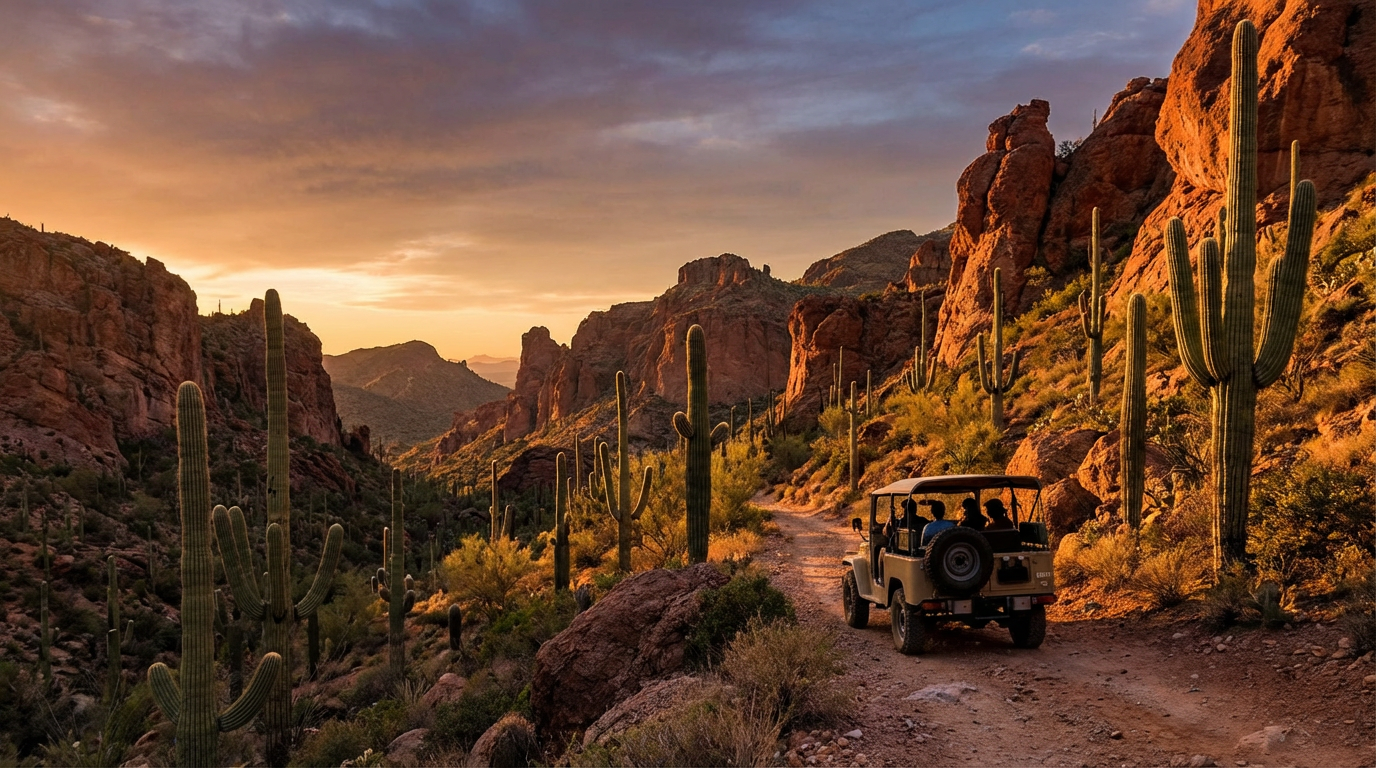
Organized excursions completely eliminate this intense navigational risk. Professional outfitters hold the necessary commercial use authorizations (CUAs) and know precisely which dry washes remain legally passable and physically stable after the unpredictable 2026 seasonal monsoons. Instead of rigidly staring at a glowing dashboard screen, constantly debating unmarked trail forks, and panicking over private property signs, guests on guided Arizona desert tours can focus strictly on the towering 40-foot saguaros rolling past the vehicle's roll cage.
Reason 2 Bypassing Expensive Permits and Recovery Gear Costs
Solo road trips into remote sandy terrain demand rigorous and remarkably expensive upfront preparation. A safe, independent UTV or 4x4 run requires securing a transient $15 to $20 Arizona State Trust Land recreational permit per vehicle, packing heavy-duty kinetic recovery ropes rated for at least double the vehicle's 2,000-pound curb weight, carrying D-ring shackles, and purchasing an independent emergency satellite communicator. Furthermore, isolated off-roading puts the onus of mechanical field repairs squarely on your shoulders. A basic recovery tool kit, a heavy-duty jack, and a portable air compressor typically add over $300 in immediate rental or purchase costs to a solo itinerary.
By booking your adventure through an established outfitter vetted by Rockon Recreation Rentals, the designated commercial operator absorbs all of these operational liabilities and overhead costs. You bypass two hours of tedious morning prep at a dusty trailhead and avoid the immense anxiety of attempting to swap a blown CVT drive belt with hot, unfamiliar tools 15 miles deep into the Tonto National Forest. You step onto the trail equipped solely with proper ANSI-rated eye protection, standard hydration, and a readiness to ride.
Reason 3 Capitalizing on Brief Photographic Lighting Windows
Professional trail leaders serve as impromptu location scouts just as much as they act as driving instructors. Capturing clear, magazine-quality photography in an arid environment requires carefully managing the harsh midday albedo effect, where intense, unfiltered sunlight bounces off light-colored sands and flushes out the famous red rock striations. According to wilderness photography guidelines published by National Geographic, anticipating light bounce off sheer canyon walls is the strictly foundational strategy for professional-grade desert imagery, yet it remains one of the hardest skills for tourists to master.
Expertly timed Arizona desert tours are meticulously choreographed so your 4x4 group arrives at high-elevation panoramic vistas exactly when the sun drops below a 10-degree angle to the horizon. Local guides know exactly which limestone routes on a Guided ATV Tour Sedona maximize the fading alpenglow, turning the rocks a brilliant crimson. Furthermore, they understand which localized slot canyons—like those featured on the Lower Antelope Canyon Tour—naturally block the abrasive 10-micron silica dust that frequently jams delicate internal mechanisms on expensive mirrorless camera lenses during heavy afternoon winds.
Reason 4 Managing Extreme Ground Temperatures Safely
In my years navigating Florida’s wetlands, water is typically a physical obstacle you push a heavy swamp buggy through; in the American Southwest, the absolute lack of it creates a quiet, creeping, and highly lethal threat. Summer ground temperatures in the Sonoran basin frequently exceed 140 degrees Fahrenheit by early afternoon. Vehicle chassis components easily hit 160 degrees in direct sunlight, creating an unforgiving environment where changing a simple flat tire escalates into a severe second-degree burn hazard within 20 minutes if you lack proper heavy leather mechanic gloves.
According to 2026 survival bulletins from the National Park Service, desert visitors require at least one gallon of water per person daily just to replace fluids lost through baseline sweat. Because precipitation instantly evaporates in humidity levels that routinely sit below 10 percent, you rarely even feel yourself sweating. The operators structuring high-end Arizona desert tours utilize insulated, commercial-grade water reservoirs mounted directly to the vehicles and proactively supply advanced electrolyte packets to prevent hyponatremia. Tossing a standard case of thin plastic water bottles into the back of a rental Jeep remains notoriously insufficient, as the liquid literally becomes unpalatably hot and begins degrading the plastic within two hours.
Reason 5 Bridging the Zero Cell Service Communication Gap
Driving just five miles past the master-planned city limits of Phoenix typically means watching your smartphone's basic cellular signal drop completely to zero. Relying on basic LTE networks in the backcountry is a systemic logistics failure routinely made by out-of-state renters. To safely explore these isolated tracts alone, you must logically invest roughly $300 to $400 in an emergency localized satellite messenger device (like a Garmin inReach), plus pay activation fees and a $15 to $30 monthly subscription plan.
Conversely, commercial off-road operators already carry commercial-grade Personal Locator Beacons (PLBs), physical satellite phones, and two-way VHF radios linking directly to county search and rescue dispatchers or private helicopter medevac services. Securing a spot on reputable Arizona desert tours guarantees vetting through centralized platforms, ensuring your guides utilize dedicated chase vehicles. These sweep teams run directly behind the primary convoy carrying heavy-duty winches, spare drive belts, and localized high-lift jacks to resolve mechanical failures in mere minutes, thoroughly insulating you from common $300-per-hour remote commercial towing fees that typically max out basic travel insurance policies.
Reason 6 Outperforming Fragile Commercial Rental SUVs
Most visitors landing at Sky Harbor Airport operate under the dangerous misconception that simply upgrading their traditional car rental to an all-wheel-drive SUV makes them instantly qualified for remote off-grid exploration. According to consumer auto guidelines published by Forbes Advisor, driving a standard commercial rental vehicle on unpaved dirt roads explicitly violates almost all standard rental agreements. It instantly voids any purchased collision damage waivers at the counter, meaning a single punctured oil pan or cracked radiator leaves solo travelers personally liable for upwards of $3,000 in recovery, towing, and engine replacement costs.
Beyond the immense financial risk, conventional crossover rental SUVs typically max out at roughly 7 or 8 inches of ground clearance with street-biased suspension tuning and road-oriented tires that puncture easily on sharp volcanic rocks. When you strategically book specialized Arizona desert tours, outfitters completely bypass these severe limitations by placing guests in custom-configured UTVs built with reinforced quarter-inch steel skid plates. As seen on an ATV Rentals Yuma AZ Thrilling Desert Adventure, these top-tier buggies deliver between 14 to 18 inches of usable mechanical wheel travel. They glide comfortably over severe washboard gravel at 30 mph that would violently rattle a factory unibody vehicle apart at just 5 mph.
Reason 7 Unlocking the Hidden Sonoran Ecosystem
Mapping the dense, visually overwhelming mangrove tunnels of coastal Florida taught me early on that untrained eyes overlook approximately 90 percent of a local ecosystem’s biological narrative. When independent travelers drive out West, a solo driver focusing intensely on avoiding potholes typically sees repetitive miles of dusty scrub brush, completely missing the intricate biological tapestry surviving just off the trail. This is where professionally guided Arizona desert tours genuinely transform a basic mechanical thrill ride into an immersive, localized field seminar.
To the uninitiated traveler, the giant Saguaro is just a classic Western movie backdrop. A seasoned local guide reveals the stark vulnerability of Carnegiea gigantea. According to the Arizona-Sonora Desert Museum, a wild Saguaro takes up to ten full years to reach a single inch in height, relying entirely on the patchy shade of a "nurse tree" like a Palo Verde to survive scorching summer soil temperatures during its infancy. Guides will physically stop the machines, shut off the engines, and point out these subtle symbiotic relationships. They utilize high-powered tripod optics to track the precise seasonal migrations of elusive desert bighorn sheep from a respectful distance, ensuring you leave with a profound understanding of desert conservation.
Maximizing Your Precious 2026 Vacation Time
My early days coordinating Florida swamp airboat excursions proved a universal tourism rule: the logistical transit from the pavement to the true wilderness always takes vastly longer than the map suggests. In the deeply rugged geography of the Southwest, securing a solo rental 4x4, tracking down the required state-issued off-highway vehicle decals from a local powersports dealer, and hauling the heavy equipment on a trailer to a legal staging area typically burns four to five hours before your tires ever touch the dirt. A highly practical metric of 2026 vacation value is calculating the precise density of actual, uninterrupted activity packed within your heavily restricted timeline.
Many premium Arizona desert tours offer direct hotel pickup in climate-controlled luxury shuttles, entirely eliminating the compounding stress of navigating unfamiliar rush-hour traffic in an expensive rental car. As highly rated on major travel platforms like TripAdvisor, these streamlined logistical procedures allow you to pull right into the remote staging area, undergo a brisk but thorough 15-minute safety orientation, and strap immediately into a rigorously inspected machine. At the end of the run, you do not have to spend an extra two hours pressure-washing 100 pounds of caked mud and dust off the buggy to avoid a hefty cleaning surcharge. This remarkable efficiency transforms a grueling administrative endurance test into a seamless half-day highlight.
Final Thoughts on Choosing the Right Outfitter
By completely bypassing heavy logistical burdens, engaging with vetted Arizona desert tours guarantees uncompromised safety, premium mechanical reliability, and a deeply enriched educational perspective on your trip. Attempting to blindly traverse unmarked slot canyons and deep sand washes without localized support needlessly exposes independent travelers to brutal heat variations and massive, hidden financial liabilities. For travelers looking to purely maximize their 2026 itineraries safely, trusting the harsh terrain to highly equipped wilderness experts simply yields the strongest, most dependable return on your vacation investment.