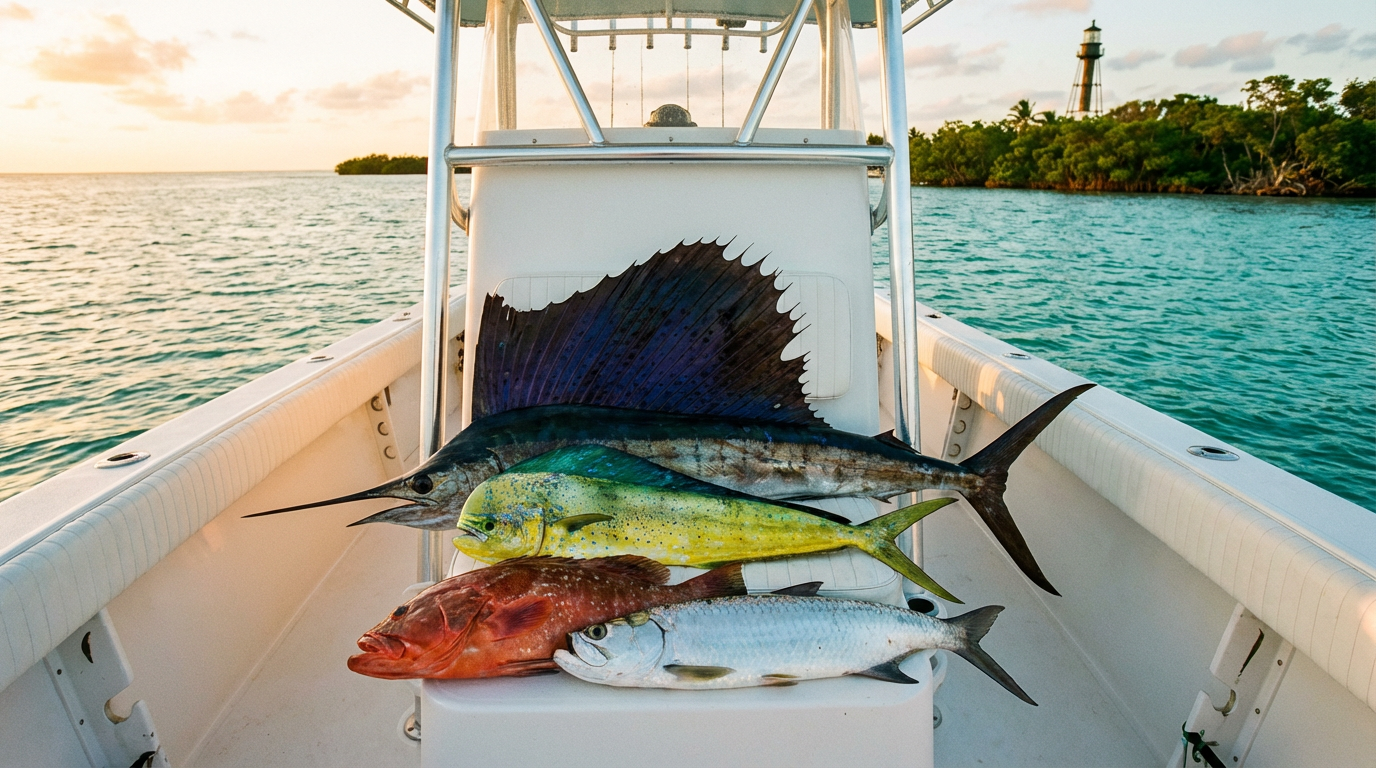
Pitfall 1 Assuming Static Migration Patterns for Florida Fishing Species
Since my first guiding season in 2018, the most frequent heartbreak I witness on the Destin docks is an out-of-state angler arriving with expensive gear to target a specific florida fishing species that is currently hundreds of miles away. Many visitors drop their lines blindly into the Gulf, missing highly productive migratory staging areas because they assume iconic gamefish display stagnant year-round feeding behaviors. Operating under this widespread assumption is a guaranteed fast track to an empty cooler and a frustrating afternoon.
The Panhandle presents a highly dynamic fishery closely tied to fluctuating water temperatures rather than fixed calendar dates. Early in the 2026 season, coastal waters off Choctawhatchee Bay warmed to the 74-degree mark slightly faster than historical averages. According to tidal and marine data published by the National Oceanic and Atmospheric Administration, predatory florida fishing species shift their depth and feeding patterns significantly right around this critical 75-degree Fahrenheit turn, demanding agile timeline adjustments from traveling anglers.
What most casual visitors do not realize is that trying to target migratory tarpon near Destin Pass in late November is essentially burning boat fuel for nothing. At roughly $5.50 a gallon at most coastal marinas (a premium frequently highlighted in modern travel reporting by The New York Times), these aimless trips quickly drain vacation budgets. As a VisitFlorida Travel Partner, we at Rockon Recreation Rentals advise timing your expeditions strictly between May and July to align precisely with explosive pass migrations, an adjustment that historically increases local strike rates by roughly 40 percent.
Pitfall 2 Ignoring Gulf Coast Slot Limits and Seasonal Closures
Just last week at the Liza Jackson Park boat ramp in Fort Walton Beach—a popular destination frequently reviewed on TripAdvisor—I watched marine officers hand a visiting angler a citation exceeding $500 for inadvertently harvesting an undersized Gag Grouper. Regulatory ignorance remains the fastest way to ruin an otherwise successful vacation. The Florida Fish and Wildlife Conservation Commission (FWC) heavily patrols Panhandle coastal access points, enforcing strict daily bag limits designed to prevent the overfishing of critical florida fishing species.
Decoding the complex terminology surrounding legal retention often confuses beginners transitioning from freshwater lakes. There is a distinct biological difference between hard minimums and slot limits when dealing with various florida fishing species. Hard minimums, such as the strictly enforced 10-inch requirement for Mangrove Snapper within state waters, ensure the individual fish has reached sexual maturity and spawned at least once before entering an angler's cooler.
Conversely, slot limits apply to heavily targeted coastal predators like Red Drum, dictating you can only keep fish strictly between 18 and 27 inches in total length. What most casual visitors do not realize is that fish exceeding 27 inches are the critical primary breeding stock responsible for replenishing our estuaries. Taking a closed-mouth measurement while pinching the tail is a strict legal requirement; improperly measuring a 27.5-inch Redfish with a relaxed tail in Choctawhatchee Bay is a common amateur mistake resulting in severe fines and potential vessel confiscation.
Pitfall 3 Deploying Freshwater Terminal Tackle in Saltwater Passes
Over my years of outfitting coastal expeditions since 2018, a highly frequent failure involves a tackle box optimized solely for Midwestern bass lakes. Tourists frequently expect their favorite one-ounce freshwater spinnerbaits to dominate the shores of Destin, completely ignoring coastal gear guides from national publications like Travel and Leisure. Unfortunately, artificial lures designed for freshwater often repel rather than attract coastal florida fishing species, which are biologically adapted to entirely different water clarities and forceful 2-knot tidal current speeds.
Relying on a standard 12-pound braided mainline tied directly to your hook is a guaranteed break-off the moment a 30-inch snook violently dives for the prop roots. The necessary upgrade is a dedicated, high-abrasion fluorocarbon leader. Marine biology research provided by Florida Sea Grant details the acute visual acuity of estuarine gamefish, proving that thick, highly visible monofilament lines directly deter cautious edge-feeders from striking in clear Panhandle shallows.
You must match your leader to the structure, not just the target weight of the florida fishing species you hope to land. In open, clear-water sand flats of 2 to 3 feet in depth, a high-quality 20-pound fluorocarbon leader provides the necessary stealth approach. However, if you are pitching live pinfish tightly into abrasive dock pilings across Choctawhatchee Bay, you must step up to a 40-pound leader to survive the initial violent dive into the barnacle-encrusted submerged wood.
Pitfall 4 Mismanaging Live Bait Profiles in High Temperature Estuaries
Historically, and continuing strong across the 2026 season, live bait remains a reliably proven primary forage for nearly every florida fishing species, yet it requires precise local rigging to stay lively in the water column. Simply threading a live shrimp onto a heavy 3/0 jig head right through its midsection pierces vital organs, killing it within five minutes and rendering it unappealing in our localized 80-degree summer estuaries.
For shallow-water presentations in moderate currents near Crab Island, I strongly recommend lightly hooking the shrimp under the horn on its head, carefully avoiding the dark brain spot so it kicks naturally backward. This specific presentation mimics local fleeing behavior perfectly, triggering aggressive strikes from ambush predators that ignore dead bait dragging unnaturally along the bottom.
When casting into deeper transit zones like Destin Pass, tail-hooking is far superior because it stops the bait from spinning wildly in heavy tidal flows. According to coastal habitat data published by the University of Florida Institute of Food and Agricultural Sciences, aligning your hook presentation directly with the precise 3-inch baitfish staging in local seagrass beds dramatically lowers the refusal rate from passing florida fishing species.
Pitfall 5 Choosing Shoreline Access Over Shallow Draft Choctawhatchee Bay Vessels
Trying to reach prime grass flats from the shoreline severely limits your access to highly sought-after catches like speckled trout. Visitors wading waist-deep into localized muck are severely constrained by crowded public access points. Renting a shallow draft vessel—particularly a well-equipped pontoon like the Crab Island Pontoon Boat Rental—allows families to safely drift over untouched flats situated just half a mile offshore, dramatically increasing encounters with diverse florida fishing species.
Choctawhatchee Bay runs roughly 30 miles long and spans 4 to 6 miles wide, but what most visitors do not realize is that devastatingly shallow sandbars shift constantly along its northern shorelines. In 2026, updated navigational data published by the National Oceanic and Atmospheric Administration stresses increased caution around newly shifted submerged grass beds near the Mid-Bay Bridge. A modern pontoon boat typically requires only 12 to 18 inches of draft clearance, giving you exclusive, safe access to the 3-foot grass perimeters where predatory florida fishing species notoriously hunt.
Navigating to these shallow zones is only half the battle; safely securing your position dictates your final harvest. Position your rental vessel approximately 30 yards up-current from the structure, allowing your live shrimp to drift naturally back into the strike zone. Because aluminum pontoon hulls heavily amplify the sound of dropped tackle boxes, keeping this 90-foot distance is a mandatory local tactic for tempting elusive florida fishing species without instantly spooking the entire school.
Pitfall 6 Misreading Tidal Flow and Destin Pass Slack Water Variations
As a local guide tracking coastal patterns across the Panhandle since 2018, one of the most painful errors I witness is visiting anglers ignoring the lunar cycle and focusing entirely on the solar clock. Moving water is the undisputed engine of the coastal food web. Dynamic currents sweeping through the bay push baitfish, disorient crustaceans, and violently stimulate feeding activity indiscriminately among nearly all florida fishing species.
Conversely, slack tides—the stagnant periods at the absolute peak of high tide or the dead bottom of low tide—often create frustrating coastal dead zones. During these stagnant intervals, dissolved oxygen levels in the extreme 1-foot shallows plummet slightly, causing fish to retreat to deep channels. You can cast the most expensive, precisely rigged live shrimp onto the flats during a slack tide near Fort Walton Beach, and your bait will likely sit untouched for a full hour.
Planning your departure strictly around tidal charts maximizes your active strikes during short, two-hour, high-percentage windows. Here in 2026, relying on generalized regional forecasts leads to missed opportunities. According to specialized marine data from the National Oceanic and Atmospheric Administration, localized wind patterns pushing through Destin Pass heavily alter predicted tidal flows, sometimes shifting peak water movement by over 45 minutes compared to basic smartphone app forecasts.
Pitfall 7 Failing to Accurately Identify Highly Regulated Florida Fishing Species
Even after executing an exact tidal strategy, misidentification can ruin hours of effort. I have continuously watched enthusiastic anglers pull a thrashing 15-inch fish over the gunwales, tossing it directly into the cooler without a second glance. Mixing up different types of snapper or grouper can accidentally turn a legal haul into a highly regulated violation affecting multiple vulnerable florida fishing species.
Distinguishing between the highly regulated American Red Snapper and the Gray Snapper (commonly known as the Mangrove Snapper) is a notorious trap for out-of-state Gulf Coast visitors. According to authoritative Florida Fish and Wildlife Conservation Commission guidelines, true Red Snapper have stark red eyes and lack the prominent dark lateral stripe that slices directly through the eye of a juvenile Gray Snapper. Red Snapper seasons remain famously short in 2026—often compressed into a localized 45-day summer window for recreational anglers.
What most casual visitors do not realize is that keeping a waterproof, laminated 8x10 identification chart thick-zip-tied directly to the inside of your primary cooler lid removes the guesswork instantly during a chaotic active bite. This simple, $15 physical backup prevents you from incorrectly guessing the identity of a protected florida fishing species when marine cellular service inevitably drops a mile off the beach.
Pitfall 8 Overlooking Necessary Descending Devices for Deep Water Catches
While inshore grass flats have complex rules, venturing roughly 9 miles out into the Gulf of Mexico past Destin Pass for deep-water bottom fishing introduces separate biological challenges. Out-of-state visitors often attempt to book offshore trips hoping to bring home cooler loads of reef fish, completely unaware of the physical effects of deep-water extraction on various florida fishing species targeted near natural limestone ledges.
Pulling a bottom-dwelling fish up rapidly from depths exceeding 50 feet predictably causes barotrauma, a condition where the rapid expansion of swim bladder gases physically prevents a released fish from swimming back down. Retaining an out-of-season reef fish simply because it is floating helplessly on the surface is not only illegal, but it severely damages the localized breeding populations of highly targeted florida fishing species.
Savvy local captains use specialized descending devices—weighted inverted hooks or clamping grips—that securely return bloated reef fish to the bottom before safely releasing them. In fact, the Gulf of Mexico Fishery Management Council legally mandates having rigged descending devices ready on all vessels targeting Gulf reef fish. Understanding exactly how to deploy these required tools preserves both your wallet from steep federal fines and the sustainability of these localized fisheries.
Pitfall 9 Navigating Fort Walton Shorelines Without Offline Depth Charts
The final, most expensive mistake visitors make when pursuing florida fishing species across the Panhandle involves assuming their standard mobile mapping applications will provide adequate marine navigation. Cellular service notoriously degrades just past the mid-bay bridges or near the outer marker of Destin Pass, rendering basic internet-reliant maps completely useless in shifting environments.
Without accurate depth readings, tourists frequently run expensive rentals hard aground on isolated oyster bars hidden mere inches below the surface near Crab Island. Beyond the profound embarrassment, what most visitors do not realize is that commercial marine towing companies typically charge base rates exceeding $800 for a simple soft grounding extraction. Furthermore, destroying protected seagrass beds around Choctawhatchee Bay with a careless propeller strike carries strict civic penalties actively enforced throughout 2026.
As a safety-first standard established since my 2018 guiding beginnings, I advise all renting captains to download offline electronic navigational charts directly from the NOAA ENC database before ever untying from the dock. Having an offline bathymetric reference ensures you can confidently navigate the intricate drop-offs and deep channels where the largest florida fishing species wait in ambush, completely eliminating the stressful risk of stranding your family on an unfamiliar Panhandle sandbar.