Navigating the Different Types of Boats Available
Selecting the right vessel is the single most critical decision when planning a florida boat hire. Through years of helping visitors navigate Florida's waterways, we have seen that the "best" boat is entirely dependent on your specific destination and itinerary. A vessel perfect for the calm, spring-fed waters of Crystal River can be dangerous in the choppy inlets of the Atlantic coast. Understanding hull dynamics, draft (how deep the boat sits in the water), and capacity ratings is essential for both safety and enjoyment during your florida boat hire experience.
Pontoon Boats for Leisure
Pontoon boats are the undisputed heavyweights of the florida boat hire market, particularly for families and groups ranging from 8 to 12 passengers. Their flat decks and fencing offer a "playpen" safety factor that is unrivaled for families with small children or dogs. What most visitors don't realize is the functional difference between a standard two-tube pontoon and a "tritoon" (three tubes). While standard pontoons are excellent for inland lakes and slow-speed cruising, they often struggle in the choppy intercoastal waters on windy days. If you are venturing into open bays like Tampa Bay or Biscayne Bay for your florida boat hire, a tritoon offers significantly better stability and handling.
The primary advantage of a pontoon is its shallow draft—typically only 12 to 16 inches. This makes them the ideal choice for "sandbar days," allowing captains to beach the craft at popular local gathering spots like Crab Island in Destin or the Peanut Island sandbar in Palm Beach County. However, because they are not designed to cut through waves, they are slower and less agile than other options. For groups wanting to incorporate watersports like tubing or wakeboarding into their florida boat hire, a Deck Boat is often a superior alternative. Deck boats feature a V-shaped fiberglass hull similar to a runabout but maintain the open floor plan of a pontoon, providing the torque and speed necessary to pull a skier while seating up to 10 people comfortably.
Fishing Vessels and Center Consoles
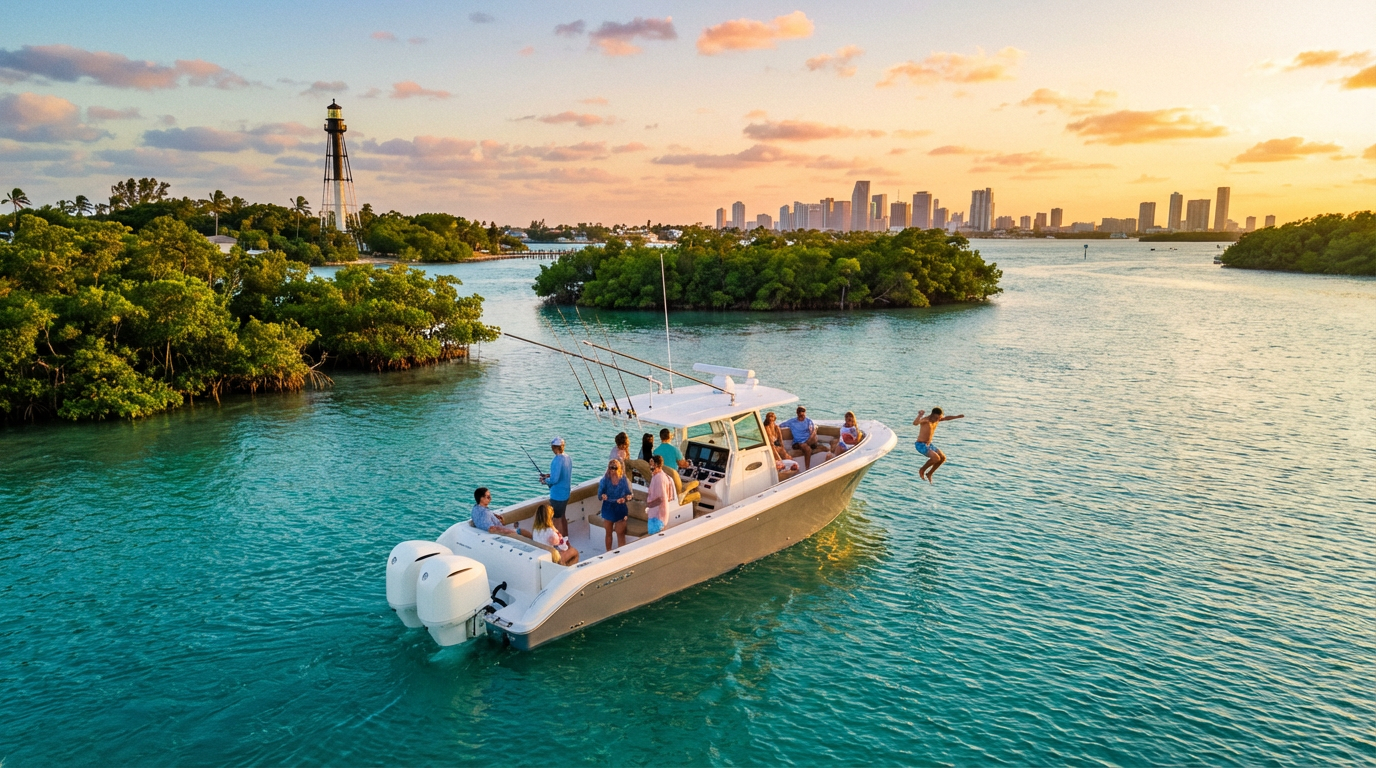
For anglers targeting Florida’s game fish, comfort takes a backseat to utility. Center console boats are purpose-built for the specific demands of Gulf and Atlantic fishing. Unlike pontoons, these boats feature a V-hull design capable of slicing through 2-to-4-foot swells, making them the only safe option for venturing offshore during a florida boat hire. The layout allows for 360-degree mobility around the deck, which is crucial when fighting a pelagic fish that decides to run around the boat.
When booking through Rockon Recreation Rentals, look for center consoles equipped with essential amenities like livewells (oxygenated tanks to keep bait alive), rod holders (often called "rocket launchers"), and T-tops for shade. It is important to note that these boats typically have less seating capacity than leisure boats—usually capped at 6 passengers due to weight distribution and Coast Guard regulations. According to the Florida Fish and Wildlife Conservation Commission (FWC), overloading a center console is a leading cause of stability issues, so be accurate with your passenger count when booking your florida boat hire.
Luxury Yachts and Sailboats
For those prioritizing luxury over logistics, yachts and sailboats offer a premium florida boat hire experience that almost always includes a licensed captain and crew. This category is distinct because it shifts the responsibility of navigation and docking entirely to professionals. In markets like Miami and Fort Lauderdale, yachts ranging from 40 to 100+ feet are popular for bachelorette parties and corporate events. A key trade-off here is the "bareboat charter" contract often used for these rentals, where the cost of fuel and captain fees may be itemized separately from the boat rental fee to comply with maritime law.
Sailboats offer a slower, more romantic pace, ideal for sunset cruises in the Keys or St. Augustine. While they lack the speed to visit multiple destinations in a single day, the silence of sailing provides a connection to the marine environment that motorized vessels cannot match. Whether you choose a 50-foot catamaran for its stability or a sleeker monohull, always confirm the "air draft" (mast height) if your florida boat hire route involves passing under fixed bridges, a common logistical hurdle on the Intracoastal Waterway.
Choosing Between Captained and Self-Drive Florida Boat Hire
Once you have determined the correct vessel class for your group, the next pivot point in planning your florida boat hire is deciding who will stand at the helm. This choice fundamentally changes the nature of your day on the water. In our experience coordinating thousands of rentals through Rockon Recreation Rentals, visitors often underestimate the complexity of Florida’s waterways. While the allure of autonomy is strong, the reality of navigating shifting shoals, heavy weekend traffic, and intricate channel marker systems requires honest self-assessment regarding your boating competence.
The Self-Drive Experience Offering Autonomy and Responsibility
Opting for a self-drive rental (bareboat charter) offers the ultimate privacy. It allows your group to set its own pace, linger at a sandbar as long as you wish, and engage in private conversations without a stranger on board. However, this freedom comes with significant legal and practical responsibilities. Florida's waterways are not an open ocean; they are strictly regulated highways. You must understand "Red Right Return," idle-speed zones, and manatee protection areas before committing to a self-drive florida boat hire.
Legally, anyone born on or after January 1, 1988, must possess a Boating Safety Education Identification Card to operate a vessel of 10 horsepower or more, according to the temporary certificate guidelines set by the Florida Fish and Wildlife Conservation Commission (FWC). Most reputable rental liveries will issue a temporary certificate after a short exam, but this does not replace actual handling experience.
The hidden trade-off with self-drive rentals is stress management. The captain is responsible for the safety of all passengers and the vessel. In areas like the Florida Keys or the shallow backwaters of the Gulf Coast, depth perception is critical. We often see unguided renters running aground on seagrass beds, which not only ends the fun but can result in hefty fines from environmental protection agencies and expensive propeller damage fees.
The Captained Advantage for Local Expertise and Stress Reduction
Hiring a licensed captain transforms the excursion from an active logistical challenge into a passive leisure experience. The primary benefit is liability and safety; according to U.S. Coast Guard 2023 Recreational Boating Statistics, operator inexperience is consistently a top contributing factor in accidents. With a professional at the helm of your florida boat hire, you remove the risk of navigation errors and allow every member of your group to consume alcohol responsibly without worrying about Boating Under the Influence (BUI) laws.
Beyond safety, a captain acts as a hyper-local concierge. Most visitors looking for wildlife simply cruise the center of the channel and see very little. A local captain knows, for instance, that the best dolphin sightings near Pensacola are often found in the currents specifically south of Santa Rosa Island during tidal changes. They know which mangrove tunnels in the Ten Thousand Islands are accessible at low tide and where the clearest water can be found when the wind shifts.
Navigation Nuances Bareboat vs Standard Charters
When browsing options for your florida boat hire, you may encounter the term "Bareboat Charter." It is vital to understand the distinction between this and a standard rental. In a standard "Time Charter" or recreational rental, the boat and captain are a package deal provided by the company. However, under U.S. maritime law, specific uninspected vessels are limited to six paying passengers.
To legally accommodate larger groups (often up to 12 passengers) on certain vessels without a Certificate of Inspection (COI), operators utilize a "Demise" or "Bareboat" charter agreement. In this scenario, you technically lease the boat as if you own it for the day, and you must select and pay the captain separately from a list of qualified mariners. This isn't just paperwork; it shifts the legal control of the vessel to the charterer (you). While this sounds complex, platforms like Rockon Recreation Rentals streamline the selection process, ensuring you stay compliant with Coast Guard regulations while securing the right florida boat hire for your group size.
FAQs
- Do I need a license to drive a rental boat in Florida?
- If you were born on or after January 1, 1988, you are required by law to have a Boating Safety Education Identification Card. Most rental locations offer a temporary certificate test on-site for a small fee, which is valid for 90 days.
- Can a captained charter take more than 6 passengers?
- Yes, but it depends on the vessel's certification. Boats with a USCG Certificate of Inspection (COI) can carry more than 6 passengers. Alternatively, a "Bareboat Charter" agreement may legally allow up to 12 passengers on uninspected vessels if the captain is hired separately by the renter.
Pricing Duration and Essential Rental Logistics
When budgeting for a florida boat hire, visitors often start with a misconception that pricing works similarly to rental cars—strictly by the day with unlimited mileage (or in this case, engine hours). In reality, the marine rental market operates on shorter, rigid time blocks due to the logistical requirements of cleaning, refueling, and inspecting vessels between customers. Based on data from hundreds of listings across Rockon Recreation Rentals, the industry standard has consolidated around two primary windows: the half-day (4 hours) and the full-day (8 hours).
While hourly rates exist, they often represent the poorest value for your money. A typical boat operator incurs the same administrative and turnaround costs whether the vessel goes out for one hour or eight. Consequently, a two-hour sunset cruise might cost 75% of a four-hour block. For most travelers, the "sweet spot" for a florida boat hire is the 4-hour half-day, which allows enough time to reach a sandbar, swim, and return without the fatigue of a full 8-hour day under the Florida sun. However, if you plan to visit spread-out locations—such as running from Miami Beach to the haulover sandbar—the full-day rate often drops the hourly cost breakdown significantly.
Variable Pricing Factors and Seasonal Surges
Base rates for rental vessels fluctuate drastically based on three metrics that are often invisible to the first-time renter: hull LOA (Length Overall), engine horsepower, and calendar demand. To help planners estimate costs, here are typical price ranges we observe in major markets like Destin, Miami, and Clearwater:
- Standard Pontoon (20-22ft, 60-90hp): Expect to pay $250–$350 for a half-day and $450–$600 for a full day. These are best for calm rivers and lakes.
- Premium Tritoon (24ft+, 150hp+): Rents for $400–$550 (half-day) to $700–$900 (full day). The extra cost covers the third tube stability and higher speed.
- Center Console Fishing Boat (21-24ft): Typically $400–$600 for a half-day. This higher price point reflects the specialized maintenance required for saltwater fishing engines.
- Deck Boats (Hurricane/Sea Ray): Range from $350–$500 for a half-day, bridging the gap between leisure and sport.
Seasonality creates the widest variance in pricing for any florida boat hire. According to boating trends monitored by local tourism boards like VisitFlorida, demand peaks sharply during "The Big Three" holidays: Memorial Day, the Fourth of July, and Labor Day. During these weekends, and frequently during Spring Break weeks in March, operators often suspend discounts and apply holiday surcharges. Conversely, savvy renters who book mid-week (Tuesday through Thursday) can often secure lower rates or free hour extensions, as fleets are less likely to be fully utilized.
Navigating Operational Costs Fuel and Security Deposits
The advertised base rate is rarely the final cost of a florida boat hire. Authoritative transparency is key here: almost every legitimate rental agreement in Florida excludes fuel from the rental price. This is distinct from a car rental; marine engines consume significantly more fuel, and marina gas stations charge a premium for non-ethanol marine grade gas. According to the Waterway Guide Fuel Price Report, marina fuel prices are typically 20% to 30% higher than roadside pump prices due to access and environmental compliance costs. Operators typically use one of two methods to bill this:
- The Top-Off Method: The boat leaves full, and upon return, the dockhand refuels it while you wait. You pay the exact pump price for what you used.
- The Estimate Method: If the boat lacks a working fuel flow meter, some operators charge a flat "engine hour" fee, typically ranging from $20 to $40 per engine hour run.
Additionally, renters must prepare for the security deposit. A hold of $500 to $1,000 is standard procedure on credit cards to cover potential damages, specifically propeller damage. In Florida's shallow waters, a "prop strike" on an oyster bed or sandbar is the most common incident, costing upwards of $250 for a replacement. This hold is released after the post-rental inspection confirms the hull and propeller are intact.
Multi-Day Rentals and Docking Logistics
For visitors renting a waterfront vacation home, keeping a boat for multiple days is an attractive option that can lower the daily average cost of a florida boat hire. However, this strategy requires advanced logistical planning that many renters overlook. Most commercial operators will only allow multi-day rentals if you can prove you have safe, legal docking.
What most renters fail to account for is Florida's tidal swing. A boat tied tightly to a fixed dock at high tide can be left hanging—or underwater—when the tide drops 3 to 4 feet six hours later. Furthermore, many Homeowners Associations (HOAs) in destinations like Cape Coral or Destin strictly prohibit commercial rental vessels from being moored overnight at private residences due to insurance liabilities. Always verify the dock situation with your host and the boat owner before committing to a multi-day contract.
Checking Included Amenities and Guest Services
Once you have determined the hull type best suited for your itinerary and navigated the cost structure, the next step in securing a successful florida boat hire is scrutinizing the specific inventory. In our experience facilitating thousands of rentals across the state, the difference between a stressful afternoon and a seamless adventure often comes down to the "small" details—specifically, shade coverage, boarding accessibility, and communications equipment. Renters often focus solely on the horsepower or price, overlooking amenities that directly impact comfort and safety in Florida’s specific marine environment.
Mandatory Safety Equipment Expectations
Every legitimate rental operator in Florida is legally bound to provide United States Coast Guard (USCG) approved safety gear. This is non-negotiable. Standard inclusions consist of proper navigation lights, visual distress signals (flares), sound-producing devices (horns or whistles), and fire extinguishers. However, the most critical component is the Personal Flotation Device (PFD).
According to the Florida Fish and Wildlife Conservation Commission (FWC), there must be one wearable USCG-approved life jacket for each person on board, plus a throwable device (like a ring buoy) for vessels over 16 feet. A common misconception among visitors is that "adult" jackets fit everyone. Local tip: Florida law strictly requires that children under 6 years of age must wear a Type I, II, or III PFD at all times while the vessel is underway. If you are boating with infants or toddlers during your florida boat hire, verify explicitly that the operator has infant-sized vests; many standard rental fleets only stock generic adult and youth sizes.
Comfort Essentials for Florida Waters
Beyond legal compliance, specific amenities are functionally required for the Florida climate. The most frequently overlooked necessity is the Bimini top. This canvas canopy provides crucial shelter from the subtropical sun. In the summer months, direct exposure on the water—where UV rays reflect off the surface—can lead to heat exhaustion in under two hours. We strongly advise against renting any open vessel without a functional Bimini top unless your trip is strictly a short sunrise or sunset cruise.
Practical accessibility is another major factor. If your itinerary involves swimming at popular spots like the Sarasota sandbars or the springs near Crystal River, a sturdy swim ladder is essential. Re-boarding a pontoon boat from deep water without a ladder is physically demanding and often impossible for seniors or children. High-quality listings on Rockon Recreation Rentals will specify the presence of boarding ladders and swim platforms, ensuring you can enter and exit the water safely.
Additionally, modern renters expect connectivity and entertainment. While not critical for safety, the presence of a Bluetooth-enabled marine stereo system allows you to curate the atmosphere. However, be aware that in many remote areas—such as the Ten Thousand Islands or the deeper channels of the Keys—cellular service can be spotty. While most boats have 12-volt plugs, high-end florida boat hire options often include dedicated USB charging ports to keep navigation apps running on your phone.
Identifying Premium Inclusions and Guide Services
The florida boat hire market generally splits into two categories: "bareboat" rentals (you drive) and chartered experiences. High-end bareboat listings are increasingly bundling "toy packages" to compete with basic rentals. Instead of just the boat, these packages often include large floating mats (often called "Lily Pads"), snorkel gear with sanitized mouthpieces, and high-performance coolers like Yetis filled with ice. From a cost-benefit perspective, a rental that includes a cooler and ice saves you approximately $40–$60 and the logistical hassle of hauling a Styrofoam cooler from a gas station to the marina.
For those prioritizing relaxation over navigation, tour-style hires with a captain provide significant value beyond just driving. A seasoned local captain acts as a naturalist guide. For example, in the Indian River Lagoon, a guide knows how to spot manatee footprints (circular calm spots on the water) that an untrained eye would miss. They also handle the anchoring process—which can be tricky in strong tidal currents found near inlets like Jupiter or Ponce Inlet—allowing the group to focus entirely on leisure.
It is also important to revisit the fuel discussion here for premium charters. While standard rentals usually deduct fuel from your deposit, many premium luxury charters include fuel in the upfront price to simplify the transaction. Always clarify the fuel policy before leaving the dock to avoid surprise charges averaging $50 to $100 depending on usage.
Steps for Booking a Florida Boat Hire Successfully
Securing the perfect vessel requires more than a quick Google search on the morning of your trip. Since 2020, we have observed a significant shift in inventory dynamics; what used to be a walk-up market in areas like Key West and Destin has transformed into a reservation-based ecosystem. To ensure your itinerary doesn't fall apart due to lack of availability, approaching your Florida boat hire with a strategic timeline is essential. Following a systematic booking process not only guarantees you get the boat you want but also protects you from common legal and financial pitfalls that catch unprepared visitors off guard.
Securing Your Reservation in Advance
The single most common mistake visitors make is underestimating demand during peak seasons. In high-traffic recreational hubs like Crab Island or the Miami Intracoastal, prime morning slots (typically 9:00 AM starts) flood with reservations weeks in advance. During "Spring Break" (which locals define broadly as the first week of March through mid-April) and the summer window of June through August, we recommend securing your rental at least three to four weeks prior to your arrival. For holiday weekends like Memorial Day or the Fourth of July, inventory often hits 90% capacity by early May.
Booking early isn't just about availability; it is about vessel quality. The newest, most fuel-efficient 2023-2026 model pontoons and center consoles are always the first to be booked. Latecomers to the florida boat hire market are often left with older fleets that may lack modern amenities like Bluetooth sound systems or updated GPS navigation.
Navigating Boating License Requirements
As mentioned in our earlier section on self-drive rentals, Florida's boating regulations are strictly enforced, and confusion regarding documentation is the primary reason rentals are denied at the dock. Detailed planning requires remembering that anyone born on or after January 1, 1988, who operates a vessel powered by 10 horsepower or more must possess a Boating Safety Education Identification Card. This requirement is non-negotiable.
For a typical florida boat hire, you typically do not need to complete the full 8-hour course intended for residents. You can obtain a Temporary Boating Safety Education Certificate. This specific exam is designed for short-term renters, costs approximately $10, and is valid for 90 days. We strongly advise completing this online at least 24 hours before your rental period begins to avoid eating into your paid water time.
Preparing Documentation and Deposits
When you arrive at the marina, the check-in process functions similarly to renting a car. All operators vetted by Rockon Recreation Rentals will require a valid physical government-issued ID (passport or driver's license) that matches the credit card used for the booking. Digital photos of IDs are rarely accepted due to insurance liabilities.
You must also be prepared for the security deposit. A "hold" ranging from $500 to $2,500 (depending on the value of the vessel) will be placed on your credit card. A critical detail typically overlooked is the difference between using a credit card and a debit card for this hold. If you use a debit card, the funds are actually withdrawn from your checking account and may take 5 to 10 business days to return after the rental concludes. Using a credit card is functionally superior, as it merely freezes the credit line without removing liquid cash from your vacation budget.
Checking Weather and Cancellation Policies
Florida is the lightning capital of the United States, and weather patterns here are distinctively volatile. A sunny forecast at 9:00 AM can turn into a severe thunderstorm by 2:00 PM. Before finalizing your booking, scrutinize the operator's cancellation policy regarding weather. Legitimate operators operate under a "Captain's Call" protocol.
This means that if the NWS Marine Forecast issues a Small Craft Advisory or if there is lightning within a certain radius, the operator will cancel the trip and offer a refund or rain check. However, renters should understand that overcast skies, light rain, or cooler-than-expected temperatures generally do not constitute grounds for a penalty-free cancellation. Protecting your purchase involves understanding that safety cancellations are determined by professional mariners, not personal comfort preferences.
Evaluating Customer Reviews for Specific Rental Companies
Once you have identified the ideal vessel type for your outing, the next critical step is vetting the provider. In the saturated market of florida boat hire, glossy marketing photos can obscure the reality of aging fleets or lackluster service. As an official VisitFlorida Travel Partner, Rockon Recreation Rentals emphasizes transparency, but we also encourage renters to independently audit potential operators. A consistent pattern in customer testimonials often reveals the true operational health of a business far better than its advertised star rating alone.
Decoding Maintenance Signals in Testimonials
In Florida's harsh saltwater environment, a boat's condition deteriorates rapidly without rigorous upkeep. Mechanical reliability is non-negotiable when navigating tidal currents or navigating busy channels like the Intracoastal Waterway. When scanning reviews, use the "search" function to flag specific keywords such as "stalled," "battery," "anchor," or "smell."
Anecdotal evidence from past renters can be invaluable. We often hear from families who chose a provider based solely on price, only to report, "The engine kept cutting out near the bridge," or "The ladder was broken, so we couldn't swim." These aren't just inconveniences; they are safety hazards. Conversely, reviews like, "The captain noticed the wind picking up and rerouted us to a calmer cove," indicate a company that empowers its staff to prioritize guest safety over a rigid scheduled itinerary.
A recurring mention of cleanliness issues is often a proxy for mechanical neglect. If a diverse range of renters over several months mention torn upholstery, mildewed life jackets, or trash in the storage compartments, it suggests a lack of systematic maintenance. Experienced boaters know that if an operator cuts corners on visible hygiene, they are likely skipping invisible but critical preventative maintenance intervals—like checking the bilge pumps or servicing the lower unit. According to the BoatUS Foundation, preventative maintenance is the primary factor in preventing on-water failures; unfortunately, renters rarely see the engine logs. Therefore, consistent detailed feedback about physical condition remains your best gauge of safety for any florida boat hire.
Assessing Dockside Assistance and Safety Briefings
The interaction at the dock is often the difference between a safe, confident voyage and a stressful afternoon. Reviews that specifically praise the "dock staff," "briefing," or "instruction" indicate a company that prioritizes safety over turnover speed. In Florida, rental liveries are required to provide pre-rental safety instruction in accordance with Florida Fish and Wildlife Conservation Commission (FWC) regulations.
Look for reviews that mention the quality of the "chart briefing" or "map integration." A high-quality operator will take 15–20 minutes to explicitly point out local hazards—such as the shallow seagrass beds in the Florida Keys or the idle-speed manatee zones in Homosassa—rather than simply handing you the keys. Conversely, be wary of reviews that state, "We were rushed," or "They didn't explain the controls." These are significant red flags that suggest the operator may be prioritizing volume over compliance and safety.
The Critical Importance of Recency and Hidden Gems
The seasonality of Florida tourism means that a review from 18 months ago provides limited value today. Fleet turnover is high; a pontoon that was pristine in 2021 may have endured hundreds of operational hours and significant saltwater corrosion by 2026. Prioritize reviews written within the last 90 days, specifically looking for recent comments on engine performance. If a listing has a 4.8-star average but the three most recent reviews mention engine trouble, trust the recent data over the historical average.
Finally, astute reviewers often inadvertently act as itinerary planners. Previous guests frequently leave breadcrumbs about unique local spots that aren't on standard tourist maps. Look for specific phrases like "we found a quiet cove near..." or "the staff recommended we head to..." These testimonials often reveal distinct routes or "hidden gems" specific to that operator's location—information you can use to upgrade your own itinerary planning. For example, reviews for a florida boat hire in Sarasota might reveal the exact tide times best for shelling on the secluded beaches of Midnight Pass, a detail generic travel guides often miss.
Essential Safety and Documentation for Florida Boaters
Safe boating in the Sunshine State requires far more than just grabbing the keys and heading toward the horizon. Once you have selected a reputable operator based on recent reviews, the final hurdle is the physical handover at the dock. The reality of a florida boat hire is that the renter assumes significant legal and financial responsibility the moment the vessel leaves the dock. Through our work as a VisitFlorida Travel Partner, we have observed that rental disputes most frequently arise not from mechanical failures, but from a lack of clarity regarding documentation, pre-existing damage, and local navigation laws.
Mandatory Equipment and Legal Licensing
Before leaving the marina, your primary task is a physical inventory check. You must verify that the vessel complies with United States Coast Guard (USCG) carriage requirements. While Rockon Recreation Rentals ensures our partners meet strict safety standards, you should personally verify the presence of a wearable Personal Flotation Device (PFD) for every passenger. Crucially, these must be the correct size; an adult vest on a 40-pound child is not compliant and dangerous. According to the Florida Fish and Wildlife Conservation Commission (FWC), vessels over 16 feet must also carry a throwable Type IV device and functional visual distress signals (flares or electric distress lights).
Licensing is another common point of friction during checkout. While we previously outlined the age requirements, having the physical documentation in hand is where many trips stall. In Florida, anyone born on or after January 1, 1988, must carry their Boating Safety Education Identification Card to operate a vessel of 10 horsepower or more. Many rental outfitters do offer the temporary, 90-day certificate test on-site, but relying on dockside Wi-Fi to finish an exam can delay your departure. Failing to have this documentation on board carries a fine of at least $50, exclusive of court costs, and will immediately halt your florida boat hire.
Executing a Proper Pre-Departure Inspection
The checkout process is your only opportunity to protect yourself from liability for damage you did not cause. Do not let a deckhand rush this step. We strongly recommend walking the perimeter of the boat (the gunwales) and inspecting the fiberglass gel coat for deep scratches or "dock rash."
The Critical Propeller Check
The single most expensive repair charged to renters is propeller damage. Before the engine is lowered, ask the operator to tilt the motor up so you can inspect the prop blades. Take a timestamped photo or video on your smartphone showing the condition of the blades. If there are nicks or bends, point them out immediately. A replacement stainless steel prop can cost upwards of $500, and without prior documentation, that cost will likely be deducted from your security deposit.
Navigating Zones and Wildlife Protections
Florida’s waterways are heavily regulated to protect fragile ecosystems, particularly seagrass beds and marine mammals. Ignorance of local zones is not a valid defense against citations. In areas like Crystal River or Brevard County, "Manatee Zones" are strictly enforced, often requiring "Idle Speed" (no wake, fully settled in the water) between November 15 and March 31. Violating these federal protections can result in fines significantly higher than standard traffic tickets.
Furthermore, operating in shallow waters requires vigilance. Damaging seagrass beds in aquatic preserves is illegal under Florida Statutes. If you run aground, do not attempt to power off, as this churns the bottom and creates a "blowhole." instead, turn off the engine and wait for the tide to rise or call a towing service. According to data from the Florida Department of Environmental Protection, seagrass supports 70-90% of the commercial fish and shellfish species caught in the state, making its preservation vital for the ecosystem and the local economy.
Communication and Emergency Planning
While most visitors rely on cell phones, reception is notoriously spotty in popular florida boat hire destinations like the Ten Thousand Islands or offshore in the keys. Before departing, confirm if your rental is equipped with a VHF radio. If you are venturing more than two miles offshore, a VHF radio is the only reliable link to the Coast Guard (Channel 16).
Finally, always file a "float plan" with a friend or family member on land. This doesn’t need to be a formal document; a simple text message stating where you are going and when you expect to return is sufficient. If you do not check in by the agreed time, that person can provide authorities with a starting point for a search, drastically reducing response times in an emergency.


