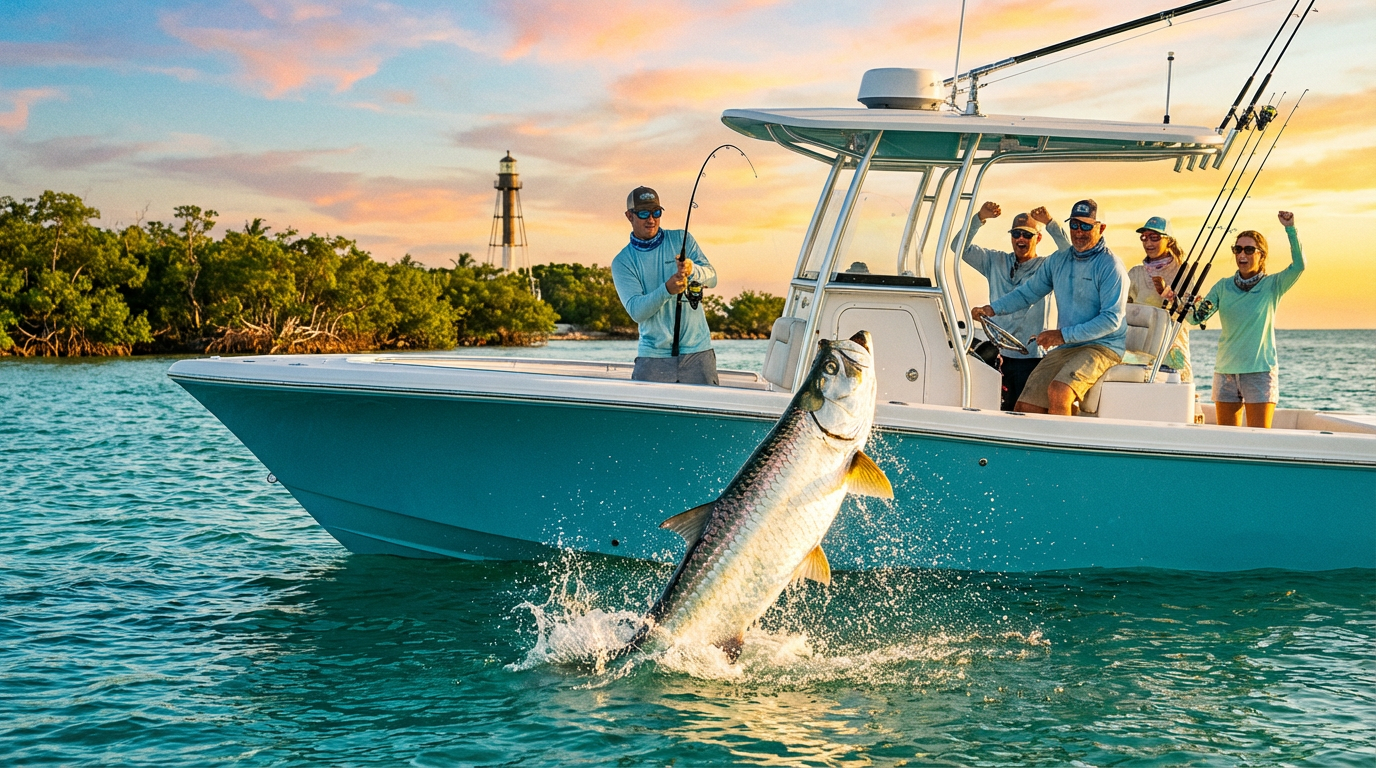
Organizing successful fishing excursions Florida starts with selecting the right vessel, which is often the difference between a cooler full of mangrove snapper and a frustrating day fighting the current. In Florida, where water conditions vary drastically from the glass-flat backwaters of the Ten Thousand Islands to the choppy Gulf Stream, the hull beneath your feet dictates where you can go and what you can catch. As a VisitFlorida Travel Partner, we often see visitors underestimate how specific boat designs impact their fishing excursions Florida. The choice is rarely just about budget; it requires matching the vessel's technical capability with the specific fishery you intend to target.
Exploring Types of Boats for Fishing Excursions Florida
Center Consoles vs Pontoons
For most serious anglers, the center console is the gold standard of Florida fishing boats. The primary advantage is 360-degree fishability; without a cabin or seating blocking the gunwales, you can follow a running tarpon or cobia around the entire perimeter of the boat. These vessels typically feature a deep V-hull design, allowing them to cut through the 2-to-3-foot chop frequently encountered in bays like Tampa or Biscayne during afternoon wind shifts.
Conversely, pontoon boats offer stability and square footage that V-hulls cannot match, making them excellent for leisurely family trips on calm bodies of water like the Caloosahatchee River. However, their flat, multi-hull design handles wave action poorly. We advise strictly against taking standard pontoon rentals into open ocean inlets or nearshore waters, as they can become difficult to maneuver in swift currents exceeding 3 knots. Pontoons are best utilized for "lazy" fishing—anchoring near a bridge piling or drifting live bait for spotted seatrout in protected zones. A critical, often overlooked factor is draft depth—the minimum depth of water a boat needs to float. If you plan to target redfish on the flats, a standard V-hull with an 18-inch draft will limit you to channels, whereas a technical skiff or a bay boat with a 10-to-12-inch draft allows access to the oyster bars where these predators hunt.
Spotlight on Performance The 21ft Mako Center Console
To provide a concrete example of a capable rental platform, we specifically look at the 21ft Mako Boat Rental Cape Coral. This vessel represents the ideal compromise for inshore and nearshore fishing excursions Florida. Unlike generic deck boats often marketed to tourists, this hull is purpose-built for angling. It features a specific draft of approximately 14 inches, allowing access to the shallow seagrass beds of Pine Island Sound while still possessing enough freeboard (gunwale height) to handle the chop of the Gulf of Mexico safely.
Renters often praise this specific setup for its integrated 30-gallon aerated livewell, a non-negotiable feature for keeping pilchards or threadfin herring alive during the summer heat. The Mako 21 also typically includes a T-top, providing essential shade for the center console unit—a minor detail that prevents instrument overheating and protects the captain from Florida's midday UV index of 11+. When comparing options, prioritize listings like this that explicitly mention "rod holders" (this model usually has 4-6 gunwale mounts) and "washdown" systems, rather than generic listings that prioritize Bluetooth speakers over fishing utility.
Guided Charters vs Self Drive Rentals
The distinction between captained charters and self-drive rentals fundamentally changes the nature of your trip. Self-drive rentals offer autonomy and privacy, perfect for competent boaters who want to explore at their own pace. However, Florida law is strict: according to the Florida Fish and Wildlife Conservation Commission (FWC), anyone born on or after January 1, 1988, must complete a boating safety education course to operate a vessel of 10 horsepower or more.
Captained charters alleviate this logistical burden. A licensed captain provides the boat, fuel, licensing, and high-quality tackle, which is a significant value add considering high-end rods and reels can cost hundreds of dollars to rent or buy. More importantly, you are paying for their intellectual property—years of logging specific GPS coordinates and understanding daily feeding windows. While a self-drive rental costs significantly less upfront (typically $300–$500 per day versus $600–$1,200 for a charter), the "cost per fish caught" is almost always lower on a guided trip due to the guide's localized expertise.
Comparing Costs and Rental Duration Options
Once you have identified the right vessel, the next step in planning your DIY adventure is navigating the complex pricing structures of Florida’s boat rental market. As a VisitFlorida Travel Partner, we often see visitors budget strictly for the daily rental rate, only to be blindsided by ancillary fees at the dock. The total cost of fishing excursions Florida is rarely just the sticker price; it is a combination of duration, fuel consumption, and seasonal demand.
Understanding Rental Tiers and Duration Value
Most outfitters in key fishing hubs like Key West, Pontoon Boat Rental Panama City locations, or the Stuart inlet prioritize two main rental windows: the half-day (4 hours) and the full-day (8 hours). While the half-day option—typically ranging from $250 to $450 depending on the vessel—seems like a budget-friendly entry point, it presents specific logistical challenges for anglers.
A standard morning slot (8:00 AM to 12:00 PM) is highly competitive because it capitalizes on the coolest temperatures and generally calmer winds. Conversely, the afternoon slot (1:00 PM to 5:00 PM) is often easier to book but riskier; experienced Florida captains know that afternoon thunderstorms during the summer months are clockwork events. According to weather data from the National Weather Service Tampa Bay, sea breeze collisions trigger thunderstorms in 40-60% of summer afternoons. Generally, paying the premium for a full-day rental—averaging $450 to $800+—insulates your investment. It grants you the flexibility to wait out a passing squall without losing your entire window or to ride out a tide change if the fish aren't biting in the morning.
Calculating the Hidden Fuel Surcharge
The single most underestimated cost in rental boating is fuel. Unlike picking up a rental car with a full tank and topping it off at a roadside store, marine fuel is almost exclusively purchased at marina pumps, where prices historically run $1.00 to $1.50 higher per gallon than street averages due to environmental compliance taxes and lack of competition. Renters must account for this "dock tax" in their budget.
The cost equation depends entirely on your itinerary and the boat's horsepower (HP). A 24-foot center console running a 250HP Yamaha outboard does not sip fuel; at cruising speed (approx. 3500-4000 RPM), it can burn between 8 and 12 gallons per hour. If your plan involves running 15 miles offshore to bottom fish, you are looking at significant consumption compared to drifting a bay in a pontoon with a 60HP engine. We advise renters to budget an additional 15% to 20% on top of the base rental rate for fuel. Always ask the dockmaster for the vessel's estimated GPH (Gallons Per Hour) at cruise speed before leaving the dock so you can regulate your throttle usage accordingly.
Navigating Seasonal Price Fluctuations
Florida’s rental market utilizes dynamic pricing similar to airlines. The "high season" is dictated by two factors: human migration (Spring Break, Winter holidays) and fish migration. For example, during the world-famous tarpon migration along the Gulf Coast (roughly April through June), demand for seaworthy center consoles skyrockets. Rentals in areas like Boca Grande or Islamorada can see price hikes of 20-30% during these windows.
Additionally, specific recreational seasons create micro-spikes in pricing. The most notable is the Spiny Lobster Sport Season (Mini-Season) in late July. During this 48-hour window, availability drops to near zero, and prices peak. For the best value on fishing excursions Florida, seasoned anglers target the "shoulder seasons"—specifically late September through November. During this time, the summer crowds have dispersed, the FWC regulations for several snapper species remain open, and rental rates often soften by 10-15%.
Party Boats vs Private Rentals Value Analysis
When analyzing costs per person, the decision often comes down to autonomy versus convenience. A ticket on a drifting "head boat" (party boat) typically costs between $65 and $85 per person for a half-day. This includes bait, tackle, and license coverage. For a solo angler or a duo, this is the most economical path.
However, the math shifts rapidly for groups of three or more. A group of four paying $85 each on a head boat spends $340 total. For roughly the same price (plus fuel), that group could rent a private 20-foot bay boat. The trade-off is clear: the head boat offers zero effort but places you elbow-to-elbow with 40 other strangers, often leading to tangled lines and limited fishing spots. The private rental requires you to act as captain and guide, but it offers the freedom to chase surface-feeding schools or move spots instantly if the bite is cold—a strategic advantage that often yields better results for competent anglers.
Essential Rigging and Outfitting and Critical Rental Features
Selecting the correct hull is only half the battle; the specific rigging of a rental vessel determines whether you spend your day fishing or merely boating. As a VisitFlorida Travel Partner, we have fielded countless calls from renters who booked a standard runabout assuming it was "fishing ready," only to find themselves holding rods for six hours because the boat lacked gunwale mounts. For successful fishing excursions Florida, you must audit the amenities list with the scrutiny of a surveyor.
Navigating Florida’s unique waterways—from the mangrove mazes of the Everglades to the limestone ledges of the Atlantic—requires specialized tools that go beyond basic Coast Guard compliance. The most critical component for Florida saltwater angling is the live well. In our warm subtropical waters, a simple bucket of water will kill pilchards or shrimp in less than 20 minutes due to oxygen depletion and rising temperatures.
You need to verify the vessel includes an aerated or recirculating live well with a high-flow pump. A 15-to-30-gallon capacity is standard for center console rentals, which is sufficient to keep three dozen pinfish or a few scoops of whitebait lively for a full morning tide. Furthermore, examine the rod holder situation. A proper layout includes flush-mounted gunwale holders for trolling baits effectively. We recommend looking for rentals that offer a dedicated bait prep station or at least a cutting board insert; cutting frozen squid directly on gel-coat fiberglass is a surefire way to lose your damage deposit.
Visual navigation is often insufficient in Florida, where shifting sandbars in passes like Mosquito Lagoon or fluctuating tides can turn safe water into a grounding hazard within hours. According to the National Oceanic and Atmospheric Administration (NOAA), electronic charts are vital for situational awareness. Do not rely on your smartphone’s mapping apps; cellular service is notoriously spotty just a few miles offshore. Most premium rentals now come equipped with combined GPS/Chartplotter and Fishfinder units (like Garmin or Simrad systems). Verify with the rental outfitter that the unit is unlocked and includes detailed coastal charts, not just a generic basemap.
Evaluating Rental Companies and Their Fleets
A critical, often overlooked component of planning successful fishing excursions Florida is vetting the specific rental outfit behind the vessel. In high-density boating hubs like Cape Coral, Destin, and the Florida Keys, the sheer volume of providers—ranging from established marinas to peer-to-peer apps—can be overwhelming. Based on our operational experience coordinating rentals since 2018, we find that the difference between a seamless trip and a logistical nightmare often hinges on the provider's maintenance rigor and transparency.
Before booking, travelers should scan reviews for specific keywords like "breakdown," "tow," or "battery issues." In saltwater environments, mechanical degradation accelerates rapidly; a fleet that isn't flushed and serviced weekly becomes a liability. We recommend specifically asking providers about the age of their outboard motors. A hull might be a decade old, but reliable operators will typically repower their vessels every 2,000 to 3,000 hours. If a rental company in Marathon or Islamorada cannot confirm the age of their engines, consider it a red flag for your safety and your fishing timeline.
Beyond the engine, the condition of the underwater gear is the most frequent point of contention between renters and companies. Insider data suggests that over 60% of damage deposit disputes in Florida arise from propeller and skeg damage. To protect your wallet, conduct a pre-departure inspection with the dockmaster. Do not simply walk around the deck; tilt the engine up and photograph the propeller blades and the skeg (the bottom fin of the motor) before leaving the dock. Pre-existing dings here are common, and without photographic proof, you could be liable for a $300 prop repair upon return.
Analyzing Customer Reviews for Boat Rentals
While a shiny website and professional photos can sell a dream, the user-generated reviews usually tell the reality of the experience on the water. In our years operating as a VisitFlorida Travel Partner, we have found that the aggregate star rating is often less important than the specific narrative details hidden within the text of three and four-star reviews. When planning fishing excursions Florida, looking past the accolades to identify operational patterns is crucial for safety and satisfaction.
What to Look For in Feedback
A five-star review saying "had a great time" offers far less utility than a three-star review detailing exactly how the livewell pump failed halfway through the day. In the granular analysis of rental reviews, mechanical reliability should be your primary filter. Florida’s saltwater environment is notoriously corrosive, and a rental fleet requires rigorous preventative maintenance that some operators neglect.
When scanning platforms like TripAdvisor or Google Maps, use the search function within the reviews section to look for keywords such as "stalled," "battery," "anchor," and "overheat." A pattern of complaints regarding hard-starting engines or dead batteries often indicates an operator stretching the lifespan of their equipment beyond safe limits. For anglers specifically, pay close attention to mentions of the "livewell" or "bait tank." We frequently see visitors overlook this, only to find themselves with a boat full of dead shrimp because the aerator pump was corroded. If verifiable reviews mention distinct disputes over "prop damage" that the renter claims was pre-existing, it is safer to book elsewhere.
Common Renter Feedback and Testimonials
From analyzing thousands of rental transactions, a clear divide exists between satisfaction with center consoles versus pontoons for fishing. Renters of vessels like the Mako 21 or Pathfinder 22 frequently highlight the "ease of cleanup" and "stability in the passes" as major positives. One recurring testimonial theme for these fishing-specific hulls is the value of the T-top; users consistently note that without the extended shade, a full 8-hour day would be unbearable in July. Conversely, negative feedback often stems from renters booking pontoons for fishing trips in open water, citing "wet rides" and "difficulty anchoring" in swift currents. The takeaway is clear: book the hull that matches the water conditions, not just the passenger count.
Navigating the Rental Process and Documentation
Securing a vessel involves far more than simply swiping a credit card at the marina. In our experience coordinating rentals across the state, the administrative phase is where unprepared anglers most often encounter friction. We recommend finalizing reservations at least 14 to 21 days prior to your intended date, particularly for high-demand windows like red snapper season.
Licensing and Legal Requirements
The most common hurdle for visitors arriving for fishing excursions Florida is the state's boating safety requirement. Contrary to popular belief, Florida does not issue a "boating license." Instead, the FWC mandates that anyone born on or after January 1, 1988, must successfully complete an approved boating safety course to operate a vessel with a motor of 10 horsepower or more. If you fall into this age bracket, you can take a condensed exam on-site for a temporary certificate, usually costing around $10 and valid for 90 days. However, we strongly advise completing a NASBLA-approved online course before your trip to save time at the dock.
Insurance Deposits and Waivers
Rental fleets carry commercial insurance, but these policies generally protect the business from catastrophic liability, not your personal wallet from minor damages. Before handing over the keys, you will sign a liability waiver and a rental agreement. Read the section on "consequential damages" carefully. Most standard waivers explicitly exclude propeller and lower unit damage from coverage. In the shallow flats of places like Mosquito Lagoon, a single prop strike on an oyster bar can cost between $200 and $600 for a replacement.
Most operators will place a pre-authorization hold on your credit card—often termed a "security deposit"—ranging from $500 to $2,500 depending on the vessel's value. This hold is released upon the safe return of the vessel, but it can tie up vacation funds for 3-5 business days. According to Travel + Leisure, clarifying the timeline of this deposit release during check-in is essential for financial peace of mind.
Top Destinations for Fishing Excursions Florida
Choosing where to trailer or rent your boat is as critical as selecting the tackle you bring. Florida’s geography creates two distinct fishing realities: the Atlantic coast, where the continental shelf drops sharply, and the Gulf coast, which features a long, gradual slope. Visitors planning fishing excursions Florida near Fort Lauderdale or Miami often seek the "Sailfish Alley" experience, where depths exceeding 500 feet are accessible just two to three miles offshore.
Cape Coral and Southwest Florida
Located in Lee County on the Gulf of Mexico, Cape Coral presents a complex labyrinth of waterways that offers a stark contrast to the open Atlantic. With over 400 miles of navigable canals, this area acts as a massive nursery for inshore gamefish. For DIY boaters, the extensive canal system provides a distinct advantage: fishable water regardless of wind conditions. We specifically recommend launching or renting from Tarpon Point Marina or Cape Harbour in the southeast quadrant. These locations provide the quickest access to the Caloosahatchee River mouth, minimizing the time spent idling through no-wake zones. However, navigating here requires vigilance; strict seasonal manatee zones are enforced by FWC, and ignorance of these slow-speed regulation signs frequently results in fines exceeding $90 for tourists.
The Florida Keys Backcountry
Driving south to the Florida Keys introduces a unique ecosystem defined by clarity and coal. For those planning fishing excursions Florida in the Keys, the primary draw is often the "backcountry" flats on the Bayside (Florida Bay). Here, vast shallow meadows of turtle grass hold bonefish, permit, and tarpon. A crucial operational note for renters: the water here is often less than two feet deep. Grounding a vessel in these protected seagrass beds is a federal offense causing environmental damage that takes decades to heal. We advise first-time visitors to utilize mapping electronics with high-resolution shading to identify channels and to always carry a push-pole if renting a skiff.
Myth Busting Common Misconceptions About Rentals
After years of helping visitors navigate Florida's waterways, we frequently encounter hesitation surrounding self-guided boating. A tangible "fear of the unknown" often pushes competent boaters toward expensive charters when they are fully capable of captaining their own adventure. While respect for the ocean is mandatory, many fears regarding DIY boat rentals are rooted in outdated information. As a VisitFlorida Travel Partner, we aim to dismantle these barriers with hard data and local reality, ensuring your next adventure is based on capability rather than apprehension.
Myth 1 Without a Captain You Will Not Catch Fish
The most pervasive myth is that fish are impossible to locate without a professional guide. While a captain certainly shortens the learning curve, modern technology has significantly leveled the playing field. Most fishing-specific rentals in our fleet come equipped with integrated GPS and fish finders—typically Garmin or Simrad units—that display bottom topography and structure clearly. Florida’s ecosystems are often visually readable. In areas like the Florida Keys, polarized sunglasses allow you to spot sea grass beds where Spotted Seatrout and Redfish congregate.
Myth 2 Florida Waters Are Too Complex to Navigate
Visitors often fear running aground on Florida's shifting sandbars. In reality, modern rental fleets have largely mitigated navigation risks through technology. Most vessels are equipped with chart plotters pre-loaded with "safe tracks" from previous trips. Additionally, mobile apps like Navionics and NOAA charts provide real-time depth shading. The primary challenge isn't getting lost; it is respecting the tides. A local tip most people overlook: navigation is easiest on a rising tide—if you touch bottom, the water will eventually lift you off.
Myth 3 Rentals Lack Necessary Equipment
Skeptics often assume rentals are bare-bones hulls, but the market has shifted toward specialized equipment. High-quality center console rentals now standardly feature aerated live wells—essential for keeping pilchards or shrimp lively—along with extensive gunwale rod holders and raw water washdowns. However, the vessel itself—often a 22-foot pathfinder or similar hull—is mechanically identical to what many inshore guides use. You are renting the platform and the access, designed and outfitted for fishing excursions Florida.
Myth 4 Renting is More Expensive Than a Charter
This misconception stems from comparing the total cost of a boat rental against a single ticket on a "head boat" (party boat). When analyzed per person for a small group, the math heavily favors renting. A private 4-hour inshore charter for four people typically ranges from $720 to $1,080 total (including tip). A full-day rental of a 21-foot center console averages between $410 and $650 (including fuel). The rental option is roughly 40% cheaper for the group and offers double the time on the water.
Related Experiences
Homosassa Airboat & Wildlife
Explore the shallow backcountry of Crystal River on an airboat—perfect for scouting shallow water terrain you might not reach by standard prop boat.
Rainbow River Kayak Adventures
Experience the crystal clear springs of Central Florida. A great alternative day trip for seeing fish in high-visibility freshwater environments.
Florida Airboat Safari - Orlando
Discover the headwaters of the Everglades near Orlando. See the wild side of Florida's freshwater ecosystem up close.