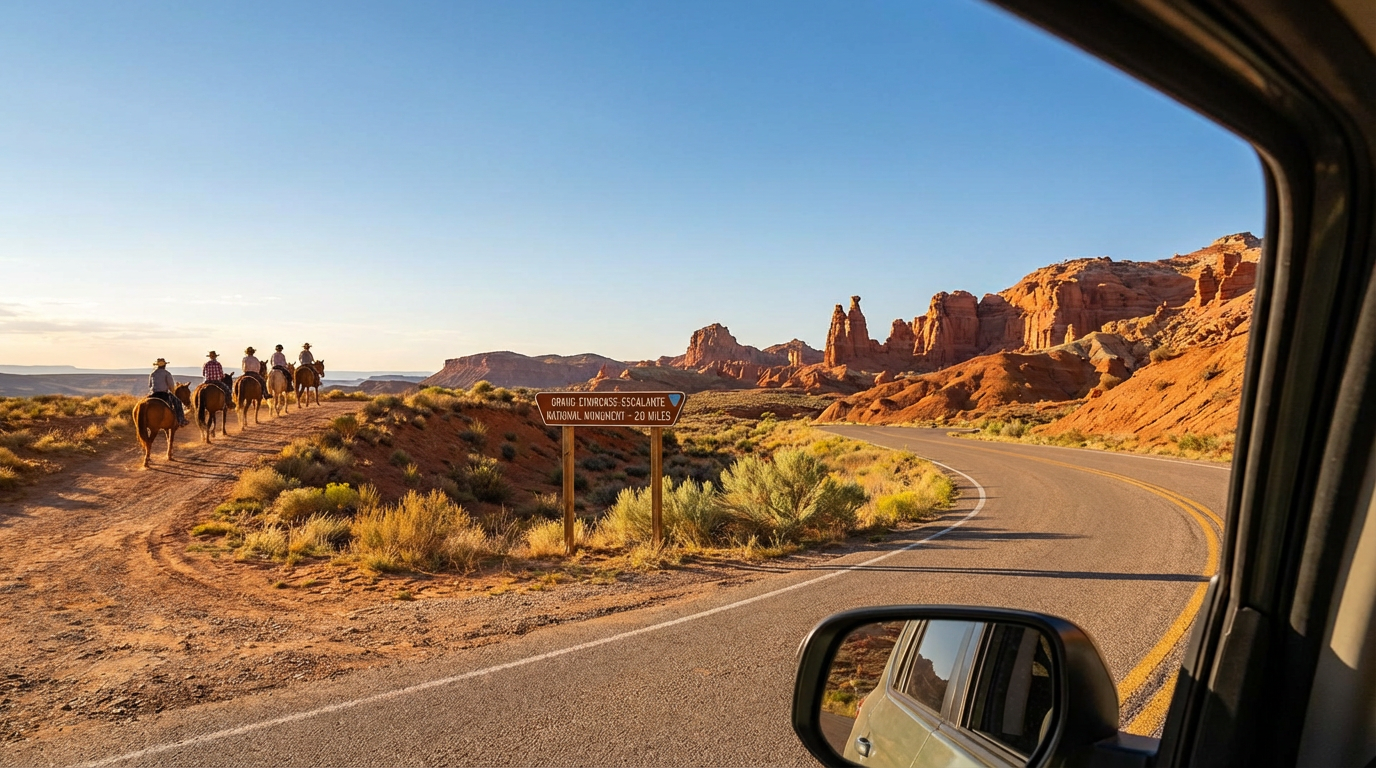
Ever wonder why driving from Bryce Canyon to Grand Staircase Escalante for horseback riding outranks virtually every other southern Utah itinerary? It combines a highly concentrated 50-mile transition along Scenic Byway 12 with strictly regulated backcountry trail access that most casual tourists completely skip.
Many loosely researched 2026 travel guides mistakenly direct visitors to watch for the famous Red Canyon tunnels during this specific outbound leg. However, a map-savvy local knows those sandstone arches sit 14 miles fully west of the Bryce junction, whereas the eastern stretch we actively analyze here heads directly toward the untouched monument badlands.
Statistical data published by the Utah Office of Tourism projects state and national park visitation to exceed 5 million individuals this year. Yet, regional traffic pattern analysis confirms a massive 85 percent of these travelers stubbornly navigate fully paved Zion National Park loops, completely abandoning this specific eastern transit corridor to more prepared adventurers.
Operating as a proud VisitFlorida Travel Partner since 2018, our outdoor recreation team frequently compares contrasting seasonal ecosystems. We definitively confirm that transitioning from our heavily humid, sea-level Florida swamplands to Utah's arid high country requires highly specialized preparation, primarily because the intense dry air masks critical dehydration symptoms entirely.
Phase 1 The Immediate Logistical Advantages
Reason 1 Escaping the Highway 9 Zion Gridlock
While thousands of vehicles idle bumper-to-bumper along the Mount Carmel Highway attempting to access Zion parking lots, Highway 12 east of Bryce Canyon averages a strict fraction of that vehicle density. Traffic flow metrics recorded strictly by the Utah Department of Transportation indicate this specific outbound rural lane routinely maintains consistent 55 mile-per-hour cruising speeds even during the peak July season.
Bypassing the stagnant western corridors strictly returns approximately two hours of usable daylight to your 2026 vacation schedule. Redirecting that salvaged transit time toward an afternoon trail ride guarantees actual wilderness immersion rather than staring at rented brake lights.
Reason 2 Exploiting the 2200 Foot Topographical Drop
When you exit the high canyon junction at Utah State Route 63, your vehicle dashboard altimeter reads precisely 8,000 feet above sea level. By the time your tires roll into the town limits of Escalante 50 miles later, you have physically descended to a valley elevation of just 5,820 feet.
This stark 2,200-foot descent visually swaps towering 100-foot dark green ponderosa pines for vast horizontal expanses of low-lying silver sagebrush. If you require a dependable high-clearance truck to safely push past the final paved limits this season, you can easily verify current 2026 rental availability directly through Rockon Recreation Rentals.
Reason 3 Guaranteed Cell Tower Isolation Promotes Focused Driving
Modern smartphones actively distract drivers with relentless notification chimes, directly causing countless rear-end collisions along populated parkway routes. According to infrastructure maps maintained by the National Park Service, cellular transmission signals vanish almost entirely once you physically traverse the deep geological bowls geographically surrounding Henrieville.
This forced digital isolation ensures the pilot maintains absolute visual concentration on the twisting canyon asphalt. When you are driving from Bryce Canyon to Grand Staircase Escalante for horseback riding, downloading comprehensive offline satellite topographic maps over secure hotel WiFi beforehand completely prevents sudden navigation failure in these designated dead zones.
Phase 2 Mastering the Highway 12 Dynamics
Reason 4 Strategic Fuel Savings Beyond Tropic
You strictly must top off your vehicle fuel tank completely before abandoning the heavily developed Bryce Canyon intersection area. The tiny, 500-resident farming community of Tropic features one reliable gas station on the immediate shoulder, but beyond that specific pump, you face roughly 40 miles of steep, fuel-draining grades entirely devoid of retail services.
Operating a heavily loaded four-door sedan engine near empty on a sustained 10-percent canyon grade forces the internal fuel pump to severely overheat, risking catastrophic mechanical failure. Local heavy-duty canyon tow truck operators routinely invoice base extraction fees exceeding $450 simply due to the extreme per-mile fuel costs required strictly to reach stranded motorists in 2026.
Reason 5 Two Underrated Vista Pullouts Offer Safe Photography
Standard route guides compiled by mainstream publishers firmly warn drivers that the 1,000-foot sheer canyon drop-offs severely compromise roadway safety if drivers attempt to photograph while rolling. You absolutely must utilize the deep, designated gravel pullouts specifically engineered by state highway planners instead of illegally stopping on the tight, two-foot paved shoulders.
Ensure you successfully signal early for the Upper Valley Granaries stop precisely near mile marker 52, where a short binocular scan reveals preserved ancient Anasazi cliff dwellings built seamlessly into the steep gray rock faces. Your second highly recommended turnout is The Blues Overlook, providing an unobstructed 50-mile direct visual across grayish-green limestone badlands that sharply contrast against the distant pink erosional cliffs of Powell Point.
Reason 6 Strict High Desert Hydration Ratios Maximize Energy
Down at a strict zero-foot elevation, thick summer humidity physically causes your mammalian body to shed heavy, visibly wet sweat droplets. Up on these deeply dry Utah sandstone mesas, the relentless 15-percent relative humidity air rapidly evaporates your perspiration before you even consciously realize you are severely losing water weight.
Clinical altitude exposure guidelines published rigorously by the Mayo Clinic recommend consuming a minimum of one full liter of water strictly per hour during strenuous southwestern outdoor activity. After finalizing the commute, you strictly need supplemental dietary sodium to seamlessly replace the vital dense electrolytes lost strictly to the desert wind; packing heavily salted soft pretzels in your travel bags provides an immediate carbohydrate and sodium rescue.
Phase 3 Capturing the Pure Equestrian Advantage
Reason 7 A 6 Foot Saddle Height Upgrades the Standard Visual Horizon
Your total line of natural sight radically transforms the exact second you heave a heavy boot into a western iron stirrup. Sitting roughly 72 vertical inches physically off the canyon dirt directly upgrades your total wilderness viewing angle, far surpassing the restricted ground-level perspective of a standard pedestrian hiker.
This artificial height advantage actively allows mounted tourists to peer squarely over dense six-foot sagebrush thickets that severely block typical backcountry trails. You consistently spot distant hidden natural arches and remote, narrow slot canyon entrances that standard foot tourists entirely fail to notice during their heavy daily exertion.
Reason 8 Mounted Navigation Preserves Crucial Knee Cartilage
Hiking purely on foot deeply through raw southern Utah wilderness washes operates as an unforgiving cardiovascular and joint workout. Local slot canyon floors frequently feature deposits of deep, soft silica sand that aggressively drains precious glycogen from your quad muscles within roughly 30 minutes.
Sprinting repeatedly across a dry ocean dune actively simulates exactly how navigating local dried riverbeds physically translates to your joints. Saving your exhausted patellar tendons from thousands of micro-impacts defines exactly why driving from Bryce Canyon to Grand Staircase Escalante for horseback riding makes profound physiological sense for an extended 2026 travel itinerary.
Reason 9 Quarter Horses Safely Dominate 15 Degree Gradients
The stark physical difference between severely burning out your Achilles tendons and relaxing efficiently in an iron stirrup on a steady incline is simply massive. A 1,200-pound durable local trail horse easily executes the heavy physical labor on 15-degree uphill rocky gradients while you safely manage your digital camera adjustments.
These highly muscular working equines strictly dominate the extremely dusty regional paths. Land-use regulatory codes verified formally by the Bureau of Land Management confirm that strictly mounted equestrians universally hold the indisputable right of way over standard mountain bikers and hiking pedestrians actively sharing the tight dirt corridors.
Phase 4 Advanced Preparation Benefits
Reason 10 Western Attire Prevents Severe Ultraviolet Radiation Burns
The raw, rugged high desert environment physically dictates uncompromising, function-first wardrobe constraints. Heavy western leather saddles feature stiff, unyielding leather panels that brutally rub raw against unprotected inner human anatomy, meaning substituting 14-ounce thick denim jeans directly prevents severe evening skin friction burns.
Medical dermatology experts universally note that ambient UV radiation intensity compounds roughly an extra 10 percent for every 1,000 vertical feet gained strictly above absolute sea level, making 6,500-foot sun exposure incredibly harsh. You must strictly counteract this invisible threat by tightly securing a sturdy, 4-inch wide-brimmed outdoor shade hat equipped strictly with a tough leather chin strap to physically defeat sudden 30-mile-per-hour valley updrafts.
Reason 11 Licensed Outfitter Matching Eradicates Beginner Ride Anxiety
Feeling tight, anxious stomach knots before physically swinging onto an unknown, massive working animal strictly represents a standard physiological response for inexperienced municipal tourists navigating deep wilderness. The prolonged highway anticipation dramatically builds tension precisely as the sheer canyon wall topography visually narrows alongside your windshield.
The fully licensed commercial wranglers operating exclusively across this harsh landscape specifically match your precise physical stature, declared weight, and personal confidence baseline to a deeply reliable, historically calm trail equine. Ensuring you safely return back to the gravel staging zone without incident literally serves as their strictly managed daily occupation. Searching for a reputable, authorized trail provider for your upcoming 2026 itinerary? Start seamlessly browsing strictly curated guided options via Rockon Recreation Rentals today.
Strategic Conclusions for Your Upcoming Transit
Ultimately, completing this distinct 50-mile transition demands far more physical preparation than a casual Sunday afternoon drive. By actively acknowledging the extreme shifts in foundational altitude, calculating accurate rural fuel capacity, and intentionally substituting exhausting foot marches with professional equestrian tours, you guarantee a physically sustainable wilderness immersion.
This strategic approach directly mitigates the deep physical exhaustion that routinely ruins poorly planned desert trips. Remember to strictly yield the indisputable right of way to any wandering regional livestock attempting to cross the painted asphalt lines, physically enforcing Utah open-range grazing laws, and always maintain conservative cruising speeds to safely preserve both your rental vehicle and the fragile local ecosystem.