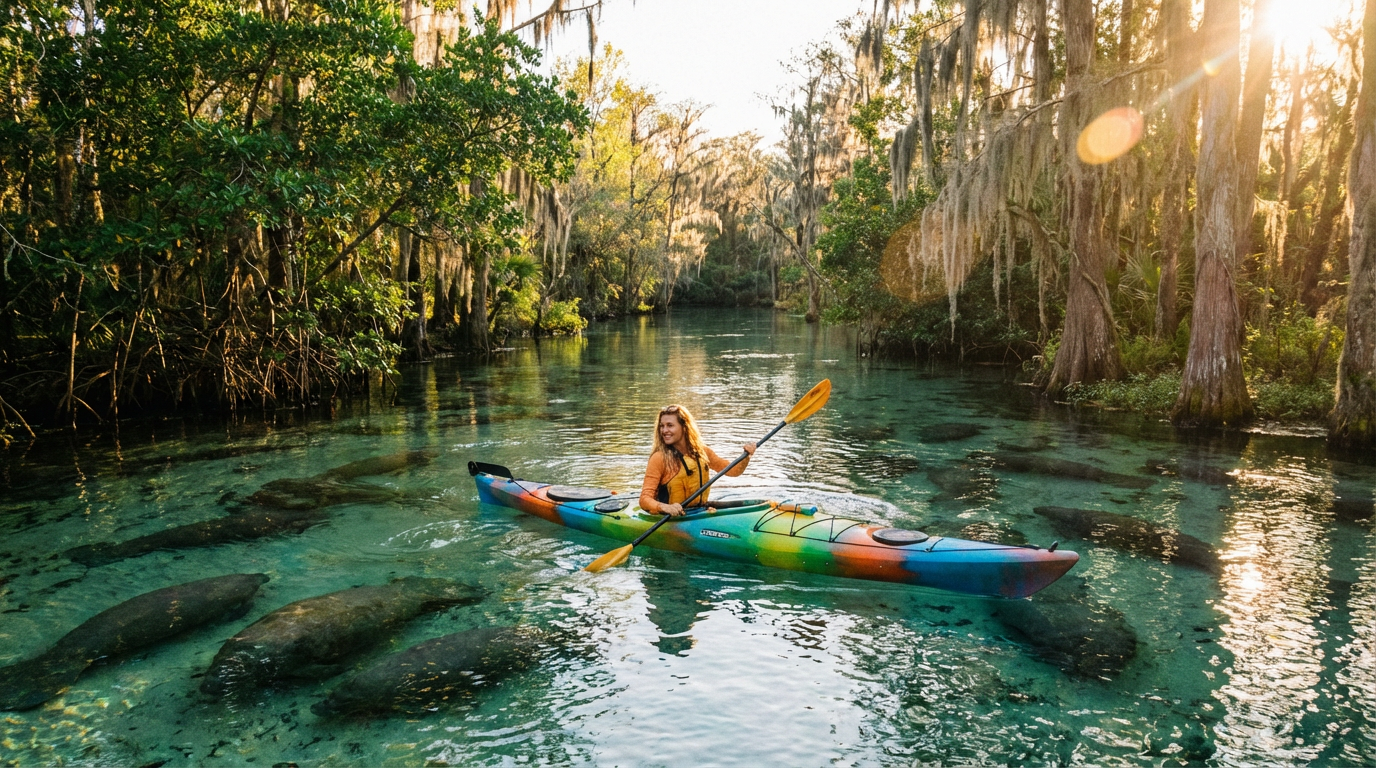
Planning a trip for kayaking in Florida reveals that the state's waterways are deceptive. To the uninitiated, a rental seems straightforward: pay, paddle, and return. But after coordinating launch logistics from the Panhandle to the Keys since 2018, we have seen how small logistical miscalculations—from hull choice to tide timing—can turn a dream vacation into an exhausting ordeal.
Too often, visitors arrive expecting a casual drift, only to find themselves battling strong currents in a vessel ill-suited for the environment. Before you book your excursion, consider these critical factors that often go overlooked but determine the success of kayaking in Florida.
Selecting the Perfect Vessel for Kayaking in Florida
Choosing the right watercraft is not merely about comfort; it is a critical safety decision dictated by Florida's unique hydrography. With over 1,700 miles of rivers and widely varying coastal conditions, the equipment that works for a calm paddle in the Ichetucknee Springs may be dangerous in the tidal currents of the Jupiter Inlet.
Most visitors assume any plastic hull will suffice. However, distinct regional differences in water temperature, salinity, and current strength demand specific hull designs to ensure safety and enjoyment.
Sit on Top Versus Sit Inside Designs
For the vast majority of paddling trips in the Sunshine State, sit-on-top (SOT) kayaks are the superior choice. This preference creates a cooler experience during Florida's sweltering summers, where ambient temperatures frequently exceed 90°F with high humidity. A traditional sit-inside kayak often functions like a greenhouse, trapping body heat and becoming uncomfortably hot within minutes of launching.
This is particularly relevant for Atlantic coast destinations like Kayaking Cocoa Beach, where surf launches are common and the self-draining capability of SOTs is essential. Beyond thermal management, safety is the primary driver for choosing SOTs in coastal environments.
These vessels feature scupper holes—self-bailing drains that prevent the boat from swamping if a wave crashes over the bow. According to safety guidelines referenced by the American Canoe Association, SOTs are safer for novices because re-entry from deep water is significantly easier compared to sit-inside models. As a standard of safety, Rockon Recreation Rentals prioritizes partnerships with outfitters providing sit-on-top models for coastal excursions to mitigate these risks.
Maximizing Visibility with Clear Bottoms
Clear kayaks—constructed from durable polycarbonate materials similar to bulletproof glass—have transformed kayaking in Florida, particularly within the freshwater spring systems. In locations like Silver Springs or Weeki Wachee, where water clarity creates visibility of 100 feet or more, these vessels essentially turn your paddle trip into a dry snorkeling session.
They are indisputably the best option for spotting West Indian Manatees, river otters, and intricate limestone formations without getting wet. For a different kind of visibility, bioluminescent tours or the unique kayak rental orlando – Explore Ivanhoe Lake at Night offer a surreal nocturnal perspective distinct from the daytime springs.
However, travelers should understand the mechanical trade-offs. Clear kayaks typically lack the tracking fins (skegs) found on performance touring boats. This means they require more correctional strokes to keep straight, especially in windy conditions. They are also heavier and wider to prevent tipping, which increases drag.
Stability Factors for Anglers and Novices
When targeting game fish like Snook or Redfish, or simply navigating as a beginner, hull width (beam) is the metric that matters most. A standard recreational kayak generally measures between 28 and 30 inches wide, offering a balance of speed and stability. Fishing kayaks, conversely, often exceed 32 to 34 inches in beam width.
This "barge-like" stability allows anglers to stand up for sight-casting without capsizing, a necessary feature when fishing the shallow grass flats of the Gulf Coast. For beginners navigating the Intercoastal Waterway (ICW), favoring a wider hull is advisable. The Florida Fish and Wildlife Conservation Commission emphasizes that falls overboard are a leading cause of paddling incidents; selecting a stable, wider platform significantly reduces this likelihood.
Understanding Rental Prices and Duration Options
Once you have identified the safe hull for your environment, the next potential pitfall lies in the rental contract itself. Budgeting for a paddling excursion involves more than simply checking the sticker price on a website. As a locally based VisitFlorida Travel Partner, we have observed that many visitors underestimate the logistical realities of Florida's waterways.
When planning for kayaking in Florida, understand that rental structures vary significantly between state-run concessions and private outfitters. The cheapest hourly rate often results in the most rushed experience.
Hourly Versus Daily Rate Structures
Most outfitters in Florida operate on a tiered pricing model where the cost per hour decreases dramatically the longer you rent. A standard single-kayak rental typically starts between $25 and $45 for the first hour. However, extending that to a four-hour or "full-day" rental often costs only $15 to $20 more than a two-hour booking.
For example, paddling the extensive "Venice of America" canal system in Fort Lauderdale is technically possible in an hour, but physically you will barely leave the launch zone. Reaching the calm residential inlets of Las Olas or the scenic sandbars requires at least three hours of paddle time. Visitors typically fail to account for the transit time against the current.
In spring runs like Rock Springs Run or the Ichetucknee, the paddle upstream to the headsprings can take 60 to 90 minutes of strenuous effort. If you book a two-hour rental, you will spend 75% of your time fighting the current. Rockon Recreation Rentals advises opting for a half-day (4-hour) minimum for any spring run to ensure the experience is leisurely rather than an athletic endurance test.
Seasonal Pricing Factors
Unlike northern destinations where summer commands peak pricing, Florida's rental market follows the "snowbird" and academic calendars. The highest demand—and often the strictest pricing—occurs from late December through April. During Spring Break (March), inventory in hotspots like Key West or Crystal River can sell out weeks in advance, and dynamic pricing models may result in rate increases of 20-30%.
Conversely, the summer months (June through September) are technically the "off-season" for many coastal outfitters due to the intense heat. While base rates may be lower, the window of availability shrinks due to reliable afternoon thunderstorms. According to climate data from Florida's National Weather Service offices, sea breeze storms develop abruptly between 2:00 PM and 4:00 PM across the peninsula. Smart renters book morning slots (8:00 AM to 12:00 PM) to avoid losing rental time to lightning delays.
Deposit and Cancellation Policies
A critical oversight for many renters is the security deposit requirement. Because modern fishing kayaks and clear-bottom vessels can cost upwards of $1,500, operators almost universally require a credit card hold or a cash deposit ranging from $200 to $500 per vessel. This is a temporary hold, not a charge, but using a debit card can result in those funds being frozen in your checking account for 3 to 5 business days.
Regarding cancellations, the "Florida Weather Guarantee" is widely misunderstood. Most reputable outfitters will not refund a booking simply because it is overcast. Refunds are typically triggered only by "unsafe marine conditions," such as lightning within 5 miles or Small Craft Advisories. Always check if the operator offers a "rain check" policy, which allows you to reschedule the credit for up to a year—a standard practice for partners listed on Rockon Recreation Rentals.
Essential Activities and Amenities Included in Rentals
Beyond the base rental fee, the specific inclusions usually determine the safety and enjoyment of the trip. When booking a paddle, many visitors mistakenly assume the fee covers only the plastic hull and a paddle. However, the operational landscape of kayaking in Florida is far more comprehensive.
A typical rental agreement is actually a service bundle designed to mitigate risks, from sudden thunderstorms to navigational complexity. Understanding exactly what is included—and what often requires an upsell—can prevent dangerous situations, such as being stranded five miles downstream without a shuttle.
Standard Safety Gear Inclusions
Legally compliant outfitters do not view safety gear as optional. According to the Florida Fish and Wildlife Conservation Commission (FWC), every specialized craft must have a United States Coast Guard (USCG) approved personal flotation device (PFD) for each person on board, plus a sound-producing device like a whistle.
However, the type of gear matters significantly in Florida's climate. While basic operations may provide the orange "horse-collar" Type II vests, experienced local outfitters often supply Type III paddling vests. Type II vests can be suffocating in 90-degree heat, leading many novice paddlers to dangerously remove them. Type III vests are designed with wider armholes and breathable mesh specifically to prevent heat exhaustion. Furthermore, while the law requires PFDs to be accessible for adults, children under six years of age must wear them at all times while the vessel is underway.
Premium Add-Ons Available
Beyond the legal minimums, the specific nature of Florida's aquatic environments often necessitates specialized equipment. For excursions into the freshwater springs—such as the crystalline waters of Weeki Wachee or Rainbow River—snorkeling gear is frequently available as a premium add-on or sometimes included in clear kayak packages.
The clarity of these waters offers visibility up to 100 feet. This makes a mask and snorkel essential for observing the submerged limestone formations and manatees that make kayaking in Florida unique. Another critical amenity is the "dry bag." While experienced paddlers bring their own, many rental locations offer 10-liter or 20-liter dry bags for rent. For expensive electronics, visitors should consider bringing their own dedicated waterproof cases or double-bagging items inside the rental dry bag.
Guided vs Self-Guided Support
The choice between a guided tour and a self-guided rental often comes down to logistics rather than skill level. Many of Florida's most scenic runs act as "conveyor belts"—strong currents push paddlers downstream, making an upstream return trip physically exhausting. Consequently, shuttle services are a vital component of the rental fee for one-way runs like Rock Springs Run or the Santa Fe River.
When you book a self-guided rental on these linear rivers, the service typically includes a drop-off at the launch point and a scheduled pickup downstream. It is crucial to verify this, as ride-share services like Uber are often unavailable in remote launch zones due to poor cellular reception. Conversely, guided tours provide ecological interpretation and safety oversight. According to the National Park Service, guided options are strongly recommended for complex ecosystems like the Ten Thousand Islands. For example, an Everglades Boating Kayaking and Walking Ecotour ensures you navigate the maze of mangroves safely with an expert naturalist.
Navigating the Booking Process and Required Documentation
Even with the right gear and price locked in, your trip can end at the check-in desk if the correct documentation is missing. While the allure of Florida's waters is undeniable, the administrative side of renting a vessel often catches visitors off guard. Successfully kayaking in Florida requires more than just showing up at the dock; it demands adherence to strict state regulations and specific outfitter policies.
Age and ID Requirements
A common misconception among travelers is that because a kayak is a non-motorized vessel, rental restrictions are lax. In reality, Florida rental operators are bound by strict liability insurance laws. The most critical rule to remember is that while a minor can operate a kayak, the individual signing the rental agreement must be at least 18 years of age. A parent or legal guardian must be present to sign for any participant under 18.
Regarding identification, relying on a digital wallet is a risky strategy. While booking platforms like Rockon Recreation Rentals streamline the reservation process digitally, the actual "boots on the ground" outfitters often require a physical, government-issued photo ID (Driver's License or Passport) to be held as collateral. This is standard practice from Key West to the Panhandle. We have seen entire families turned away because the primary renter left their physical wallet in the hotel safe.
Liability Waivers Explained
The "Sign Here" portion of your adventure is not merely a formality; it is a legal acknowledgment of the inherent risks associated with water sports. Florida's waterways present dynamic hazards ranging from tidal currents and submerged oyster beds to interactions with wildlife like alligators and manatees. Liability waivers explicitly release the operator from responsibility regarding these natural elements.
In the post-2020 travel landscape, most outfitters have migrated to digital waiver systems (such as SmartWaiver). A tactical tip for minimizing wait times is to sign these waivers via the confirmation email before arriving at the launch site. At high-traffic locations like King's Landing, the queue to sign waivers on a provided iPad can delay your launch by 20 minutes or longer. By handling this administration in advance, you ensure your scheduled rental time is spent kayaking in Florida springs rather than standing in a parking lot.
Insurance and Damage Policies
Understanding who pays for what in the event of an accident is critical. Standard rental fees rarely cover physical damage to the vessel. Renters are typically liable for the full replacement cost of the equipment if it is lost or destroyed due to negligence. This is a significant consideration when renting costly clear kayaks regarding scratches.
Dragging a clear kayak across a concrete boat ramp can render the "clear" view opaque, constituting significant damage. Many outfitters will charge a damage fee ranging from $50 to over $1,500 depending on the severity. According to general industry standards found in rental agreements, "normal wear and tear" is covered by the operator, but "negligence" is the renter's financial responsibility. Some premium outfitters offer an optional Damage Waiver at checkout, which we strongly recommend for peace of mind.
Why Fort Lauderdale Highlights the Best of Kayaking in Florida
With the logistics mastered, the final oversight is often the destination itself. Many travelers bypass urban centers, assuming excellent kayaking in Florida requires a trek to the remote Everglades or isolated springs. This often leads to missed opportunities right under their noses. The urban waterways of Fort Lauderdale offer a distinct experience that challenges this misconception.
Often mislabeled by visitors as strictly a "party destination," Fort Lauderdale actually boasts approximately 165 miles of navigable waterways. This intricate network has earned it the moniker "The Venice of America." Unlike the remote isolation of the Everglades, paddling here creates a surreal juxtaposition: navigating a primitive plastic vessel through high-end engineering, passing beneath drawbridges, and floating alongside mega-yachts.
Exploring the Venice of America
The defining feature of the Fort Lauderdale paddle is the sheer scale of its residential canal system. Most Floridian paddling trips focus on mangrove tunnels; here, the "canyons" are formed by multi-million dollar mansions. A prime example is the route through the Seven Isles, located just north of Las Olas Boulevard. This area is practically inaccessible to the general public by land due to gated entries, yet under Florida law, the water remains a public right-of-way.
For those utilizing Rockon Recreation Rentals to secure Kayaking Fort Lauderdale, the visual contrast is striking. You are scanning for iguanas sunning on seawalls and manatees seeking the warmth of residential canals. However, paddling here requires awareness. According to the City of Fort Lauderdale Marine Unit, traffic on the New River can be heavy. Experienced locals know to hug the seawalls, using the "shoulder" of the waterways as a designated lane for paddlecraft.
Urban Paddling Advantages
One specific oversight travelers make when planning kayaking in Florida is assuming they must pack a cooler and drive two hours into the wilderness. Fort Lauderdale disrupts this notion with the concept of "Dock and Dine." Unlike the isolated runs of the Peace River, the waterways here are lined with amenities. It is entirely feasible to launch from George English Park and pull up to the floating docks of waterfront restaurants.
This accessibility solves a major logistical hurdle: the shuttle. In many rural Florida runs, you paddle 8 miles downstream and require a shuttle service to return. In Fort Lauderdale's canal loops, the hydrology is manageable, allowing for circular routes. This makes it feasible to squeeze a two-hour paddle into a morning before an afternoon flight—or before enjoying a Fort Lauderdale Private Yacht Charter—a flexibility impossible with remote wilderness excursions.
Family-Friendly Water Conditions
From a technical standpoint, the residential canals of Fort Lauderdale offer some of the most protected saltwater paddling in the state. The density of the infrastructure actually serves as a benefit for novices; the rows of homes and seawalls act as massive windbreaks. On days when the open Atlantic Ocean shows 3-to-4-foot swells, the finger canals of neighborhoods like Victoria Park often remain glass-smooth.
The water here is brackish—a mix of saltwater and freshwater runoff. This mixture is significantly more buoyant than pure freshwater, adding a slight stability advantage for first-timers. Furthermore, the designated "Idle Speed/No Wake" zones strictly enforced by the FWC in narrow residential zones ensure that paddlers aren't battling massive boat wakes. For families, launching from the sandy gradual entry at Richardson Historic Park & Nature Preserve provides a stress-free environment to learn paddle strokes.
How to Evaluate Reviews for Florida Kayak Rentals
Finally, regardless of whether you choose an urban canal or a wild river, the operator you choose makes or breaks the experience. In the digital age, a five-star rating can sometimes obscure critical operational details. When planning an excursion for kayaking in Florida, treating online reviews on platforms like TripAdvisor as a safety audit rather than a popularity contest is essential.
Checking Equipment Quality Feedback
The specific wording in reviews often reveals the true state of a rental fleet. Ignore generic praise like "great fun" and scan for keywords such as "seats," "clips," "faded," or "scratches." In Florida, the combination of intense sun and saltwater accelerates the breakdown of equipment. A review mentioning "uncomfortable seats" often indicates broken lumbar supports.
More critically, look for comments about life jackets (PFDs). If a reviewer notes "smelly" or "moldy" vests, it suggests the operator fails to properly rinse and dry gear. For those renting clear kayaks, the review section is the only place to verify visibility. A pattern of reviews complaining about "cloudy" bottoms means you likely won't get the view you are paying for. According to consumer protection advice from the Federal Trade Commission, looking for these specific, repeated complaints provides a more accurate picture than the average star rating.
Assessing Staff Interactions and Safety Briefings
In Florida's dynamic waterways, a friendly staff member is nice, but a knowledgeable one is a lifesaver. When reading feedback, prioritize mentions of "orientation," "map," or "safety briefing." A responsible operator will always brief renters on "rules of the road" and tidal changes before launch. If reviews consistently state, "they just handed us the paddles and pushed us off," consider this a serious warning sign.
Furthermore, look for evidence of how staff handles Florida's unpredictable weather. Reviews that mention staff proactively calling to reschedule due to lightning demonstrate a safety-first culture. Sources like the Florida Fish and Wildlife Conservation Commission (FWC) emphasize that local knowledge from vendors is a primary defense against boating accidents.
Red Flags to Watch For
Beyond safety, financial transparency is a recurring theme in negative reviews. A common practice in some tourist-heavy areas involves "bait and switch" pricing where the advertised rate excludes mandatory "launch fees" or fuel surcharges. For example, renting kayaks in Florida state parks often incurs a separate park entrance fee ($4-$6 per vehicle) that private third-party generic listings might not mention.
Another subtle red flag is the frequency of "cancellation disputes." While strict cancellation policies are standard, a pattern of the operator being unreachable by phone or email in the days leading up to a reservation is problematic. Reliable operators maintain clear lines of communication. If you see multiple reviews citing "no one answered the phone," avoid that vendor.