Exploring Different Types of Watercraft Available
Planning boat excursions in Fort Lauderdale offers the only true vantage point to appreciate the "Venice of America" and its 165 miles of navigable waterways. From the deep, swift currents of the New River to the wide, energetic expanses of the Intracoastal Waterway, these routes define the city's character. Choosing the right vessel is arguably the most critical decision in planning your itinerary, as the type of boat dictates not just your comfort level but also where you can physically go.
While the Greater Fort Lauderdale Convention & Visitors Bureau highlights the diversity of marine tourism, navigation charts reveal a more practical reality: draft depth and bridge clearance determine access. For instance, a sailing yacht with a 60-foot mast cannot pass under fixed bridges on the Dania Cut-off Canal, while a shallow-draft pontoon is the only safe way to approach the famous Fort Lauderdale Sandbar at low tide.
Public Sightseeing Boats Versus Private Charters
For first-time visitors, large public tour boats like the iconic Jungle Queen Riverboat or the Water Taxi offer a cost-effective introduction to the city's history. These vessels typically accommodate 100 to 200 passengers and operate on a strict, fixed schedule. The trade-off is often a lack of autonomy; you view the "Millionaire's Row" mansions from a distance while listening to a prerecorded or scripted narration, often fighting for rail space to snap a photo. Prices are generally lower, averaging between $30 and $60 per person.
In contrast, private boat excursions in Fort Lauderdale unlock a level of intimacy and freedom that public tours cannot match. Booking a private vessel through Rockon Recreation Rentals, a recognized VisitFlorida Travel Partner, allows you to curate the playlist, bring your own provisions, and dictate the route. If a pod of manatees surfaces near Las Olas Isles, a private captain can idle the engine for extended viewing—something a scheduled commercial ferry simply cannot do.
However, federal maritime law (specifically the Passenger Vessel Safety Act) creates a distinct capacity threshold. Most standard private recreational charters are limited to "six-pack" (6 passengers) or "12-pack" (12 passengers) regulations unless the vessel is a COI-inspected ferry. This means private options are more exclusive but require splitting a higher hourly rate, typically starting around $150 to $300 per hour for the whole boat, among your group.
Sailing Yachts and Catamarans
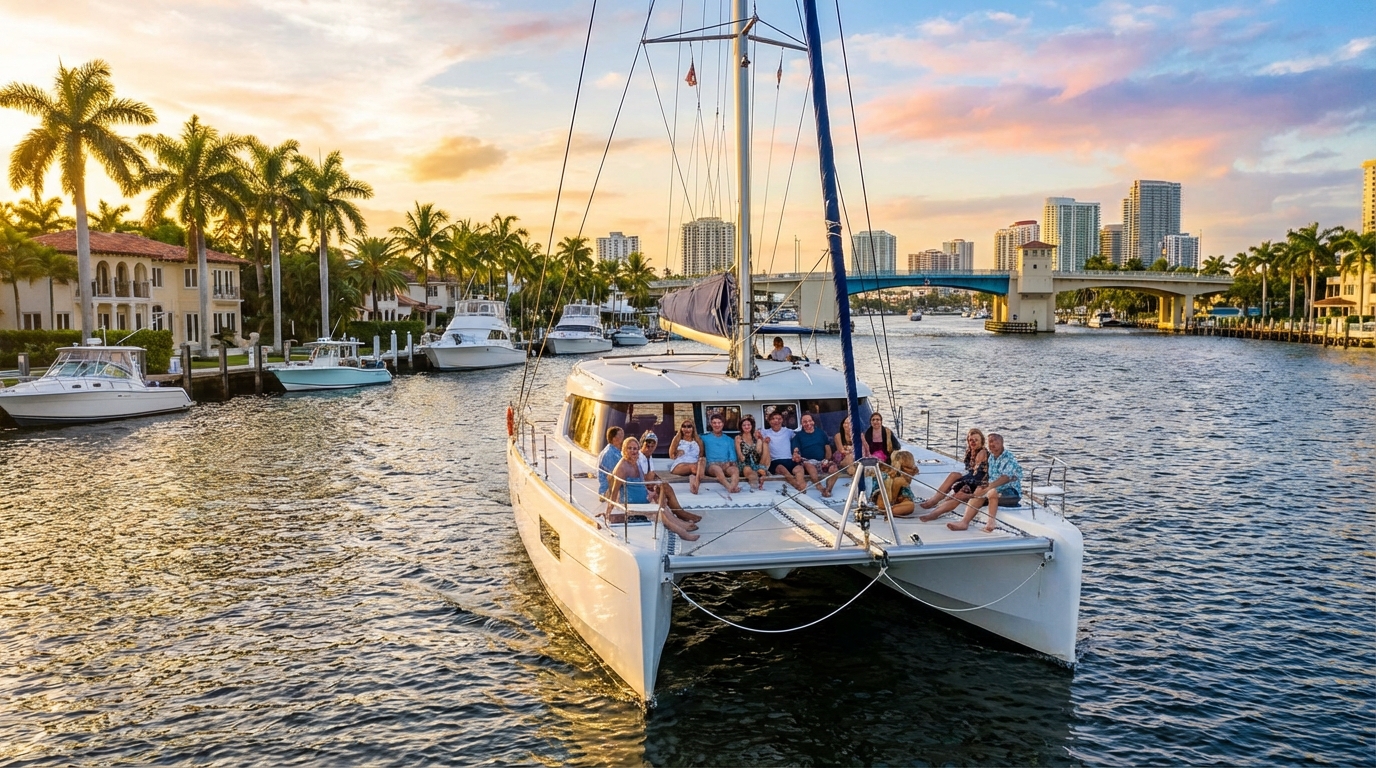
Travelers seeking a sensory connection to the ocean often underestimate the noise of a motorboat engine. Sailing yachts provide a stark alternative, offering a silent, wind-powered experience that allows you to hear the water against the hull. In Fort Lauderdale, catamarans (multi-hulled vessels) are particularly popular for groups prone to motion sickness.
Their dual-hull design significantly reduces "rolling" (tipping side-to-side) compared to traditional monohull sailboats. Furthermore, catamarans often feature "trampolines"—mesh nets stretched between the forward hulls—which offer one of the most coveted lounging spots on the water. For a truly immersive experience on the water, a Fort Lauderdale Full-Day Sailing Charter allows you to disconnect completely and enjoy the rhythm of the Atlantic.
It is important to note that sailing excursions usually stick to the wider sections of the Intracoastal or head out to the Atlantic Ocean via the Port Everglades inlet. Navigating a sailboat through the narrow, winding residential canals of the New River is technically challenging and often avoided due to the frequency of drawbridge openings required for tall masts.
Powerboats and Luxury Motor Yachts
Engine-powered vessels dominate the local rental market due to their versatility. Pontoons are the definitive choice for casual social gatherings. These "party barges" feature flat decks and shallow drafts, making them the safest option for beaching at the Fort Lauderdale Sandbar without damaging the propeller or hull. They prioritize stability and space over speed, rarely exceeding 20-25 mph.
For those intent on fishing or cruising offshore, center console boats are the standard. Designed with a deep-V hull, these vessels cut through ocean chop that would swamp a pontoon. Anglers specifically looking for inland trophy catches often hire a professional Peacock Bass Fishing Guide to navigate the intricate canal systems where these exotic fish thrive.
If your goal is to experience the high-end lifestyle associated with South Florida, a Fort Lauderdale Luxury Yacht Charter equipped with air-conditioned salons, flybridges, and professional crews provides a floating venue for events. According to maritime safety regulations referenced by the U.S. Coast Guard, larger yachts also tend to carry more robust safety equipment and stabilizers, ensuring a smoother ride in rougher Atlantic waters. Lastly, for a strictly romantic, low-speed twilight trip, electric gondolas operate silently through the Las Olas canals, offering a Venetian-style perspective that faster vessels might miss.
Average Costs for Boat Excursions in Fort Lauderdale
Understanding the pricing structure for boat excursions in Fort Lauderdale requires navigating a market that fluctuates significantly based on vessel class, seasonality, and legal charter definitions. Unlike booking a hotel room with a fixed nightly rate, marine recreation costs are dynamic.
From my experience managing rentals on the Intracoastal, visitors often budget for the base rental rate while overlooking the ancillary fees that are standard in the industry. Generally, you should expect to spend anywhere from $50 per person for shared public tours to over $4,000 for a half-day excursion on a luxury yacht. However, the most value often lies in the middle ground—private pontoon or center console rentals—where the cost per head decreases significantly as your group size increases.
Per Person Versus Whole Boat Pricing
The primary financial distinction in the local market is between per-capita ticketing and "whole boat" chartering. Public charters, such as the Jungle Queen or large catamarans, operate on a ticket basis, typically ranging from $35 to $75 per adult depending on the inclusion of food or alcohol. This is generally the most economical choice for couples or solo travelers.
However, once your group exceeds six people, the economics shift in favor of private charters. For example, a standard 24-foot pontoon boat capable of holding 10 to 12 passengers often rents for approximately $500 to $700 for a half-day. If you split this cost among 10 friends, the price drops to roughly $50 to $70 per person—comparable to a crowded public tour ticket—but with the added value of privacy and a customized itinerary. When booking through Rockon Recreation Rentals, you are reserving the entire vessel, meaning the price remains static whether you bring two people or fill the boat to its United States Coast Guard (USCG) certified capacity.
Duration Based Cost Differences
In Fort Lauderdale, the industry standard for rental duration is the four-hour "half-day" block, usually scheduled as a morning (9:00 AM – 1:00 PM) or afternoon (2:00 PM – 6:00 PM) slot. Full-day (8-hour) rentals offer a better hourly rate but require a higher upfront commitment.
Typical Base Rate Ranges (excluding fuel and crew)
- Pontoons and Deck Boats (Self-Captain or Hired): $450 – $800 for 4 hours.
- Center Consoles (25-30 ft): $600 – $1,200 for 4 hours.
- Sport Yachts (40-60 ft): $1,500 – $4,500 for 4 hours.
Seasonality plays a massive role in these figures. Prices peak from February through April (Spring Break and snowbird season) and during major holidays like the Fourth of July or the Fort Lauderdale International Boat Show. Conversely, booking a significantly cheaper rate is often possible during the low season (September and October), though you contend with higher humidity and hurricane risks. According to Travel + Leisure, traveling during shoulder seasons can yield savings of up to 20-30% on accommodations and activities, a statistic that holds true for local marina pricing as well.
Hidden Fees and Gratuities
The most common friction point for visitors is the difference between the "base charter fee" and the final checkout price. This is frequently due to USCG regulations regarding "Demise Charters" (or bareboat charters). For vessels carrying more than six passengers that do not have a Certificate of Inspection (COI), federal regulations usually require the renter to pay the boat owner for the vessel and, utilizing a list of approved captains, pay the captain via a completely separate transaction. This is not a scam; it is a legal necessity to comply with maritime law.
When budgeting for private boat excursions in Fort Lauderdale, you must account for the following add-ons:
- Captain’s Fee: Typically $40 to $75 per hour, paid directly to the captain (often in cash or via Venmo/Zelle upon arrival).
- Fuel Surcharges: While some luxury yachts offer all-inclusive "term charters," most rentals operate on a consumption basis. If you spend your four hours idling at the Fort Lauderdale Sandbar, your fuel cost might be $30. If you cruise aggressively up to the Hillsboro Inlet, that cost could jump to $200+.
- Docking Fees: If you request a pickup at a specific waterfront restaurant like 15th Street Fisheries or a private residence rather than the boat’s home slip, you may incur a "relocation fee" or landing fee, ranging from $50 to $150.
- Gratuity: In the American maritime industry, it is standard practice to tip the captain and crew 15% to 20% of the total charter cost (not just the captain's fee). This rewards them for safety, navigation, and hospitality.
A transparent booking platform like Rockon Recreation Rentals helps clarify these structures upfront, but savvy renters should always ask, "Is fuel included?" and "How is the captain paid?" before finalizing their budget.
Top Amenities to Expect on Board
While the hull design determines where you can navigate, the onboard amenities dictate how much you enjoy the journey. In the sweltering heat of a South Florida summer, where the UV index frequently hits "extreme" levels by 11:00 AM, the difference between a basic vessel and a well-outfitted charter is palpable.
For premium boat excursions in Fort Lauderdale, understanding the hierarchy of amenities helps manage expectations and ensures your group—whether a bachelorette party or a multi-generational family—remains comfortable. Beyond the safety equipment mandated by the Florida Highway Safety and Motor Vehicles department like life jackets and flares, the most sought-after features focus on mitigating the elements.
Comfort and Convenience Features
The most critical amenity for any Florida boater is shade integration. On entry-level center consoles (typically 20-25 feet), expect a "T-top" or "Bimini top" that covers the captain and perhaps two passengers standing at the helm. However, if you are booking through Rockon Recreation Rentals for a leisure cruise, look for vessels offering extended sunshades or full hardtops that cover aft seating areas.
Local captains know that the sun on the Intracoastal Waterway reflects off the water, effectively doubling exposure, making shade non-negotiable for groups with children or seniors. Restroom facilities, nautically known as "heads," represent another major dividing line in boat comfort. Small deck boats often lack facilities entirely, requiring stops at public marinas like Cooley Landing or riverside restaurants. Mid-range cruisers usually feature a "wet head" (cramped combination toilet and shower handle), while luxury yachts provide "dry heads," which are separate, residential-style bathrooms.
Crew and Service Levels
The caliber of crew transforms a standard rental into a luxury service. While a "bareboat" charter puts the onus of operation on you, crewed charters include a licensed captain whose role extends far beyond steering. Experienced local captains act as concierge guides, navigating complex bridge schedules on the New River to prevent getting stuck idling in the heat. According to the National Maritime Center, captains operating commercial charters must hold specific licensure, ensuring they are trained in first aid and navigation safety.
On vessels exceeding 40 feet, it is common to have a deckhand or steward specifically assigned to guest service. Unlike the captain, who must remain at the helm, a deckhand manages the playlist, serves beverages, and handles the physical labor of deploying fenders and lines during docking. This service tier is essential for those seeking a "hands-off" relaxation experience, especially when navigating busy waterways like the intersection near the 17th Street Causeway.
Water Sports and Entertainment Add Ons
To fully capitalize on the calm waters of the Fort Lauderdale Sandbar or Lake Sylvia, amenities must extend beyond the boat itself. Standard private boat excursions often include 6-foot by 15-foot floating water mats (often called "lily pads"), which create a stabilized swim platform safe for non-swimmers to lounge on. Paddleboards and snorkeling gear are frequently included in "fun-in-the-sun" packages, though quality varies; verify in advance if the charter provides adult and child sizes.
Regarding sustenance, amenities range from basic coolers filled with ice to full galley access. While most renters opt to BYOB (Bring Your Own Beverage), larger yachts often feature electric grills or catering options. Note that due to fire safety regulations outlined by maritime insurance policies, open-flame charcoal grills are almost nonexistent on modern rental fleets. For the ultimate upgrade, some 60-foot+ vessels allow for private chef boarding, utilizing onboard galley kitchens to prepare fresh seafood while anchored.
Comparing Popular Boat Excursions Companies
The marketplace for boat excursions in Fort Lauderdale is polarized between two distinct business models: high-capacity commercial tourist attractions and agile, tailored boutique charters. According to the City of Fort Lauderdale, the marine industry is a primary economic driver, supporting thousands of jobs; however, for the consumer, this density creates a "paradox of choice." Many visitors assume all boat tours offer similar experiences, but the operational differences between a 200-passenger vessel and a 6-passenger private charter fundamentally alter the nature of your trip.
Major Tourist Operators
The most visible players in the local market are the large-scale commercial operators, specifically the Jungle Queen Riverboat and the Fort Lauderdale Water Taxi. These entities operate under United States Coast Guard (USCG) "Inspected Vessel" regulations, allowing them to carry large groups (often 100+ passengers) on fixed schedules.
The Jungle Queen has been a local staple since 1935. Its primary selling point is consistency and nostalgia. Their "Dinner Cruise" to a private tropical isle is an orchestrated production featuring all-you-can-eat ribs and variety shows. While excellent for large multi-generational families needing a structured 4-hour activity, the itinerary is rigid. You are a spectator, not a participant; the boat stays in the deep channel of the New River, meaning there are no opportunities to swim or deviate from the route.
Similarly, the Water Taxi functions as a hybrid between a tour and public transit. It offers a hop-on, hop-off model with 11 stops between Shooters Waterfront and Esplanade Park. While convenient, locals know that during peak season (December through April), these boats can reach capacity quickly, sometimes forcing ticket holders to wait 30 to 45 minutes for the next vessel. It serves as an efficient survey of the area, but it lacks the intimacy required for a true connection with the waterways.
Boutique Charter Services
For those seeking to actually get into the water rather than just look at it, boutique charter services are the superior option. These operators typically utilize center consoles, pontoon boats, or bowriders and fall under "Uninspected Passenger Vessel" (UPV) regulations, or "6-pack" charters, limiting groups to six guests (or up to 12 with specific endorsements). This smaller scale unlocks access to shallow-water gems like the Fort Lauderdale Sandbar, located near the confluence of the New River and Intracoastal, which large commercial vessels cannot physically approach due to draft restrictions.
When you book through Rockon Recreation Rentals, you are connecting with these boutique operators who can adjust the itinerary in real-time. If a summer thunderstorm rolls in from the Everglades—a daily occurrence in August—a private captain can quickly reroute to a dockside bar like 15th Street Fisheries, whereas a scheduled tour boat must complete its loop regardless of the weather. The cost comparison is vital here: while a Water Taxi ticket is roughly $35-$40 per person, a private pontoon charter might cost $400-$600 total. For a group of six, the price difference is negligible, yet the upgrade in privacy and flexibility is substantial.
Themed Excursion Providers
Beyond standard sightseeing, specialized operators cater to niche demands, though they come with specific caveats:
- Cycle Boats and Party Barges: Operators like Paddle Pub focus on the bachelorette and party demographic. These are active, high-energy excursions centered on music and drinking. Local insight: Strict noise ordinances on the New River are aggressively enforced. Many of these tours now utilize quiet zones near residential areas, which can dampen the party vibe unexpectedly.
- Eco-Tours and Electric Boats: Companies like Ecoboats focus on silent, electric cruising. This is ideal for spotting manatees in the residential canals of Las Olas Isles without the noise of a gas engine spooking the wildlife.
- Water Sports Specialists: For those who prefer personal watercraft over boats, a Fort Lauderdale Jet Ski Adventure offers a distinct adrenaline rush and allows you to cover more distance than most standard boat tours.
Regardless of the theme, verifying credentials is non-negotiable. Legitimate boat excursions in Fort Lauderdale providers must have a captain with a valid USCG license. There has been a rise in illegal charter operations in South Florida reported by the Sun Sentinel, where boat owners rent vessels without proper commercial insurance or licensed captains. A legitimate operator will always display their credentials and safety briefing protocols before leaving the dock.
Navigating the Booking and Rental Process
Securing the perfect vessel for boat excursions in Fort Lauderdale requires navigating a logistical landscape that is surprisingly more complex than renting a car. In high-demand seasons—particularly from February through May—availability is fluid.
Experienced locals know that while spontaneous weekday rentals are possible, weekend slots for premium vessels often book out two to three weeks in advance. When you book through a trusted marketplace like Rockon Recreation Rentals, the process is streamlined to ensure transparency, but understanding the financial and legal mechanics behind the transaction is essential for a seamless departure.
Reservation Steps and Deposits
The booking process typically begins online, where real-time calendars prevent the frustration of "ghost availability" common with outdated phone-booking systems. However, the most frequent point of confusion for first-time renters involves the security deposit.
Unlike the rental fee, which pays for your time on the water, the security deposit is a mandatory pre-authorization hold placed on your credit card—not a charge—that guarantees the vessel against damages. In the Fort Lauderdale market, these deposits generally range from $500 to $2,500 depending on the vessel's value and horsepower. Debit cards are generally discouraged for this purpose, as the bank effectively "freezes" those liquid funds for 3 to 7 business days locally, whereas a credit card hold merely reduces your available credit line. The hold is released post-rental, provided the hull returns without scratches and the propeller remains intact—a crucial detail given Fort Lauderdale's shallow sandbars.
Required Documentation and Waivers
Showing up to the dock without proper documentation is the fastest way to derail a planned excursion. Federal and state laws are strictly enforced by the U.S. Coast Guard and local marine patrols. Every designated driver must present a valid, government-issued photo ID. However, the most critical requirement concerns boating education.
According to the Florida Fish and Wildlife Conservation Commission (FWC), anyone born on or after January 1, 1988, who operates a vessel powered by 10 horsepower or more must carry a Boating Safety Education Identification Card. Visitors often assume a standard driver’s license suffices; it does not. If you fall into this age bracket, you must complete a NASBLA-approved boating safety course before arrival, or take a temporary certification exam often available at the rental office. Furthermore, all passengers must sign liability waivers. These appear standard, but they are legally binding documents that acknowledge the inherent risks of maritime activities.
Insurance and Liability Coverage
Understanding the distinction between the operator's commercial insurance and your personal liability is vital. Commercial boat insurance typically covers the rental company against catastrophic liability claims, but it rarely absolves the renter of responsibility for negligence.
This is why many operators offer an optional Damage Waiver. For an additional fee (usually $30-$50), this waiver may reduce your financial exposure for minor incidents, such as cosmetic gel coat scratches or fender damage. However, renters should be aware that these waivers almost never cover "gross negligence," such as grounding the boat on a charted sandbar or operating while intoxicated. Clarifying these boundaries upfront ensures your boat excursions in Fort Lauderdale remain safe, legal, and within the scope of your coverage.
What Customer Reviews Say About Local Charters
In the digital age, a glossy brochure or a high-resolution Instagram post can make any vessel look pristine, but user-generated content acts as the ultimate truth serum for the maritime industry. Analyzing customer feedback is essential when planning boat excursions in Fort Lauderdale, as it reveals the gap between marketing promises and the reality on the water.
Based on data from major travel aggregators and direct customer feedback logs, the variance in service quality in the South Florida charter market is significant. Firsthand experience in this region since 2018 suggests that a 4.8-star rating is the baseline for competency; anything lower often signals systemic issues regarding maintenance or transparency. Visitors should approach reviews as a risk management tool. While accolades often focus on the fun factor, the critical insights lie in how operators handle logistics, safety, and the unpredictable Florida weather.
Common Positive Feedback Themes
Across thousands of verified reviews for Fort Lauderdale charters, the single most cited factor in five-star experiences is the crew's personality and local knowledge. Visitors consistently praise captains who do more than steer; they value guides who can identify specific celebrity homes along Millionaire's Row, spot iguana nests in the mangroves, or navigate to Sandbar locations before the crowds arrive. This aligns with the curation standards of Rockon Recreation Rentals, where partner operators are vetted not just for seamanship, but for their ability to facilitate an engaging experience.
Cleanliness is the second major pillar of positive feedback. Given the humid, saltwater environment of South Florida, boat upholstery can quickly develop mildew if not rigorously maintained. Top-rated reviews frequently mention that the "boat looked brand new" or "cushions were spotless," indicating the operator invests in professional detailing between trips rather than a quick hose-down. Additionally, guests highly rate vessels that provide high-quality amenities, such as functioning Bluetooth sound systems and coolers pre-stocked with ice—small logistical wins that save renters from hauling heavy gear from the parking lot to the dock.
Red Flags in Negative Reviews
The most frequent and vitriolic complaint in the Fort Lauderdale charter industry concerns "hidden fees," specifically regarding fuel and captain gratuities. It is a common, albeit frustrating, practice for some operators to advertise a low base rate, only to charge a $200 "fuel surcharge" or a mandatory 20% gratuity at the dock after the trip concludes. According to the Federal Trade Commission's guidelines on transparent pricing, all mandatory fees should be disclosed upfront, but enforcement in the tourism sector can be loose.
For public tours, overcrowding is a persistent issue. Reviews often highlight instances where passengers were forced to stand for the duration of a three-hour tour or were separated from their families because the vessel was booked to its absolute Coast Guard capacity limit. Another specific red flag to watch for is "maintenance failures on the water"—reviews citing engine trouble or broken toilets mid-trip suggest a company that prioritizes maximizing booking volume over necessary preventative maintenance schedules.
Importance of Recent Testimonials
The maritime industry experiences high staff turnover, meaning a review from 2021 may no longer reflect the current reality of a charter operation. It is crucial to filter reviews by "Newest First." A company might have had stellar reviews two years ago, but a change in ownership or a lapse in maintenance can cause a rapid decline in service quality that only shows up in feedback from the last 90 days.
Furthermore, recent reviews are the best gauge for how a company handles Florida’s volatile weather. During the summer, afternoon thunderstorms are a daily occurrence. You want to see feedback stating, "The captain monitored the radar and adjusted our route to keep us dry," rather than complaints about being refused a refund during a lightning storm. Finally, scan recent posts for mentions of safety protocols. Phrases like "The captain gave a clear safety briefing" or "Life jackets were easily accessible/offered" are indicators of a professional operation compliant with U.S. Coast Guard safety standards.
Preparing for Your Boat Excursions Fort Lauderdale Trip
A successful day on the water in South Florida requires more than just booking the vessel; it requires tactical preparation for the specific environment of the "Venice of America." In my experience navigating local waterways since 2018, I have seen countless visitors arrive unprepared for the unique combination of tropical sun, salt spray, and boat-specific etiquette. Whether you are cruising the Intracoastal or heading out to the open Atlantic through the Port Everglades Inlet, proper preparation ensures safety and comfort. When planning your boat excursions in Fort Lauderdale, treating the Florida sun and marine environment with respect is the first step toward a memorable experience.
Packing Essentials Checklist
The intensity of the UV index in Fort Lauderdale is deceptive, often masked by the cooling trade winds. According to the Skin Cancer Foundation, water surfaces can reflect up to 100% of UV rays, effectively doubling your exposure. Therefore, standard beach packing lists are insufficient for stern-to-bow boating. Based on years of local trips, here is the non-negotiable checklist:
- Non-Marking Footwear: This is the most common point of friction at the dock. Wear boat shoes or sneakers with white or light-colored rubber soles. Black-soled running shoes or heels can leave scuff marks on the gelcoat that are arduous to buffer out. Most captains will strictly require passengers with marking soles to board barefoot.
- Polarized Sunglasses: To truly appreciate the marine life, polarization is essential. It cuts through the surface glare of the New River, allowing you to spot manatees or stingrays swimming below the surface that are invisible to the naked eye.
- Reef-Safe Sunscreen (Lotion Only): Avoid aerosol spray sunscreens entirely. Not only is the overspray bad for the environment, but it also renders the fiberglass deck dangerously slippery and can stain boat upholstery.
- Windbreaker or Light Layer: Even in July, a boat moving at 25 knots creates a significant wind chill, particularly after you have been swimming.
- Hard-Sided Coolers (If allowed): While Rockon Recreation Rentals connects you with many boats that include built-in coolers, bringing your own provisions often requires a hard-sided cooler rather than a soft bag, which can leak condensation onto the deck.
Arrival and Boarding Tips
Traffic in Fort Lauderdale, particularly on A1A and Las Olas Boulevard, can be unpredictable. Many visitors underestimate the time required to navigate the drawbridges and find parking at popular marinas like Bahia Mar or Pier 66. As a rule of local logistics, plan to arrive at the marina 20 to 30 minutes prior to your scheduled departure. This buffer is necessary to complete liability waivers, receive a mandatory safety briefing, and load provisions without cutting into your actual charter time. Captains operate on strict schedules; if you are 20 minutes late, that is 20 minutes lost from your trip.
Regarding prohibited items, nearly every private charter strictly bans red wine and glass bottles. Red wine stains on teak decks or white vinyl typically result in a forfeited security deposit, and glass presents a severe safety hazard if broken. Additionally, if you plan to bring a pet, do not assume the vessel is dog-friendly. Always verify in advance, and if approved, bring a properly fitted canine life jacket (PFD). The water currents in the Intracoastal can be stronger than they appear, making a PFD essential even for dogs that are strong swimmers.
Weather and Safety Preparation
The marine forecast often differs significantly from the general weather app on your phone. South Florida is famous for isolated, ephemeral rain showers that locals call "liquid sunshine." These often pass in 15 minutes. Before canceling due to a generic rain icon, check the official National Weather Service Marine Forecast for the Fort Lauderdale coastal waters. This source provides critical data on wave height and wind speed, which are far more relevant to your comfort than cloud cover.
For those prone to motion sickness, preparation must begin before you board. Once nausea sets in on a rolling ocean, it is difficult to reverse. If your itinerary involves exiting the inlet into the Atlantic Ocean, where swells typically range from 2 to 4 feet, consider taking non-drowsy motion sickness medication one hour before departure. However, if you stick to the Intracoastal Waterway, the water is generally flat and calm, making it the preferred route for sensitive passengers enjoying boat excursions in Fort Lauderdale.
Maximizing Your Fort Lauderdale Aquatic Adventure
Selecting the correct vessel is the linchpin of a successful day on the water, transforming a simple outing into a definitive Florida memory. As we have explored, the difference between a cramped, impersonal ride and a tailored journey often comes down to matching your group's specific dynamics with the right hull design. Navigating the 165 miles of local waterways requires foresight.
A deep-draft yacht offers luxury but simply cannot access the shallow, festive waters of the Fort Lauderdale Sandbar, while a pontoon boat provides accessibility at the expense of speed in open water. Experienced locals know that Florida Fish and Wildlife Conservation Commission regulations dictate strict capacity limits based on vessel classification, meaning a group of nine often faces a hard choice: split between two smaller boats or invest in a larger, federally inspected vessel. Your budget and itinerary must align with these logistical realities to prevent last-minute disappointments at the dock.
The Distinct Value of Private Itineraries
While public sightseeing tours provide a general overview of the "Venice of America," they inherently lack the flexibility that defines a premier maritime experience. On a scheduled tour, you are a passenger; on a private charter, you are a participant in the voyage. The ability to request a sunset detour down the New River or to anchor for an hour of swimming near Las Olas requires the autonomy of a private captain.
This customization is particularly vital given Florida’s dynamic weather patterns—a private captain can shift the route to finding calm water in the lee of land when the afternoon sea breeze kicks up, a nuance fixed-route commercial boats cannot offer. For families and serious travelers, private boat excursions in Fort Lauderdale offer a superior value proposition, often costing a comparable amount per person to public tickets when the total is split among a group of six to ten guests.
Securing Availability During Peak Seasons
The demand for water access in South Florida has reached historic highs. According to VISIT FLORIDA, the state welcomed millions of visitors recently, substantially increasing competition for recreational rentals. It is a common misconception that boats can be easily booked the day of or even the week of your trip. In reality, prime weekend slots—especially during Spring Break (March-April) and the Winter holiday season—are frequently reserved four to six weeks in advance.
Waiting until you arrive at your hotel to look for a boat often results in settling for less desirable time slots (like midday when the heat is most intense) or older vessels. To secure the most sought-after boat excursions Fort Lauderdale has to offer, utilizing a verified marketplace is essential. Booking through Rockon Recreation Rentals ensures you are viewing real-time availability for vetted captains and vessels. By locking in your reservation early, you not only guarantee your spot on the water but also give your captain ample time to prepare a customized provisioning and route plan suited exactly to your preferences.
Highlights of the Best Boat Experiences
With a marine industry valued at nearly $9 billion annually in Broward County alone, navigating the sheer volume of options can be overwhelming for visitors. After years of traversing these waterways—from the festive chaos of the Fort Lauderdale Sandbar to the quiet, mangrove-lined canals near Whiskey Creek—it becomes clear that the best experiences fall into distinct categories. Rather than guessing, most savvy travelers prioritize their boat excursions in Fort Lauderdale based on the specific type of water activity they desire: sandbar socializing, scenic luxury cruising, or active watersports. According to booking data and local trends, the following three categories represent the highest-rated experiences on the water.
Top Rated Excursion Types by Popularity
1. The Pontoon Sandbar Day
By far the most popular choice for groups of 6 to 12 people is the pontoon charter specifically targeting the Fort Lauderdale Sandbar. Located near the confluence of the New River and the Intracoastal, this shallow ridge becomes a floating social club on weekends. The primary advantage of a pontoon boat here is its shallow draft (the depth of water needed to float), which allows your captain to anchor in waist-deep water where you can safely hop off. Unlike V-hull boats that rock significantly with wake, pontoons offer a stable, patio-like platform perfect for lounging. The fort lauderdale boat club – Explore the Waterways fleet is an excellent example of vessels optimized for this specific activity.
2. The Intracoastal Luxury Cruise
For those prioritizing aesthetics over swimming, a yacht charter along the Intracoastal Waterway offers a glimpse into the lifestyle that defines the city. These excursions typically depart from marinas near the 17th Street Causeway and head north toward Las Olas. The Greater Fort Lauderdale Convention & Visitors Bureau notes that this route, flanked by mega-mansions and superyachts, is the quintessential "Venice of America" experience. A key differentiator here is amenities: unlike smaller center consoles, these vessels almost always include a full head (bathroom), air-conditioned cabins, and a flybridge for elevated views.
3. Sport Fishing and Center Consoles
While relaxation dominates the market, adventure charters utilizing fast center console boats remain a staple. These vessels are designed to cut through ocean chop, making them ideal for heading out the Port Everglades Inlet for deep-sea fishing or cruising south to Haulover. However, guests should be aware regarding comfort: these boats prioritize speed and rod holders over plush seating, and shade is often limited to the T-top area.
Selecting the Right Vessel for Your Group
Choosing the wrong boat layout can ruin a day on the water, particularly when the group dynamic isn't considered. The physical configuration of the vessel dictates safety for children and intimacy for couples.
Best for Families with Children
For families, particularly those with children under 12, pontoon boats or catamarans are the superior choice. The high rails (fencing) around the perimeter provide a safety barrier that open-deck speedboats lack. Furthermore, stability is crucial; monohull boats tend to list (tilt) when passengers move around, which can unnerve young children or cause motion sickness. A local tip that often goes unmentioned: ensure your rental includes a sturdy, deep-ladder system. Trying to lift a wet, slippery child out of the water onto a boat without a proper swim ladder is physically exhausting and dangerous.
Best for Couples and Romantic Outings
Couples seeking a sunset experience should look for "slower" displacement hull vessels or private sailing charters. The psychological impact of engine noise is real; shouting over a roaring outboard motor kills the romantic ambiance. Electric boats (Duffy boats) or sailing yachts offer a quieter, smoother ride, allowing for conversation while navigating the narrower, more picturesque canals of the Las Olas Isles where larger, noisier boats are restricted.
The Critical Role of Verified Safety and Reviews
Perhaps the most vital "insider" advice concerns the legality and safety of the charter itself. South Florida is unfortunately a hotspot for illegal charters—unlicensed operators running commercial tours without proper Coast Guard inspections or captain credentials. The U.S. Coast Guard frequently terminates voyages of illegal charters, which not only ends your vacation day abruptly but can leave you stranded at a marina without a refund. Legitimate operations carry verified commercial insurance and employ USCG-licensed captains who undergo drug testing and background checks.
When booking through Rockon Recreation Rentals, every listing is vetted for compliance. We ensure that the boat excursions fort lauderdale visitors book meet strict safety standards. Unlike peer-to-peer marketplaces where anyone can list a personal boat, a curated platform guarantees that you aren't stepping onto a vessel with expired flares, insufficient life jackets, or a captain who doesn't know the local navigation markers. Always prioritize verified reviews that mention the captain by name and reference specific safety briefings—these are hallmarks of a professional operation.