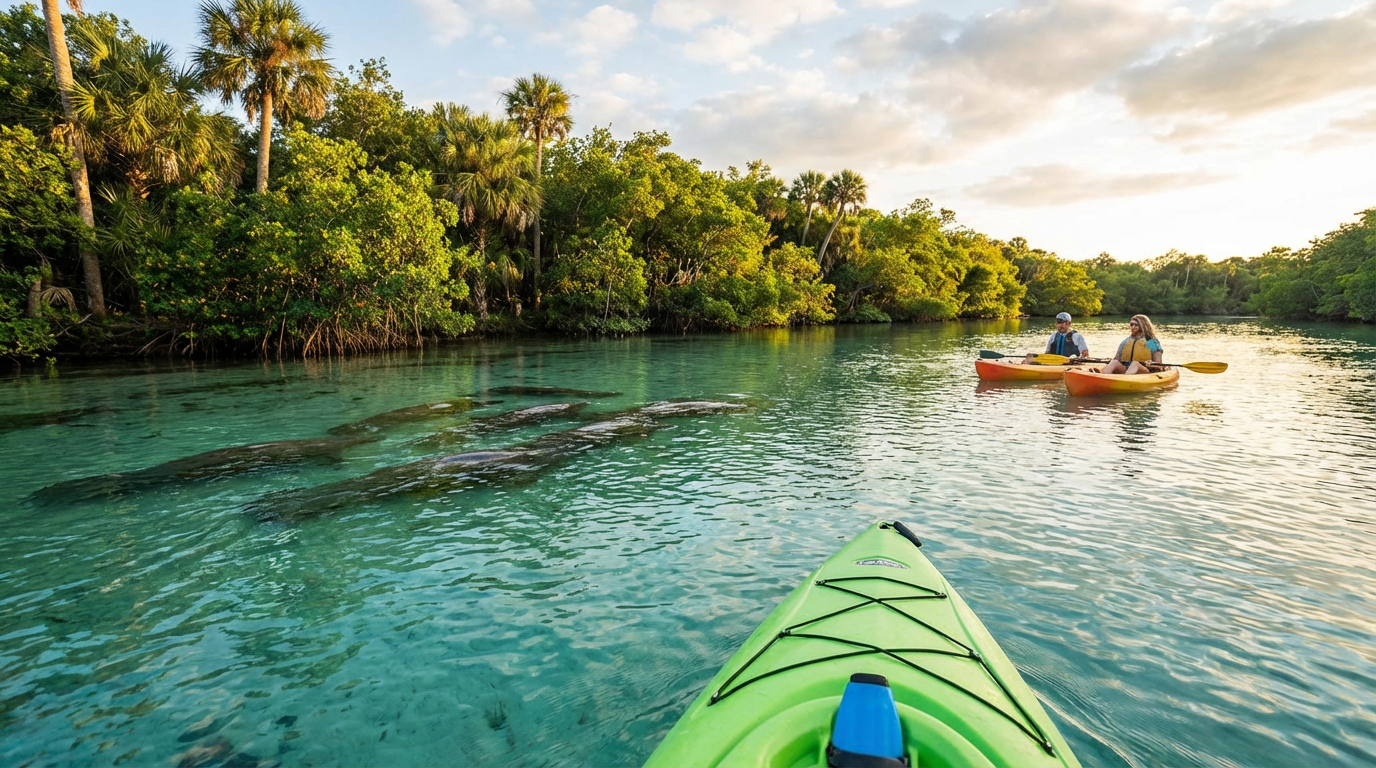
The Appeal of a Winter Manatee Encounter
Since guiding my first eco-tours in 2018, I have learned that embarking on a Florida kayak with manatees excursion requires precise timing to maximize your chances of witnessing these 1,200-pound mammals in their 72-degree spring habitats. Floating on a glass-clear spring run while a sirenian glides beneath your hull provides a striking contrast to the manufactured attractions found elsewhere in the state. As a VisitFlorida Travel Partner, the team at Rockon Recreation Rentals constantly reminds visitors that a successful journey requires deep situational awareness. The appeal isn't just marking a species off a checklist; it involves observing subtle behaviors in a wild habitat. You typically hear the resonant whoosh as a manatee surfaces to breathe approximately every three to five minutes, or spot a mother nursing her calf in the shallow, two-foot-deep eelgrass beds. Because these animals lack natural predators in fresh water, they exhibit a relaxed, slow-moving demeanor that instantly shifts the pace of your 4-mile round trip.
Why Florida Springs Become Winter Havens
What many out-of-state visitors fail to realize is that these massive gatherings are a matter of survival rather than leisure. The Florida manatee lacks a thick, continuous layer of insulating blubber to prevent heat loss. According to biological data published by the National Park Service, manatees become highly susceptible to cold stress syndrome when aquatic temperatures drop below 68 degrees Fahrenheit. This physiological vulnerability forces a highly predictable annual migration. Between late November and March, thousands of manatees abandon the rapidly cooling waters of the Gulf of Mexico to seek refuge in inland waterways. The state's artesian aquifers continuously pump out groundwater at a remarkably stable 72 degrees Fahrenheit year-round. Approaching these habitats during a Florida kayak with manatees trip requires the understanding that these specific waterways serve as critical thermal shelters. Paddlers navigating runs narrower than 30 feet must always leave a deep-water exit channel open, as blocking a manatee's path to warmer thermal layers causes immediate physiological panic and stress.
Why Non Motorized Vessels Offer the Best Viewing
Navigating these delicate ecosystems in a quiet, non-motorized vessel presents the least intrusive method for wildlife observation. Motorized pontoon boats and aluminum skiffs cover more territory, but their heavy outboard engines generate underwater acoustic noise that disturbs resting manatees from up to 100 yards away. The prop wash also stirs up bottom sediment, rapidly degrading water clarity from 50 feet of visibility down to less than five feet. In contrast, taking a Florida kayak with manatees trip allows paddlers to slide cleanly through narrow limestone channels drawing as little as 10 to 12 inches of water. This shallow draft grants access to secluded coves that larger coastal tour boats simply cannot reach. However, kayakers must recognize that rough blade handling—specifically the concussive slap of a poorly angled paddle or heavy water dripping from an elevated shaft—triggers a flight response just as rapidly as a trolling motor.
Furthermore, kayaks are uniquely suited for passive observation, the strict viewing standard legally enforced by the Florida Fish and Wildlife Conservation Commission. When a manatee approaches within 50 feet, kayakers can easily lift their paddles flat across the gunwales and let the natural 2-knot spring current do the work. By drifting silently and eliminating sudden splashing movements, you avoid violating federal harassment laws. One necessary local tip for proper navigation: strictly secure all loose metal items, like 32-ounce insulated water bottles or aluminum carabiners, inside your 10-liter dry bag. A dropped metal flask against the high-density polyethylene interior hull acts as an acoustic drum underwater, sending shockwaves through the spring run that will immediately scatter a resting herd from 50 yards away.
Best Places to Rent a Kayak With Manatees in Florida
Since starting my local paddling logs in 2018, I consistently advise visitors that the launch location drastically alters the ecosystem you experience. Driving the 40 miles between a coastal hub like Crystal River and an inland system like the Silver River heavily changes the waterway conditions, from tidal flow to specific salinity levels. Planning a proper Florida kayak with manatees excursion requires deciding between the gin-clear visibility of artesian springs and the sheltered, brackish waters of coastal mangroves. Understanding the environmental differences, wind limitations, and specific federal sanctuary regulations of each basin ensures your expectations match the reality of navigating these distinct waterways.
The Clear Water Hub of Crystal River
Crystal River and the adjacent Kings Bay area remain the undisputed heavyweights of manatee tourism, largely due to the crystalline quality of the underlying aquifer. According to the U.S. Fish and Wildlife Service, the Crystal River National Wildlife Refuge serves as a critical wintering habitat for upwards of 600 manatees during sharp cold fronts. Paddling out toward the famous Three Sisters Springs, you get unparalleled underwater visibility that frequently exceeds 50 feet. However, a crucial local tip that most tourists realize too late is that navigating from the $5-per-day public launches to Three Sisters requires crossing deep-water residential canals where heavy chop and 15-knot winds funnel through the concrete seawalls. Furthermore, the actual spring runs within Three Sisters are closed to all watercraft from November 15 through March 31 to protect resting manatees. During winter months, you cannot paddle directly over the spring boilers; you must carefully tie off your kayak at the run's entrance and observe from designated perimeter zones situated approximately 10 yards back.
Inland Encounters at Silver Springs State Park
Further inland, Silver Springs State Park offers a distinctly different freshwater aesthetic perfectly suited for a Florida kayak with manatees journey. Launching onto the Silver River provides a classic, old-Florida environment flanked by 80-foot towering bald cypresses and wild rhesus macaques swinging through the sabal palms. Unlike the dense residential development rounding parts of Kings Bay, the 5-mile Fort King Waterway paddling trail is a tightly protected natural environment. Based on environmental data from Florida State Parks, the primary spring basin pumps over 500 million gallons of 72-degree water daily. Because manatees must travel extensively up the Ocklawaha River to reach this basin, sightings here trade the massive, densely packed herds of the coast for quiet, solitary encounters with one or two individuals. A significant trade-off to consider is the river's steady 2 to 3-mile-per-hour current; paddling upstream against the flow for the first three miles requires a baseline level of physical stamina, though the return trip to the launch basin transforms into a leisurely, paddle-free float.
Coastal Mangroves at Manatee Park in Fort Myers
Not all manatee environments feature 50-foot transparent visibility. While East Coast visitors might enjoy the diverse marine life when Kayaking Cocoa Beach, heading south to Manatee Park in Fort Myers provides an entirely different harbor. The warm water here does not come from a natural aquifer; it is the 75-degree thermal discharge originating from an adjacent Florida Power and Light facility. Managing the coastal waters of the Orange River, Lee County Parks operates this designated refuge where manatees gather by the hundreds in shallow, tannin-stained waters. Navigating a Florida kayak with manatees adventure through this mangrove-lined river means relying heavily on auditory cues—listening for resonant exhalations and watching for the swirling vortexes of paddle-shaped tails breaking the dark surface. A crucial reality check here: because this coastal river connects to the Gulf of Mexico, it is heavily influenced by tides. Launching at a dead-low winter tide routinely leaves inexperienced paddlers stranded on sticky, sulfur-smelling mudflats just one mile outward from the main dock.
Navigating Peak Crowds and Launch Logistics
The reality of viewing these protected mammals is that you will rarely be alone on the water during a chilly 50-degree weekend in January. To avoid the logistical bottlenecks at major launch ramps, timing your arrival is just as critical as your chosen destination. The vast majority of standard outfitter tour groups stagger their departures between 9:00 AM and 11:30 AM. Arriving precisely at an 8:00 AM park opening or delaying your launch until after 2:30 PM significantly reduces local boat traffic by up to 70 percent. When overnight temperatures dip below 50 degrees Fahrenheit, dense morning mist obscures surface visibility until roughly 8:30 AM, yet this exact window is when the mammals are most actively migrating into the runs. As a VisitFlorida Travel Partner, the team operating Rockon Recreation Rentals constantly emphasizes that selecting a mid-week Tuesday or Wednesday rental directly translates to a quieter, more respectful wildlife observation. Launching early before the crowds arrive also provides fundamentally better water clarity, as the sandy bottoms of narrow spring runs have not yet been disturbed by dozens of inexperienced paddlers dragging their blades through the sediment.
Exploring the Types of Boats Available and Included Amenities
Choosing the Right Vessel for Your Wildlife Encounter
When preparing for a Florida kayak with manatees trip, vessel selection dramatically alters what you see and how your lower back feels after three hours on the water. As a VisitFlorida Travel Partner, the team at Rockon Recreation Rentals steers newcomers toward specific hulls based on water conditions rather than pure aesthetics. Clear kayaks, manufactured from transparent polycarbonate, are undeniably popular for navigating pristine spring runs because they provide a 100-percent visible floor. Watching a 1,200-pound marine mammal glide directly beneath your hull is striking. However, what most visitors do not realize before renting is that these transparent boats are substantially heavier—often exceeding 45 pounds for a single—and track poorly in 15-knot open-water crosswinds compared to a traditional polyethylene V-hull.
Standard single sit-on-top kayaks remain the most versatile local choice for navigating Florida's inland waterways. They offer excellent immediate drainage and make re-entry effortless if you legally disembark to snorkel in designated interaction zones. A critical insider tip for winter paddling: you must mandate scupper plugs from your outfitter for your sit-on-top hull. Without these rubber stoppers, you will sit in an inch of 72-degree ground water for three hours while exposed to 55-degree ambient air temperatures. Tandem kayaks, which usually measure between 13 and 14 feet in length, are highly practical and cost-effective for families. Yet, tandems typically max out around 425 to 450 pounds of displaced weight capacity. Pushing that threshold with two full-grown adults causes the vessel to track sluggishly and sit uncomfortably low, drawing over 6 inches of water.
Stand-up paddleboards present a unique strategic advantage for wildlife spotting that traditional sit-down hulls lack during a Florida kayak with manatees tour. While balancing requires greater core stability, standing upright shifts your eye level five to six feet above the water. This elevated vantage point cuts through surface glare, allowing experienced paddlers to spot a manatee’s distinct gray silhouette from 30 yards away, an advantage similarly enjoyed by guests on Dolphin Tours Fort Myers. The serious trade-off is winter capsize risk; falling off a 10-foot paddleboard into a 72-degree spring when ambient air temperatures hover at 48 degrees introduces a legitimate hypothermia threat, making a strapped-down 10-liter dry bag containing spare synthetic clothing entirely mandatory for boarders.
Standard Safety Gear and Expected Equipment
Every reputable local outfitter equips paddlers with fundamental safety gear dictated by state maritime law. According to regulations published by the Florida Fish and Wildlife Conservation Commission, all unmotorized vessels under 16 feet must carry a United States Coast Guard-approved Personal Flotation Device for each passenger onboard. Quality liveries provide Type III PFDs, which feature widened armholes specifically designed to prevent underarm chafing during extended 4-mile paddling motions. You typically receive a two-piece break-down paddle, matching an aluminum shaft with highly durable nylon blades measuring roughly 220 centimeters. Additionally, Florida law mandates that all vessels carry a sound-producing device. Most first-timers mistakenly leave the provided safety whistle zipped away inside a life vest pocket. As professional guides, we mandate clipping it externally to your collarbone strap so it can be reached in under three seconds if a fast-moving 20-foot bass boat rounds a blind riverbed bend.
Premium Additions for Comfort on the Water
Maximizing your Florida kayak with manatees experience often comes down to the subtle amenities that elevate basic comfort over a four-hour excursion. Standard molded plastic kayak seats frequently cause hamstring fatigue and lower back pain after the first 90 minutes of constant hip rotation. Searching for an outfitter offering premium seating upgrades, such as a raised, aluminum-framed mesh seat or a high-density gel backrest, prevents the dreaded paddler’s slouch and extends your physical endurance. Premium rentals often include indispensable add-ons like 5-liter or 10-liter roll-top dry bags to protect electronic key fobs and $1,000 smartphones from the inevitable paddle drip. Finally, prioritize hydration capacity. Even with cooler 60-degree winter air temperatures, navigating against a 2-knot thermal spring current elevates your core temperature rapidly. Plan for at least 32 ounces of drinking water per person for a standard four-mile round trip on the river.
Understanding Pricing and Rental Duration
Budgeting appropriately for a Florida kayak with manatees trip involves far more than simply finding the cheapest vessel listed on a roadside billboard. Because these wildlife encounters operate in distinct ecological zones spanning multiple counties, your rental choices directly impact how much time you actually spend observing the marine life versus just racing the clock to return your boat. Hidden municipal parking fees—often reaching $5 per hour via mobile payment apps at crowded county ramps like Hunter Springs—can unexpectedly inflate your daily budget by $20. Navigating the differing price structures across Florida's spring networks requires understanding both the logistical reality of the 3-mile paddling trails and the seasonal demands of the local outfitter industry.
Hourly Versus Extended Rentals
First-time visitors often default to booking a quick two-hour, self-guided rental, assuming it will be enough time to secure a photograph. As local guides who have paddled these spring runs since 2018, we constantly warn guests that short-term hourly rentals are usually a tactical mistake. At major congregational hubs like Crystal River or Weeki Wachee, paddling from standard public launches to the protected manatee sanctuary zones often takes 30 to 45 minutes each way against a persistent 2 to 3-mile-per-hour spring current. If you only book two hours, you will spend your entire trip aggressively paddling at a cardiovascular deficit rather than floating silently to observe the wildlife.
While an hourly rental rarely exceeds $15 to $25 per hour for a basic 10-foot sit-on-top, booking a half-day consisting of 4 hours is the sweet spot for a sustainable excursion. Half-day rates for single polyethylene kayaks routinely run between $45 and $65, whereas full-day 8-hour rentals sit between $65 and $85 depending on the launch location's proximity to the main springs. We recommend browsing the vetted half-day options available through Rockon Recreation Rentals. This 4-hour duration allows you to lay your paddle across the hull just outside the 50-foot sanctuary buffers and peacefully watch the animals surface without the anxiety of returning your equipment late—which often incurs arbitrary penalty fees upward of $35 from independent coastal vendors.
Self Guided Trips Versus Guided Eco Tours
Pricing splits significantly when deciding between navigating the rivers yourself and joining an organized 10-person tour group. Self-guided excursions remain the most economical route, typically capping at around $65 for a 4-hour half-day. However, they demand a strong sense of waterway navigation and strict adherence to federal wildlife protection laws. Conversely, fully guided eco-tours generally cost between $75 and $120 per person for a condensed 2.5-hour experience led by an expert.
Why the steep $40 to $50 premium for guided tours? These operators frequently provide transparent clear kayaks, which require expensive, labor-intensive polishing weekly to maintain their Lexan visual clarity, and employ certified Master Naturalists. According to wildlife tourism analysis published by Travel + Leisure, having an expert guide dramatically improves your sighting probability on warmer winter days when manatees disperse outward from the springs. When budgeting a guided Florida kayak with manatees tour, you must also mechanically factor in the local industry standard tipping rate of $10 to $20 per person for your knowledgeable guide.
Insider Strategies for Securing Better Rates
If you are coordinating a Florida kayak with manatees adventure on a strict family budget, timing and group size serve as your greatest leverage points. Outfitters heavily penalize last-minute bookings during the peak mid-winter migration bridging January and February. You can bypass premium weekend pricing by seeking out 'dawn patrol' discounts; many launch operators offer 10% to 15% off regular rates if you book a launch slot before 8:00 AM, helping them clear their inventory before the midday crowds arrive. Additionally, travel experts at Lonely Planet note that launching early provides the most tranquil and pristine viewing conditions before the afternoon sea breeze typically picks up to 10 knots.
Furthermore, do not forget to factor state park entry charges into your total expenditure worksheet. As detailed by the official Florida State Parks administration, accessing high-density manatee havens like Blue Spring involves vehicle admission fees ranging precisely from $4 to $8, plus a potential $4 separate launch fee if you bring your own 12-foot vessel. State parks strictly cap daily attendance; heavily trafficked gates at Silver Springs or Weeki Wachee routinely lock for maximum capacity by 9:30 AM on Saturdays, invalidating your outfitter reservation entirely if you are trapped in the admission line outside the main ranger station.
Booking Procedures and Required Rental Documentation
Since I began facilitating local eco-tours in 2018, the most common operational mistake I see visitors make is assuming they can simply walk up to a launch site during peak winter months and secure a 12-foot vessel. When planning a trip, securing your reservation at least 14 days in advance is absolutely critical. During January and February, popular hubs like Crystal River and Hunters Spring frequently exhaust their total 150-boat rental inventory by 9:00 AM. Navigating this process demands specific logistical preparations to ensure your group actually gets on the water.
Navigating the Reservation Process
The step-by-step rental process requires more than simply handing over a credit card upon arrival at the dirt parking lot. Your journey begins by securing an online reservation through a verified VisitFlorida Travel Partner like Rockon Recreation Rentals. Once booked, visitors must arrive on site at least 45 minutes prior to their scheduled launch time. This buffer accounts for notorious weekend parking delays at busy county ramps and provides adequate time for mandatory check-in steps. At federally monitored locations, securing a boat entails completing a mandatory viewing of the FWC's 10-minute Manatee Manners instructional video prior to launch. Crucially, cellular reception at rural launch basins like the Chassahowitzka River or remote areas of the Ocklawaha is notoriously non-existent. Always download and screenshot your digital liability waivers and confirmation QR codes while still on your standard hotel Wi-Fi.
Essential Documentation and Age Guidelines
Before your aluminum paddle blade ever touches the water, specific physical and digital documentation must be verified by the dockmaster. Outfitters require a valid, government-issued photo ID that exactly matches the printed name on the booking credit card. Additionally, all participants must sign digital liability and safety waivers. Because you are entering a critical marine ecosystem, these waivers serve as your legal acknowledgment of the Marine Mammal Protection Act. According to biologists at the U.S. Fish and Wildlife Service, harassing a marine mammal can carry severe federal penalties reaching up to $100,000 and one year in federal prison.
Age restrictions and pet policies also heavily influence your booking logistics. Generally, solo paddlers must be at least 18 years old due to stringent commercial maritime insurance limits required by the state. Minors aged 13 to 17 are typically permitted to operate their own 10-foot single kayak provided a parent or legal guardian is actively present on the water within 50 feet to supervise. Children aged 12 and under are universally required to ride in a dual-seat tandem kayak with an adult. Additionally, while many sluggish rivers are technically dog-friendly in the 90-degree summer, bringing a pet on a focused winter wildlife tour is universally prohibited by ethical liveries, as canine barking induces severe physiological stress in resting manatee calves.
Understanding Equipment Protection and Liability
Paddling through shallow, 3-foot-deep spring-fed rivers presents unique hazards to rental equipment that you will not encounter in deep open ocean water. Submerged limestone formations, dense oyster beds in coastal transition zones, and hidden cypress knees can easily scrape or puncture a standard polyethylene hull. While most baseline rental agreements cover normal wear and tear like light floor scuffing, catastrophic damage leaves the renter entirely financially liable for replacement costs. A snapped fiberglass paddle shaft or a lost tracking fin will instantly incur a $75 to $120 replacement fee charged directly to your card on file.
Many premium outfitters offer an optional equipment protection plan at checkout, typically costing an additional $5 to $15 per vessel. As a local guide who has seen countless unpredictable underwater collisions with submerged logs during heavy 3-knot currents, I always advise purchasing this nominal coverage for absolute peace of mind. If the outfitter does not offer direct damage waivers, you should proactively consult your personal policies. According to insurance analysts at Forbes Advisor, certain comprehensive travel insurance plans or homeowner policies may extend liability coverage to recreational rental equipment, though standard trip deductibles often apply.
Top Rated Kayak Rental Operators and Tour Experiences
Standout Local Companies and Eco Certification
Having paddled Florida's extensive coastal and inland spring networks spanning 500 miles since 2018, I have seen firsthand the stark difference between high-volume tour mills and dedicated eco-tour providers. Highly-rated regional operators like Kayaking Fort Myers have built sterling 5-star reputations not by crowding the waterways with 30-boat fleets, but by strictly adhering to ethical wildlife guidelines. Many leading operators seek out and maintain rigorous certifications from the Florida Society for Ethical Ecotourism. This specific credential requires guides to pass formal 40-hour training courses regarding the Marine Mammal Protection Act. Furthermore, these professional outfitters strictly enforce favorable guide-to-guest ratios, legally capping their manifests at exactly eight paddlers per Master Naturalist to maintain total environmental control. Authorities like the Florida Fish and Wildlife Conservation Commission actively rely on these professional liveries to model proper spacing on the water, effectively minimizing acoustic stress during the manatees' critical winter resting periods.
Analyzing Customer Reviews on Equipment Quality
A deep dive into verified customer testimonials across major travel platforms like Tripadvisor reveals a surprisingly consistent trend among five-star reviews. While close-proximity 20-foot marine sightings are the primary motivation for booking, guests overwhelmingly cite specific guide knowledge and ergonomic equipment comfort as the defining markers of a successful $75 trip. Reviewers frequently praise seasoned naturalists who can instantly identify the smooth, circular upwellings of displaced water locally called manatee footprints, signifying a submerged 1,000-pound animal rests just ten feet ahead. What most first-time visitors do not realize until they are two miles up a winding 2-knot current is how vital proper seating is. Top-tier outfitters invest heavily in tracking-fin, sit-on-top hybrid kayaks outfitted with high-back, adjustable lumbar support, successfully avoiding the localized lower back fatigue routinely reported on cheaper $25 unguided tours.
Specialty Tour Offerings and Photography Excursions
Beyond standard two-hour midday rentals, elite operators have expanded their catalogs to include niche 3-hour excursions tailored for serious nature enthusiasts. If you want to optimize your adventure, specialized photography-focused tours are an exceptional $100 investment. These intimate, small-group early-bird tours typically launch precisely at 7:00 AM, strategically beating the chaotic 9:00 AM recreational crowds that stir up the limestone silt. The primary biological and environmental advantage here is profound: morning water surface tension. Early morning spring runs often resemble unblemished glass, eliminating the harsh 6-inch surface chop and reflective mid-day sun glare that ruins polarized underwater photography. Sunset and moonlight combination tours are another specialized outfitter offering, capitalizing on the dramatic golden hour lighting while allowing paddlers to observe unique behavioral shifts, such as the nocturnal roosting of blue herons deep within the cypress tree lines.
Safety Rules and Etiquette for Paddling Tours
Embarking on an eco-tour carries significant legal and ethical responsibilities, a strictly enforced point frequently emphasized in sustainable tourism guides published by the New York Times. Because these gentle giants are federally protected under the Marine Mammal Protection Act of 1972 and the Endangered Species Act, human interaction is heavily regulated across all 67 state counties. According to the Florida Fish and Wildlife Conservation Commission, harassment is legally defined as any action that alters a manatee's natural behavior. This includes pursuing, touching, or cornering the animals into shallow 2-foot inlets. Federal penalties for violating these statutory protections are intensely severe, potentially resulting in cumulative federal fines up to $100,000 and one full year in prison. Understanding these 50-foot boundaries distinguishes a responsible paddler from a disruptive tourist.
Mastering Passive Observation Techniques
After observing paddlers on central Florida's spring runs since 2018, one of the most common physical errors novice kayakers make is actively chasing a submerged 10-foot shadow. The golden rule of marine mammalian encounters is passive observation. FWC guidelines stipulate that motorized marine vessels and human-powered craft alike should identically maintain a minimum distance of 50 feet—roughly four standard kayak lengths—from a resting manatee herd. If a curious animal breaks the 72-degree surface near you, the mandated local response is to lay your 220-centimeter paddle shaft horizontally out of the water across your gunwales and let the vessel drift naturally, allowing the 1,200-pound manatee to dictate the entire interaction.
To avoid sudden splashes that might startle a resting 60-pound newborn calf, seasoned guides highly recommend using low-angle paddle strokes. Instead of lifting your blade 3 feet out of the water, practice feathering the paddle close to the surface or using continuous, quiet sculling motions to hold your position against the 2-knot current. Never position your 12-foot kayak between a mother and her calf, and strictly limit your paddling over shallow submerged eelgrass beds measuring naturally less than 3 feet deep. Manatees actively feed in these shallow grass flats, and the 6-inch draft of your loaded hull could accidentally pin a surfacing animal against the sandy bottom.
Essential Gear for Ethical Encounters
As a proud VisitFlorida Travel Partner, the outfitting experts at Rockon Recreation Rentals constantly emphasize that protecting the freshwater ecosystem begins with your 10-liter dry bag packing list. Standard chemical sunscreens pose a severe toxicological threat to the fragile spring environments where manatees winter. Visitors must exclusively apply biodegradable, reef-safe sunblock completely free of oxybenzone and octinoxate, adhering strictly to National Oceanic and Atmospheric Administration aquatic toxicity standards. Because the 72-degree ground water feels deceptively cool against a 15-knot winter air breeze, paddlers rarely realize they are sustaining severe UV damage until they load their 50-pound boats back onto the trailer. Applying these mineral-based zinc creams 30 minutes before launching ensures the lotion fully absorbs into your skin rather than immediately washing off into the pristine aquifer.
Visual Clarity and Hydration Strategies
Beyond eco-friendly UV protection, visual preparation dramatically improves your safety and 50-foot viewing experience. An insider secret that many out-of-state tourists overlook is the specific chemical color tint of their polarized sunglasses. While standard gray lenses work perfectly fine for offshore ocean paddling, amber or copper-tinted polarized lenses are exponentially superior for cutting the harsh UV surface glare on Florida's tannic 4-foot-deep rivers and crystal-clear springs. These specialized colored lenses dramatically enhance contrast against the white limestone bottom, allowing you to instantly spot the distinct gray, potato-like shape of a manatee—or a submerged 200-pound log capable of capsizing your boat—well before you accidentally drift into the impact zone. Finally, while it might seem counterintuitive when surrounded by 500 million gallons of fresh water, bring adequate 32-ounce hydration in reusable thermoses firmly tethered to your seat rigging. Using aluminum carabiners directly prevents plastic single-use waste from accidentally rolling overboard into the protected habitat during your 4-mile journey.