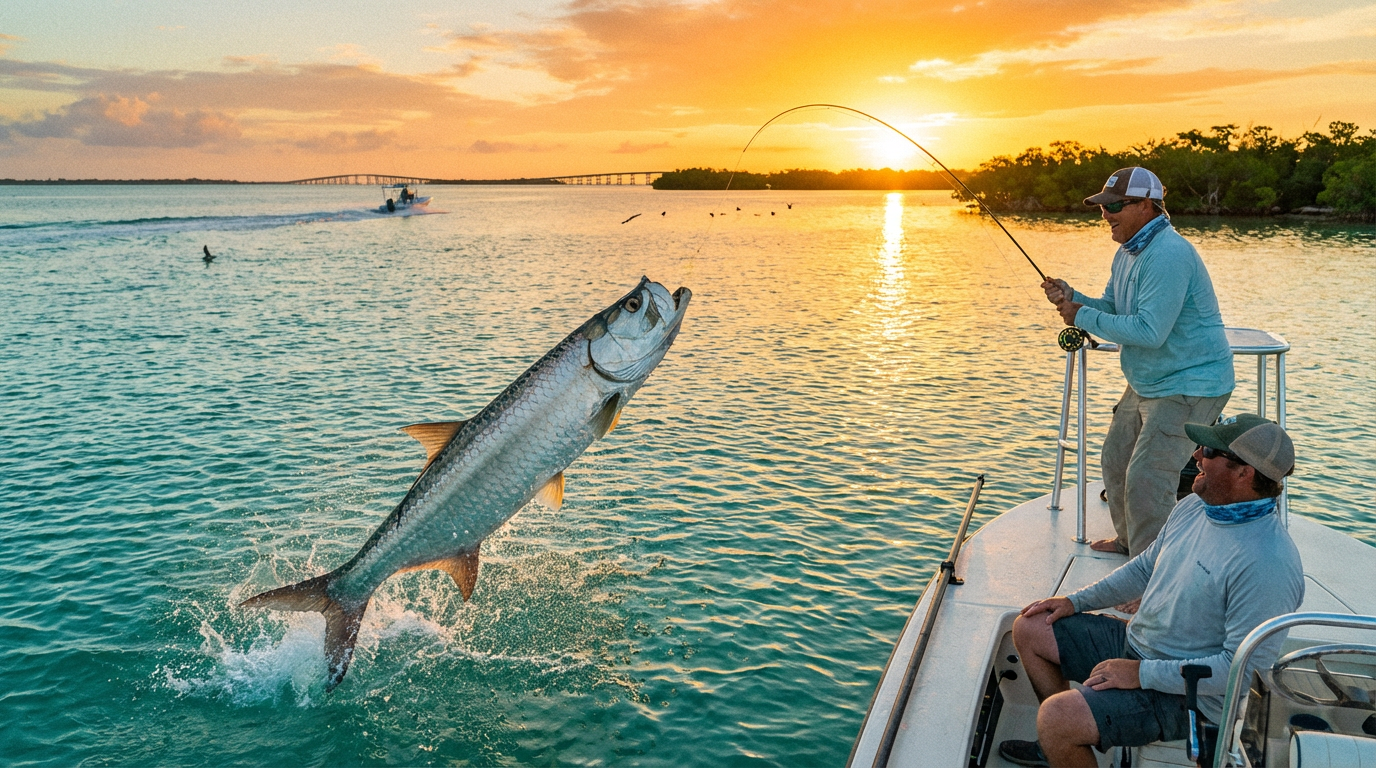
Why the Silver King Demands Heavy Saltwater Gear
When it comes to the ultimate saltwater challenge, tarpon fishing in Florida requires physical endurance, specialized gear, and highly precise timing. Since I first began tracking Gulf Coast migration patterns from the shallow flats of the Ten Thousand Islands up to the Panhandle back in 2018, I have watched seasoned offshore anglers completely lose their nerve. Pushing a standard drag system to a 20-pound pressure limit against an armored, prehistoric fish aggressively exploding out of the water is a jarring experience that frequently melts synthetic reel washers and quickly separates prepared anglers from amateurs.
The sheer chaotic torque of a hookup makes tarpon fishing in Florida a highly demanding saltwater pursuit. Often tipping the scales at well over 150 pounds and physically capable of launching their massive bodies 8 feet into the humid 85-degree air, these fish instantly test both terminal tackle and human stamina. As a proud VisitFlorida Travel Partner, Rockon Recreation Rentals connects traveling groups with licensed local captains who intimately understand the heavy nautical logistics required to consistently land massive migratory fish.
Anatomy of an Apex Inshore Predator
To truly understand the modern obsession with Megalops atlanticus, you must examine their hard-wired survival biology. Tarpon fishing in Florida consistently pushes standard equipment to the failure point because these resilient survivors possess physiological traits that have remained virtually unchanged for 100 million years. Experienced local guides can literally smell a concentrated school roughly 48 hours before a passing cold front—a musky, almost watermelon-like odor drifting across slick, glassy flats when 2026 summer water temperatures finally stabilize at 80 degrees.
According to field biologists at the Florida Fish and Wildlife Conservation Commission (FWC), mature tarpon are shielded by interlocking, armor-like scales measuring up to 3 inches across. Their rigid jaws heavily feature calcified bone, famously earning them the nickname "bucket mouths," which strictly explains why the hook-up ratio for visiting beginners hovers brutally below 10 percent. Furthermore, tarpon possess a uniquely modified swim bladder functioning as a primitive lung. This adaptation allows them to gulp atmospheric air and survive in Pine Island Sound backwater basins where dissolved oxygen levels can plummet by 20 percent during the intense July heat.
The Science Behind the Jump
The acrobatic leap of a hooked tarpon is a calculated biological mechanism specifically evolved to violently head-shake and dislodge foreign objects. When a mature 50-year-old fish feels the sudden tension of a 65-pound braided line, its immediate instinct is to breach the surface, presenting an inherent obstacle when tarpon fishing in Florida.
What most generic travel guides omit is the critical local rod maneuver universally called "bowing to the king." By violently dropping the rod tip directly to the water's surface to instantly feed 3 to 4 feet of slack into the main line, you prevent the 150-pound airborne weight from instantly snapping your heavy fluorocarbon leader. Failing to bow perfectly within a one-second window is universally the most common reason first-timers lose their catch.
Predicting the 2026 Gulf Coast Tarpon Migration
As we map out 2026 seasonal patterns, the aggressive cyclical movement of these fish dictates regional coastal activity. Beginning in late April, massive dense aggregations move out of the Florida Keys and systematically travel northward along the western coastline. According to acoustic coastal temperature data compiled by the National Oceanic and Atmospheric Administration (NOAA), migratory tarpon strictly follow a 75 to 79-degree water temperature boundary, hunting dense seasonal bait pods of pass crabs and threadfin herring.
This massive tidal influx culminates in deep topographical bottlenecks like Boca Grande Pass, widely considered a renowned global hub for tarpon fishing in Florida. Here, massive spring tidal fluxes moving at up to 5 knots create large-scale flushing feeding frenzies. Current acoustic tracking data from local conservation organizations like Mote Marine Laboratory emphasizes the critical need for heavy tackle to forcefully shorten fight times. Prolonged multi-hour battles in these heavily congested passes drastically increase the chances of the exhausted tarpon falling victim to resident 12-foot hammerhead sharks.
Tracking the Summer Migration
The 2026 migration journey consistently kicks off in the Lower Keys around March, but the prime window historically opens as massive pods push up toward Captiva and Sanibel Islands by May. Intercepting these fast-moving schools requires highly precise boat positioning in relation to the moving tide, specifically focusing drifts along 10-foot depth contours where tidal currents naturally accelerate.
Many local guides note that the technical peak of tarpon fishing in Florida occurs when post-spawn fish stack up on 20 to 30-foot deep rocky ledges near Tampa Bay and the Nature Coast in late June. At Rockon Recreation Rentals, we remind our visiting anglers that targeting these specific post-spawn intercept points often yields much cleaner hookups completely away from the chaotic, bumper-boat crowds found further south.
As these same post-spawn schools migrate further north into shallower estuarine bays by early July, their cruising speed decreases significantly. This precise behavioral shift creates a unique technical advantage for recreational groups. Reaching skinny backwaters for tarpon fishing in Florida is distinctly easier on a pontoon. Renting an inshore pontoon specifically allows families to quietly drift into these glassy, sheltered 3-foot flats, offering a massive elevated vantage point for visually spotting rolling tarpon without the heavy fiberglass hull slap associated with traditional deep-V offshore boats.
Prime Hotspots on the Panhandle Coast
As Gulf waters reach their absolute peak warmth in late July, the primary migration funnels directly into the northern Panhandle. Booking a Pontoon Boat Rental Panama City puts your party directly in the geographic path of late-summer giants steadily moving past Destin and Apalachicola, offering a pristine coastal theater for tarpon fishing in Florida.
What most generic visitors absolutely do not realize is that the northern Gulf offers a highly rewarding, visual sight-casting fishery. Instead of dredging 80-foot southern passes with heavy 4-ounce lead sinkers, Panhandle anglers systematically sight-cast 4-inch live blue crabs to rolling fish cruising just 50 yards off the dazzling white sand beaches of St. George Island. The primary trade-off is geographic density; the fish are spread thinly over 50 miles of sandy coastline rather than stacked vertically in a single deep tidal hole, making the spacious comfort and mobility of a modern rented pontoon absolutely essential.
Essential Gear for Landing Massive Migratory Tarpon
Securing a landing ratio of just one out of ten aggressive bites is widely considered an excellent conversion rate for inshore beginners. When taking on tarpon fishing in Florida, your mechanical equipment must be completely flawless to handle 30 pounds of sustained, heat-generating drag pressure during blistering open-water runs.
Having visually tracked these precise seasonal migrations intimately since 2018, I have personally watched bargain-bin graphite rods violently shatter completely at the ferrule under the agonizing torque of a deep-diving fish. Tarpon instantly locate the single weakest component in your setup, meaning 30-ounce, heavy-duty offshore equipment is strictly non-negotiable for serious anglers.
Choosing the Right Heavy Tackle
For navigating the 2026 season effectively, the optimal local setup heavily relies on a 7.5 to 8-foot extra-heavy action spinning rod. This specific parabolic taper provides the necessary robust backbone to lift a heavy fish directly from bottom ledges while actively maintaining enough tip flexibility to absorb high-velocity, bone-rattling head shakes. This heavy rod must be securely paired with an 8000-class fully sealed saltwater reel that holds an absolute minimum of 300 yards of premium 65-pound braided mainline.
According to detailed catch-and-release survivability studies published by marine researchers at the University of Florida IFAS, employing heavy drag systems to definitively minimize the fight duration is undeniably crucial for the animal's ultimate biological recovery. The required terminal connection must utilize a 60 to 80-pound heavy fluorocarbon leader wrapped via a slim FG knot, allowing the thick connection to pass cleanly through the ceramic rod guides without snagging during a crucial cast.
Comparing Live Bait and Artificial Lure Success Rates
Selecting the optimal presentation during tarpon fishing in Florida depends heavily on localized tidal flow and the current lunar cycle. Down in the southern deep passes during aggressive spring "hill tides," rigging 2-inch live pass crabs swept naturally in massive 3-knot currents remains the absolute gold standard for striking a brutal reactionary bite.
In noticeably slower navigation channels moving under 1.5 knots, pitching a large 5-inch live threadfin herring generally triggers a much higher feeding response. Conversely, throwing 10-inch soft-plastic swimbaits offers a highly demanding technical daytime hunt. The core trick with specialized artificial lures is the specific retrieve; you must slowly sweep the heavy swimbait 3 to 4 feet strictly across the fish's peripheral vision. Burning a loud lure directly at a cruising adult tarpon typically spooks the entire school instantly.
Navigating Congested Gulf Coast Waterways
Since 2018, the absolute most startling realization I frequently see for new traveling anglers is the chaotic marine traffic highly concentrated around prime coastal ambush points. By the absolute peak height of the 2026 season, popular deep-water inlets completely transform into high-stakes combat zones filled simultaneously with drifting 18-foot flats skiffs, commercial tug barges, and surging 70-foot luxury yachts.
Securing the silver king safely during a busy weekend of tarpon fishing in Florida requires constant, highly focused 360-degree situational awareness. You are not primarily just battling an apex predator; you are constantly maneuvering a vessel around massive plunging tidal rips and navigating heavy 2-foot crossover boat wakes.
Staying Safe in Deep Water Passes
Dropping a strictly traditional heavy anchor with 100 feet of scope in a 5-knot tidal pass is an incredibly dangerous, potentially fatal rookie mistake. If a panicked 130-pound tarpon suddenly runs deeply under your fiberglass hull, a tightly locked anchor severely restricts your maneuverability, creating a genuine physical risk of swamping the vessel heavily in the choppy cross-current.
According to strict maritime enforcement regulations set by the U.S. Coast Guard Navigation Center, maintaining a proper lookout is a strict federal operational requirement. To stay entirely safe, landing the silver king during tarpon fishing in Florida mandates specialized quick-release anchor systems hooked directly to a large neon poly-ball float. The very instant an angler hooks up, the captain manually throws the entire float overboard within 15 seconds, immediately freeing the vessel to aggressively chase the running fish.
Respecting Commercial Shipping Channels
Beyond dense recreational congestion, visiting anglers must maintain strict absolute vigilance around major commercial shipping lanes like Port Tampa Bay or Miami's Government Cut. These heavily dredged, 40-foot deep artificial corridors hold massive aggregations of commercial resting points for tarpon fishing in Florida but serve primarily as critical maritime freight hubs.
Major international ocean freighters simply cannot safely alter their charted trajectory for a 22-foot center console fighting a recreational gamefish. As a best navigational practice, you must continuously monitor standard VHF Channel 13. If an approaching 50,000-ton cargo vessel physically enters your active drift path, you must be fully prepared to immediately clamp down your reel's drag and intentionally snap your 65-pound braided line to preserve essential maritime safety.
How a Pontoon Outperforms a Technical Skiff for Group Angling
When people initially envision an intense saltwater battle, they typically picture nervously balancing on incredibly narrow, 16-foot carbon-fiber technical skiffs. However, what most visiting groups do not realize until hour four in the blazing unprotected sun is how rapidly an unstable, rocky V-hull casting platform violently drains physical stamina, leading directly to lost fish and completely exhausted participants.
Opting strategically for a highly stable deck platform has fundamentally transformed how modern families successfully experience tarpon fishing in Florida. Utilizing a spacious, flat-decked vessel directly matches a recreational group's distinct physiological needs. Booking effectively through Rockon Recreation Rentals ensures your six-person crew avoids the cramped, heavily exhausting quarters of traditional inshore skiffs entirely.
Unmatched Stability for the Big Fight
Successfully landing a massive tarpon requires completely favorable geometric leverage. When a 120-pound silver king finally initiates a blistering 50-yard secondary run, the engaged angler must aggressively "walk the dog"—moving quickly and safely along the outer perimeter of the boat to strictly prevent the braided line from chafing heavily against outboard propellers or sharp fiberglass gunwales.
A modern 22-foot pontoon boat completely neutralizes the unsteady side-to-side rocking of a typical V-hull. Supported evenly by wide, 25-inch diameter aluminum logs and offering an 8.5-foot beam, it securely delivers an obstruction-free flat deck. This specifically allows multiple active anglers to safely navigate the boat perimeter during high-tension fights without violently tripping over heavy tackle bags or tightly packed crewmates.
Comfort and Shade for Long Summer Excursions
The technical pursuit of these migratory giants inherently involves brutally long waiting periods. You might stubbornly soak large cut baits on the bottom for six exhaustive hours before a chaotic, highly concentrated 15-minute feeding window finally opens during a sudden scheduled tide shift.
According to historical thermal heat metrics meticulously published by the National Weather Service, specific afternoon heat indexes severely surge past 105 degrees Fahrenheit along the southwest Florida coast during the 2026 summer peak. A pontoon heavily equipped with a massive 10-foot bimini top critically provides deep, restorative shade, effectively protecting vulnerable children and older family members from dangerous heat exhaustion.
This distinct approach inherently offers serious financial advantages as well. A dedicated two-person sport fishing charter easily commands $800 to $1,200 locally, whereas independently renting a shaded 6-passenger pontoon costs roughly $400 to $600 per day. This smart, highly adaptable alternative strongly democratizes physical access, reliably allowing the whole family to comfortably participate in world-class tarpon fishing in Florida without severely draining the yearly vacation budget.
Executing Ethical Catch and Release Protocols
Bringing a prehistoric 100-pound giant completely safely boat-side is fundamentally a monumental angling achievement. However, the true ethical test of tarpon fishing in Florida begins precisely once the operational captain physically grabs the 80-pound technical leader to carefully begin the release process.
Since I strictly started exclusively practicing safe catch and release along the Gulf Coast back in 2018, prioritizing the immediate biological survival of an exhausted fish over snapping a social media photograph remains the hallmark of a deeply respected local angler. These massive fish genuinely give you absolutely everything they have in the heavy fight, completely elevating their heart rates to 140 beats per minute and drastically lowering their overall blood pH due to severe lactic acid buildup.
Understanding the 2026 FWC Guidelines
The strict conservation regulatory framework for the 2026 season is uncompromisingly firm. According to official compliance regulations strictly enforced by the Florida Fish and Wildlife Conservation Commission (FWC), tarpon strongly remain strictly a regulated catch-and-release species for nearly all standard recreational circumstances.
Specific state law absolutely mandates that any landed tarpon physically measuring over 40 inches laterally must consistently remain fully submerged directly in the water at all times. Improperly dragging a 130-pound fish horizontally over the hard gunwale of a boat violently compresses their highly sensitive internal organs and severely strips off the vital external slime coat that strictly prevents deadly bacterial marine infections.
Best Practices for Revival and Release
Effectively reviving a heavily fatigued tarpon strictly requires technical precision and deep, focused patience. To adequately reverse the severe physical exhaustion, they biologically need steady forward momentum to force cool, oxygen-rich water forcefully over their large gills—a crucial biological process known precisely as ram ventilation.
Professional operators must strictly use non-offset circle hooks (typically in the 6/0 to 9/0 size range) engineered specifically to cleanly hook the outer corner of the jaw, making manual localized de-hooking exceptionally safe. To effectively revive the catch, simply use your quiet outboard motor to idle slowly forward at roughly 1.5 knots while securely holding the fish's hardened lower jaw with a specialized non-puncture lip-grip tool. Maintain this steady, supported posture for an absolute minimum of five minutes.
As a final localized technical insight for tarpon fishing in Florida: if an aggressive 10-foot bull shark heavily shadows your actively hooked catch in deep water, immediately clamp your leather-gloved hand down tightly on the reel spool to intentionally break the braided line. Sacrificing your terminal tackle entirely to actively give a respected 50-year-old fish a 100 percent maximum chance to escape an apex predator is universally recognized globally as the absolute most respected conservation decision you can actively make on the water.
Related Experiences
- Pontoon Boat Rental Panama City: Hunt the elusive silver king and smoothly cruise the gorgeous Emerald Coast waters using an incredibly stable, spacious group pontoon setup.
- Rainbow River Kayak Adventures: Take a much-needed physical break from grueling heavy offshore tackle and peacefully explore Florida's serene inland 72-degree freshwater springs.
- Florida Airboat Safari - Test: Experience breathtaking surface speed and intensely unique backcountry natural access through a true Everglades-style technical airboat tour.
- 22Ft Boat Rentals of Cape Coral: Navigate the structurally complex southwestern 15-foot pass channels highly dynamically with a fast, agile center console deep-V hull.