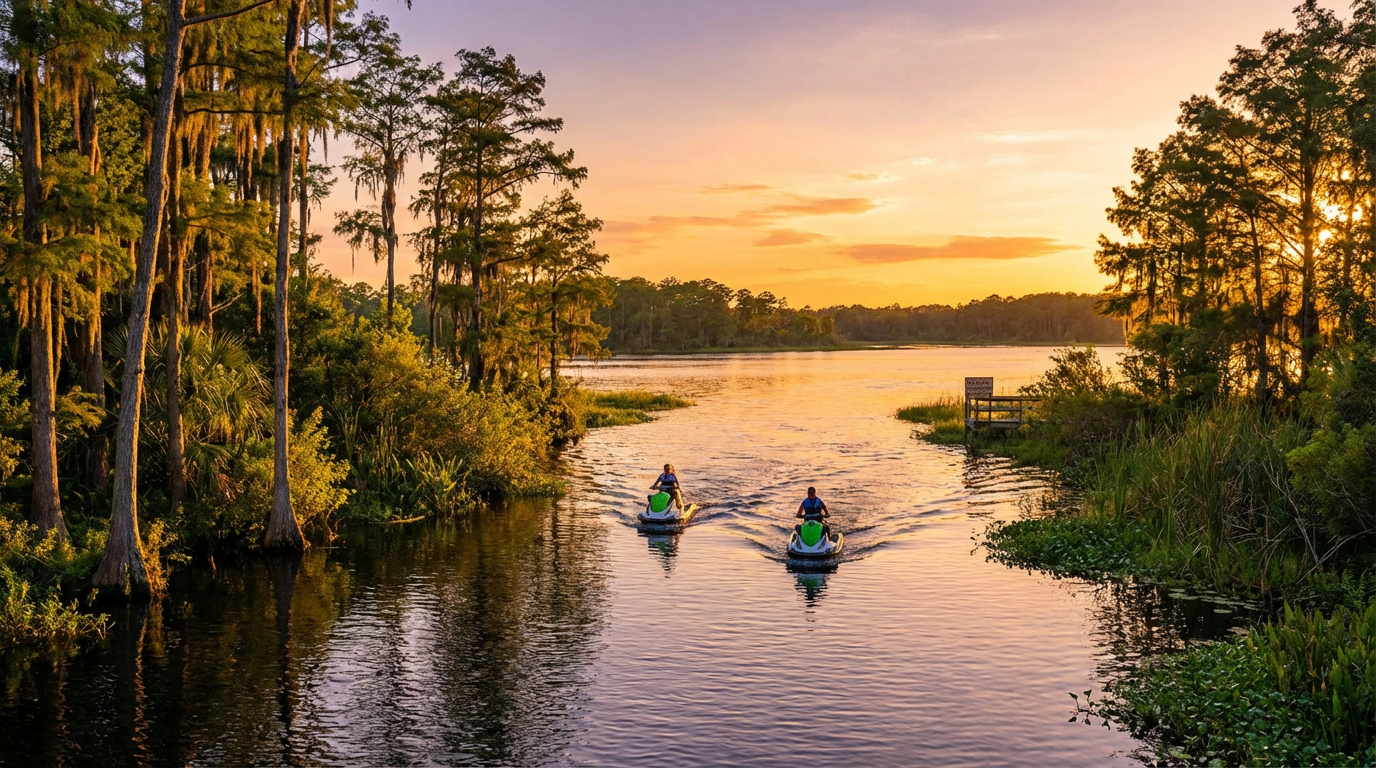
Understanding Wildlife Behavior in Lake Harris
For anyone planning a thrill ride across Florida's waterways, a specific question inevitably surfaces. Visitors constantly ask are there gators in Harris Chain of Lakes jet skiing areas? The short answer is yes. As a VisitFlorida Travel Partner operating in these waters since 2018, we can confirm that the Harris Chain—comprising Lake Harris, Little Lake Harris, Lake Eustis, and others—is a thriving ecosystem. However, understanding where these reptiles live and how they react to personal watercraft (PWC) is crucial for a safe experience. The reality of riding here is often quite different from the fearful images discussed on forums. Unlike the confined spaces of a zoo, this is a vast, open system where wildlife typically prioritizes survival over confrontation.
Habitat Preferences of Local Wildlife
To understand potential encounters, you must first understand the topography. The Harris Chain features nutrient-rich, tannic water, often referred to as "stained" water. According to data from the Florida Fish and Wildlife Conservation Commission (FWC), Florida is home to an estimated 1.3 million alligators, and they inhabit virtually every freshwater body in the state. However, they are not evenly distributed.
In our experience navigating these lakes, alligators heavily favor the littoral zones. These are the shallow, vegetated edges where cattails and cypress knees provide cover and hunting grounds. They rely on these areas for thermoregulation, basking in the sun on mudbanks to raise their body temperature. Conversely, the center of Lake Harris, which can reach depths of 30 feet and experiences significant wind chop, offers little appeal to a reptile trying to conserve energy. While you might spot a snout navigating a canal like the Dead River during transit, it is statistically rare to find them loitering in the open, deep water where jet skiers spend 90% of their time.
Impact of Engine Noise on Animal Behavior
One of the most overlooked factors in wildlife interactions is the sensory impact of a jet ski. Alligators are naturally wary of humans and large disturbances. They possess highly sensitive integumentary sensory organs (ISOs) along their jaws that detect vibrations in the water. The acoustic signature and hull vibration of a modern PWC traveling at 40 MPH create a sensory environment that most wildlife actively avoids.
Most visitors don't realize that the majority of negative alligator encounters reported by sources like the U.S. Geological Survey (USGS) generally involve swimming in quiet, non-designated areas or the illegal feeding of wildlife. A jet ski is loud, fast, and imposing. In my years on the water, I have consistently watched alligators submerge and retreat the moment they detect an approaching engine. They view the machine as a larger predator or a threat, not prey. Therefore, when discussing the question of are there gators in Harris Chain of Lakes jet skiing zones, remember that while the animals are present in the ecosystem, the noise of your ride serves as a highly effective deterrent.
Areas to Avoid for Maximum Peace of Mind
While the risk is low, prudence is key. To maximize safety and minimize stress, we recommend specific navigational adjustments:
- Stick to the Channels When moving between lakes, such as through the Haines Creek or the Dora Canal, stay in the marked navigation channels. These areas have higher boat traffic, which tends to keep wildlife pushed back into the adjacent marshes.
- Avoid Dawn and Dusk Alligators are crepuscular, meaning they are most active during low-light periods. Planning your ride between 10:00 AM and 4:00 PM significantly reduces the likelihood of seeing active wildlife.
- Vegetation is for Viewing Only Avoid cutting engines to drift silently into dense lily pad fields or tall marsh grass. These are prime nesting spots. If you need to stop, do so in open water with clear visibility 360 degrees around you.
Safety Protocols for Wildlife Encounters
In our experience facilitating water sports rentals since 2018, the most critical safety briefing occurs before you ever leave the dock. While the presence of wildlife is undeniable, incidents involving personal watercraft (PWC) and alligators are exceptionally rare, primarily because operators enforce strict protocols. When guests research are there gators in Harris Chain of Lakes jet skiing zones, we emphasize that safety relies on behavior management. The loud acoustics of a jet ski impeller churning underwater typically act as a deterrent, sending most reptiles submerging long before a rider approaches. Educational briefings focus on respecting the animal's space rather than fearing an aggressive pursuit.
Maintaining a Safe Distance from Shorelines
The cardinal rule for riding in Lake Harris, Lake Eustis, or the connecting canals is depth management. We instruct all renters to maintain a buffer zone of at least 100 feet from proper shorelines and emergent vegetation. This isn't just to avoid wildlife; it is a mechanical necessity. Jet skis utilize a direct-drive impeller system that sucks water from the bottom. Riding in shallow littoral zones—where alligators prefer to bask and hunt—risks sucking up hydrilla or mud, which can overheat the engine. For those prioritizing safety, the Orlando Jet Ski Rental — Harris Chain of Lakes (Tavares Launch) is a top choice, as their briefings specifically cover these depth management zones in detail.
Riders must be vigilant in "No Wake" zones, particularly the Dead River, a narrow canal connecting Lake Harris to Lake Eustis. Here, you are required by law to travel at idle speed. While transiting these narrow corridors, riders should stay in the absolute center of the waterway. If you spot a gator here, it is usually merely crossing from one side to the other. Continuing at a steady, predictable pace allows the animal to track your movement and avoid you.
Standard Wildlife Interaction Rules
A fundamental component of our safety orientation involves the Florida state laws regarding wildlife harassment. According to the Florida Fish and Wildlife Conservation Commission (FWC), it is illegal to intentionally feed or entice alligators. This is non-negotiable. Feeding creates "conditioned" animals that associate humans with food, stripping away their natural fear—a dangerous scenario for future visitors.
If you encounter wildlife while at speed:
- Do not chase Swerving toward an animal to get a GoPro shot is considered harassment and is punishable by law.
- Do not cut the engine If you see a gator ahead, maintain a steady throttle and steer around it. Sudden silence (cutting the engine) can sometimes pique an animal's curiosity, whereas the constant drone of the engine encourages them to keep their distance.
- Observe body language A gator that hisses or opens its mouth is signaling distress and defensiveness. This usually only happens if a rider has cornered the animal against a bank, violating the 100-foot buffer rule.
Emergency Procedures on the Water
The most common fear we hear regarding are there gators in Harris Chain of Lakes jet skiing experiences is the "what if I fall off?" scenario. Capsizing or falling off a PWC is a standard part of the sport, and standard operating procedures (SOPs) are designed to minimize risk.
When you enter the water, the immediate priority is re-boarding. Modern jet skis are equipped with re-boarding steps. We teach riders to approach the ski from the stern (back), never the side, to avoid tipping it again. While the water in the Harris Chain is tannic (tea-colored) and visibility is low, this does not mean an attack is imminent. Alligators are ambush predators that rely on stealth; the immense splash and commotion caused by a rider falling off, combined with the idling engine nearby, creates a sensory environment that most wildlife avoids. We discourage "swimming breaks" in vegetated covers or near dusk and dawn, which are peak feeding times.
Selecting the Right Watercraft for Safety and Stability
One of the most persistent misconceptions we encounter at Rockon Recreation Rentals involves the physical stability of the watercraft itself. Many visitors, recalling the lightweight "stand-up" models of the 1990s, fear that personal watercraft (PWC) are tippy, unstable vessels that will dump them into the water at the first sign of a turn. When addressing concerns about dangers on the water, the underlying anxiety is often about falling in. The reality of modern rental fleets is vastly different. Today’s recreational watercraft act less like water toys and more like compact boats. If high speed isn't your priority, Orlando Boat Rentals available at the same marina offer even greater stability.
Stability Features of Modern Personal Watercraft
The jet skis you will encounter on the Harris Chain—typically models like the Yamaha VX Deluxe or the Sea-Doo GTI—are engineering marvels designed specifically for stability and buoyancy. Unlike the 300-pound skis of the past, these modern "Rec-Lite" and "Recreation" class vessels typically weigh between 700 and 900 pounds dry. They utilize advanced hull geometries, such as deep-V designs, which cut through the wind-driven chop often found on Lake Eustis and Lake Harris in the afternoons.
From a biological perspective, size matters. An 11-foot-long, fiberglass machine differs drastically from smaller prey items alligators target. According to the Florida Fish and Wildlife Conservation Commission (FWC), alligators are opportunistic feeders that target accessible prey smaller than themselves. A standard rental PWC presents a large, loud, and hard profile that does not trigger a predator's feeding instinct. Furthermore, most modern skis feature a "reboarding step," allowing you to climb back on quickly and easily.
Comparing 2-Seater and 3-Seater Models
When selecting your vessel, we almost universally recommend opting for a 3-seater model, even if you are riding solo or with just one passenger. The physics behind this recommendation is simple: length equals leverage against the water.
- The 2-Seater (Rec-Lite) Models like the Sea-Doo Spark are agile and fun but have a shorter hull and are lighter (around 400-450 lbs). They sit lower in the water and are more reactive to rider weight shifts.
- The 3-Seater (Recreation/Luxury) This is the standard for most reputable rental outfits in Lake County. With lengths exceeding 130 inches and weight capacities often surpassing 500 pounds, these act as floating platforms. They are incredibly forgiving of weight shifts.
For visitors nervous about general safety, the 3-seater provides peace of mind. The added buoyancy keeps you higher above the waterline—often 18 to 24 inches at the seat level—providing a literal and psychological vantage point. This stability is significantly higher than what you might experience on a Jet Ski Rental South Beach adventure, where ocean swells can make idling difficult.
Why Jet Skis Are Safer Than Swimming
It is critical to distinguish the risk of swimming from the risk of boating. Swimming places a human directly in the food chain's environment, with a low profile that mimics distress (splashing, thrashing). In contrast, riding a PWC places you on top of the environment. In our years operating as a VisitFlorida Travel Partner, we have observed that wildlife invariably retreats from the sound and displacement of a jet ski.
The National Park Service notes that alligators generally shy away from humans and machinery unless they have been fed. The noise and vibration of a jet drive engine are deterrents. By staying on your vessel and avoiding the marshy edges where gators thermoregulate, you effectively remove yourself from the equation of risk.
Included Amenities and Safety Gear Services
When visitors ask about reptile risks on the water, the anxiety often isn't about the ride itself, but rather the fear of an unexpected swim. As a VisitFlorida Travel Partner, we emphasize that the primary defense against wildlife interactions isn't just driver behavior—it is the professional-grade safety infrastructure provided by reputable rental operators. Unlike private ownership, where maintenance and gear quality can vary, commercial rentals in Lake County are held to rigorous standards.
Since 2018, we have observed a shift in the local rental market; top-tier providers now bundle premium safety amenities that were once considered optional add-ons. These inclusions are specifically curated to address the topography of the Harris Chain, particularly the navigation of canals like the Dead River and the Dora Canal, where shallow waters and proximity to shorelines make distinct gear essential.
Essential Safety Equipment Provided
The days of being handed a flimsy, orange "horse-collar" life jacket are largely over for premium rentals. Legitimate operators on Lake Harris and Lake Eustis provide United States Coast Guard (USCG) approved Type III Personal Flotation Devices (PFDs). Unlike the Type II vests often found on pontoon boats, Type III vests are designed for high-impact water sports. They are form-fitting, preventing the vest from riding up over your head upon impact.
Furthermore, federal law and Florida Fish and Wildlife Conservation Commission (FWC) regulations mandate the use of an engine cutoff switch link (ECOSL). Every rental unit is equipped with this lanyard system, which attaches to the rider’s wrist or PFD. If you fall off, the engine creates an immediate "kill," stopping the jet ski within feet of you. This is the single most important safety feature for mitigating concern regarding are there gators in harris chain of lakes jet skiing, as it ensures you are never stranded in the water.
Communication Tools for Emergencies
Communication breakdowns are a primary risk factor in water sports. While the Harris Chain generally offers better cellular coverage than the remote Everglades, dead zones exist. Standard rental packages now strictly adhere to the Florida Statute 327.50 requirement for sound-producing devices. You will find a marine-grade whistle attached directly to your life vest.
Beyond the legal minimums, veteran operators typically provide waterproof dry bags or hard-case storage compartments. We advise renters to keep a phone in these verified dry zones to maintain a line of contact with the rental base. Some premium commercial fleets have begun integrating waterproof two-way radios for guided tours.
Navigational Aids to Keep You in Safe Zones
Getting lost is the fastest way to end up in the shallow, vegetated littoral zones where alligators prefer to hunt and bask. The Harris Chain is complex; navigational errors often occur at the junction of the Dead River and Lake Eustis. To combat this, standard rentals include laminated, waterproof charts that clearly mark not just depth, but specific "Idle Speed" and "No Wake" zones.
However, the industry standard is moving toward digital solutions. Many high-end Yamaha and Sea-Doo rental units now feature integrated GPS systems with geofencing capabilities. According to BoatUS Foundation safety guidelines, maintaining situational awareness via GPS significantly reduces grounding incidents. By keeping you in the deep, open channels (typically 15 to 25 feet deep in Lake Harris), these navigational tools naturally separate riders from the shoreline habitats.
Pricing and Rental Duration Options for Every Budget
When planning a trip to Central Florida, budgeting often focuses heavily on lodging and flights, but understanding the nuance of watersport pricing is essential for a stress-free experience. As a VisitFlorida Travel Partner operating since 2018, we have seen countless visitors book the shortest possible rental to save money, only to find themselves rushing through the waterways. This haste can inadvertently create safety risks. When visitors ask about the presence of gators, they often fail to realize that time pressure is a significant risk factor; rushing riders are more likely to cut corners through shallow, vegetated "shortcuts."
Hourly Rates Versus Package Deals
The Harris Chain is massive, covering over 75,000 acres. A straightforward one-hour rental is rarely sufficient to explore beyond the immediate vicinity of the launch ramp—typically areas like Venetian Gardens in Leesburg or the shores of Tavares. While a one-hour rental offers a quick adrenaline rush, the cost-per-minute is generally the highest in this bracket, though still often more competitive than tourist-heavy Jet Ski Rental Orlando pricing found closer to the theme parks.
- Standard Hourly Rate Expect to pay between $85 and $125 per hour for a single jet ski. This usually includes life jackets and basic instruction.
- Multi-Hour Discounts Most reputable outfitters offer a sliding scale. A two-hour rental often drops the effective hourly rate to approximately $75–$90.
- Full-Day Packages For an 8-hour rental, prices typically range from $450 to $600. While the upfront cost is higher, the hourly breakdown drops significantly (often under $60/hour), making this the most economical choice for groups.
According to rental market analysis from Travel + Leisure, booking mid-week (Tuesday through Thursday) can sometimes yield an additional 10-15% savings compared to weekend peak rates.
Benefits of Half-Day Rentals
The "sweet spot" for most visitors navigating the Harris Chain is the half-day (4-hour) rental. From our operational experience, four hours allows a rider to legitimately travel from Lake Harris, through the Dead River, and into Lake Eustis or even Lake Dora without unintentional rule-breaking.
The safety implication here is distinct. Riders on a tight one-hour clock often panic about late return fees (which can exceed $30 per 15 minutes). This panic leads to speeding through no-wake zones or traversing shallow, marshy littoral zones to save time. By booking a half-day, you afford yourself the luxury of staying in the deep, center channels. This keeps you far away from the shoreline vegetation, answering the concern regarding are there gators in Harris Chain of Lakes jet skiing areas by simply keeping you out of their preferred habitat.
Cost Factors for Fuel and Insurance
The advertised rental price is rarely the final number on your receipt. To budget accurately, you need to account for fuel consumption and liability coverage.
Unlike rental cars, jet skis are rarely returned with a full tank by the customer. Instead, you typically pay for what you use upon return. A modern Yamaha VX or Sea-Doo Spark generally burns between 3 to 5 gallons per hour at moderate cruising speeds. However, aggressive riding at full throttle can spike this to 8+ gallons per hour. Operators usually charge marina pricing for fuel, so for a vigorous 4-hour ride, budget an additional $60 to $80 for fuel.
Most rental agreements also require a refundable security deposit, typically held against a credit card. In the Harris Chain area, this averages $300 to $500 per ski. Additionally, if you need a temporary boating certificate, expect a small fee (usually around $10) for the online exam.
Navigating the Booking Process and Documentation
While the anticipation of throttle-down freedom on the water is exciting, the administrative side of jet ski rentals in Florida is governed by strict state statutes, not just rental company policies. As a VisitFlorida Travel Partner, we often see visitors caught off guard by the documentation requirements, which can delay or even cancel a planned excursion. Navigating these logistics effectively is the first step toward a safe experience on the Harris Chain.
Step-by-Step Reservation Guide
Booking a personal watercraft (PWC) in Lake County utilizes a digital-first approach. Unlike beach rentals where walk-ups are common, the marinas servicing Lake Eustis and Lake Harris typically operate on scheduled slot systems to manage traffic in the canals, such as the Dora Canal and Dead River.
Most visitors don't realize that during peak alligator mating season (May through June), early morning slots—typically 9:00 AM to 11:00 AM—are not only safer regarding thunderstorms but also offer the calmest water. We recommend booking at least 48 hours in advance through the Rockon Recreation Rentals to secure these prime times. Once booked, you will receive a confirmation email containing the launch location, typically at established points like Hickory Point Recreation Park or Venetian Cove Marina.
Age and ID Requirements for Renters
The most common hurdle for out-of-state visitors involves Florida’s boating safety laws. According to the Florida Fish and Wildlife Conservation Commission (FWC), anyone born on or after January 1, 1988, must successfully complete an approved boating safety course to operate a vessel powered by a motor of 10 horsepower or more.
For renters, this means you must generally be at least 18 years old to sign the rental contract. However, drivers as young as 14 can operate the ski if they hold the safety card and are accompanied by an adult, depending on the specific vendor's insurance policy. If you do not have a permanent boating safety card, you can take a temporary exam online prior to arrival. We strongly advise taking this test 24 hours before your booking. You must carry a physical photo ID and your boater education card (or temporary certificate) while riding.
Understanding the Rental Agreement and Waivers
The rental agreement is legally binding and addresses specific environmental risks inherent to Central Florida. This is where the theoretical question of wildlife presence becomes a contractual reality. Standard liability waivers in Florida include clauses regarding "interaction with wildlife," which covers everything from jumping mullet to alligators and submerged cypress stumps.
These clauses are standard operating procedure and are not an indication of heightened aggression in the area. They function to affirm that you understand you are entering a wild habitat, not a controlled amusement park. The agreement will also outline the security deposit policy. Vendors typically place a hold of $500 to $1,000 on a major credit card to cover potential damages to the impeller or hull—damage often caused by running into shallow, vegetation-heavy preservation zones where wildlife, including alligators, tend to nest.
Real Rider Reviews on Wildlife Safety
For many prospective visitors, the anticipation of a jet ski adventure is often mixed with a specific anxiety regarding local reptiles. As a booking platform that processes thousands of rentals, we frequently analyze post-ride feedback to monitor safety standards and customer satisfaction. The data reveals almost universally that the pre-ride fear found in queries like are there gators in Harris Chain of Lakes jet skiing areas is significantly higher than the reality of the on-water experience. While the concern is valid given Florida's reputation, the consensus among hundreds of verified reviews for rentals launching from Tavares, Mount Dora, and Eustis is that wildlife encounters are generally passive, distant, and considered a highlight rather than a hazard.
Most negative anticipation dissolves within the first ten minutes of the ride. We find that what riders expect—aggressive animals actively patrolling the water—contrasts sharply with what they experience. They typically find a vast, open waterway where wildlife generally retreats from the noise and wake of a Personal Watercraft (PWC). Credible rental operators in Lake County maintain strict safety protocols, and according to the Florida Fish and Wildlife Conservation Commission (FWC), unprovoked incidents involving visitors on watercraft are statistically anomalous.
Testimonials on Safety and Staff Support
The primary theme in rider feedback centers on the effectiveness of the safety briefings provided by local outfitters. New riders often arrive at the docks in Wooton Park or near the Dora Canal expecting to be thrown the keys and left to fend for themselves. Instead, reviews consistently highlight the thoroughness of the "land-side introduction."
Experienced rental staff, many of whom have spent decades on the Harris Chain, provide detailed maps indicating "safe zones" for high-speed riding and specific "idle/no-wake zones" where vigilance is required. One frequent sentiment expressed in reviews is the calming effect of knowing exactly where to go. Riders note that understanding the difference between the deep, chop-heavy water of Lake Eustis (where gators rarely venture) and the marshy edges of the Dead River helps them manage their comfort levels.
Experiences with Wildlife Sightings
When verified guests review their experience, the context is almost always one of safe observation rather than confrontation. We often see reviews stating, "We saw a medium-sized alligator sunning on a log, but it didn't even look at us." This behavior aligns with biological facts; most reptiles in this system are habituated to the sound of boat engines and associate them with danger, opting to stay submerged or motionless on the bank.
A common review pattern involves the popular run through the Dora Canal. While this cypress-lined corridor is a prime habitat, it is also a strict no-wake zone. Riders appreciate that the slow pace allows them to spot wildlife from a safe distance—typically 20 to 50 yards away. The fear of an animal "chasing" a jet ski is a cinematic trope that does not appear in our customer feedback logs. For a deeper dive on safe observation distances, the National Park Service suggests keeping a safe distance of at least 15 to 20 feet, a buffer that is easy to maintain on an agile jet ski.
Why Families Feel Safe Renting Here
Families with teenagers constitute a large portion of our rental demographic in the Harris Chain, and their feedback highlights the stability of modern equipment as a major confidence builder. Modern skis like the Yamaha VX series, commonly used by our partners, are incredibly stable platforms. A recurring realization in reviews is how difficult it actually is to fall off these machines unless the rider is engaging in reckless maneuvers.
- Stability minimizes exposure Parents report relief realizing they are riding on the water, not in it. The likelihood of an involuntary swim is low for responsible riders.
- Traffic control Unlike the crowded diverse waterways of South Florida, the Harris Chain offers thousands of acres of open water. Reviews mention that the lack of congestion allows riders to give shoreline vegetation a wide berth (often 100+ yards), completely removing them from the typical gator habitat zone.
Local Insights on Rental Companies and Safety Focused Offerings
Selecting the right rental provider in Tavares—often dubbed "America’s Seaplane City"—is about more than just finding the lowest hourly rate; it is a critical component of risk management. As a VisitFlorida Travel Partner operating here since 2018, we have observed that the quality of your briefing directly correlates to the safety of your ride. When tourists ask if it is safe to ski, the most honest answer comes from operators who provide detailed territory maps rather than just handing over a key.
Evaluating Rental Provider Reputation
Not all rental operations in Lake County are created equal. The most trustworthy providers operate out of established marinas, such as those near Wooton Park in Tavares or the Mount Dora Boating Center, rather than pop-up stands that may bypass safety protocols. A primary indicator of a top-tier provider is their adherence to the Florida Fish and Wildlife Conservation Commission (FWC) boating safety education requirements.
Furthermore, reliable operators maintain their fleets meticulous to prevent mechanical failures. In an ecosystem where wildlife presence is a valid consideration, the last thing a rider wants is a stalled engine drifting toward the cattails in the Dead River canal. We recommend asking providers specifically about their towing protocols and whether their PWCs are equipped with GPS tracking.
Guided Tours Versus Free Riding
For visitors unfamiliar with the 75,000-acre Harris Chain, the choice between a guided tour and a "free ride" rental is the single biggest factor in mitigating wildlife encounters. While free riding offers autonomy, it places the burden of navigation entirely on the guest. The intricate canal systems, particularly the Dora Canal and the Dead River, require strict adherence to "Idle Speed/No Wake" zones. Guided tours offer a significant safety advantage because local guides know the deep-water channels intimately. According to safe boating practices outlined by the National Association of State Boating Law Administrators (NASBLA), situational awareness is the primary defense against accidents; a guide provides that awareness essentially on loan.
Special Packages for First-Time Riders
To bridge the gap between anxiety and adventure, several Tavares-area companies now offer introductory packages designed for novices. These often utilize "learning keys" or governor modes on the personal watercraft. This technology electronically limits the top speed of the vessel—typically to around 35 or 40 MPH—allowing new riders to master maneuvering without the risk of losing control at the 60 MPH speeds modern skis can reach. What most visitors don't realize is that these packages frequently include a stronger focus on orientation "laps" within a visible designated zone before the rider is cleared to head into open water.
Risk Assessment for Alligator Encounters
When our guests arrive at the dock, the apprehension is often palpable. The question of are there gators in Harris Chain of Lakes jet skiing zones is usually the final hurdle before they commit to an adventure. As a Rockon Recreation Rentals VisitFlorida Travel Partner operating locally since 2018, we believe that informed riders are safe riders. The perception of danger often eclipses the reality, driven more by cinematic dramatization than biological fact.
Statistical Reality of Wildlife Attacks
The discrepancy between the perceived threat of wildlife and the actual risks of water sports is stark. According to the Florida Fish and Wildlife Conservation Commission (FWC), Florida consistently leads the nation in registered vessels, yet wildlife interactions constitute a statistical anomaly for boaters. In the 2022 Boating Accident Statistical Report, attacks by alligators on moving Personal Watercraft (PWC) are virtually non-existent.
The Harris Chain, specifically Lake Harris and Lake Eustis, sees thousands of PWC launches annually. In our years of facilitating rentals here, we have never documented an instance of an alligator aggressively pursuing a jet ski that is actively under power. Alligators are ambush predators that rely on stealth and energy conservation. Chasing a noisy, 130-horsepower machine moving at 40 MPH contradicts their biological imperative to conserve energy.
Human Error Versus Animal Aggression
In the rare instances where interactions occur, human error is almost invariably the catalyst. The most significant risk factor is not the presence of the animal, but the behavior of the human. Feeding alligators, which is illegal under Florida law, conditions them to associate humans with food. This typically happens near residential docks or fishing piers, not in the open channels where jet skiers operate.
The acoustic footprint of a jet ski acts as a deterrent. The vibration and noise of the impeller underwater signal "danger" to aquatic reptiles. Danger arises only when riders ignore safety protocols, such as killing the engine in littoral zones to drift silently into heavy vegetation. This removes the acoustic deterrent and puts you in their territory.
Final Verdict on Water Safety
Ultimately, the answer regarding local gator activity is that their presence does not equate to an imminent threat for responsible riders. The University of Florida's Institute of Food and Agricultural Sciences (IFAS) emphasizes that alligators are naturally wary of humans. The Harris Chain offers expansive, deep-water riding zones where gators simply do not loiter. The verdict is clear: the danger is manageable and minimal if you adhere to standard boating safety.
Final Thoughts for Your Harris Chain Adventure
Planning a day on the water involves balancing the thrill of speed with the realities of navigating a wild ecosystem. After facilitating thousands of rentals since 2018, our perspective is grounded in daily operations rather than internet hearsay. While the Harris Chain of Lakes defines the "Old Florida" aesthetic with its cypress-lined shores, it remains one of the safest places for high-speed water sports when protocols are followed.
Balancing Wildlife Safety with Recreation
The primary concern for most new visitors is understanding the real risk profile. When asking about local reptiles, the answer is grounded in behavioral biology rather than horror movie tropes. Alligators do not hunt objects moving at 40 to 50 MPH. In our operational history, we find that the vibration and noise of a Personal Watercraft (PWC) engine act as a powerful deterrent.
The Florida Fish and Wildlife Conservation Commission (FWC) consistently reports that most aggressive encounters occur when humans feed wildlife or swim in designated "no swim" vegetated areas at dusk or dawn. By staying in the marked navigation channels and open water—areas where jet skis perform best anyway—you effectively segregate yourself from the alligator's preferred habitat in the littoral zone.
Selecting the Right Rental Partner
Your choice of rental outfitter plays a surprisingly large role in your wildlife experience. We advise booking with companies that utilize well-maintained floating docks or developed concrete boat ramps, such as those found at Wooton Park in Tavares or Venetian Gardens in Leesburg. Launching from a primitive, grassy shoreline forces you to wade through shallow, murky water where visibility is zero—exactly where gators tend to bask or hide.
Documentation and Booking Logistics
Before arriving at the dock, securing the necessary credentials is mandatory for legal operation. Florida law is strict regarding boating education. Anyone born on or after January 1, 1988, must possess a Boating Safety Education Identification Card to operate a vessel of 10 horsepower or more. Most reputable rental locations can issue a temporary certificate for the duration of your rental, but this requires an exam that takes approximately 20-30 minutes. We recommend completing the official state-approved course online before your trip to save time.
Finally, regarding the question about wildlife safety, remember that preparedness is the ultimate safety tool. Book your slot at least 48 hours in advance, especially for weekends between March and September. Bring polarized sunglasses to spot submerged logs or wildlife easier, and always carry a waterproof bag for your phone so you can map your location. By respecting the local wildlife and adhering to state regulations, you ensure a safe, high-adrenaline exploration of Central Florida's premier lake chain.
Essential FAQs Regarding Safety Logistics and Wildlife on the Harris Chain
At Rockon, we have facilitated thousands of rental bookings across Central Florida, and our team hears the same specific concerns from first-time visitors to Lake County. While the thrill of skimming across Lake Eustis or navigating the Dora Canal is the primary draw, pragmatic questions regarding safety and legality are paramount. Below, we address the critical inquiries regarding wildlife interactions, pricing structures, and state regulations.
Do Alligators Pose a Threat to Jet Skiers?
This is the single most frequent inquiry we receive. When visitors research are there gators in Harris Chain of Lakes jet skiing areas, they are usually really asking if they are at risk of an attack while riding. According to state data, unprovoked alligator attacks are statistically rare. In the context of Personal Watercraft (PWC) usage, the risk is negligible.
From an operational standpoint, the noise and vibration generated by a jet ski engine (even quieter 4-stroke models) act as a powerful deterrent. Alligators are ambush predators that rely on stealth; a loud, fast-moving object typically triggers their flight response rather than aggression. In our years of navigating the connect channels like the Dead River, we have observed that gators will submerge and retreat long before a jet ski comes within 50 feet of them. The danger primarily exists if a rider shuts off their engine and drifts silently into dense vegetation (cattails or marsh) at dawn or dusk—behavior we strictly advise against.
What Are the Licensing Requirements for Renting?
Florida maritime law is strict but straightforward regarding PWC operation. If you were born on or after January 1, 1988, you are required by law to possess a Boating Safety Education Identification Card. Most visitors do not have the permanent card, but this does not prevent you from renting. Rental liveries in Tavares and Mount Dora are authorized to administer a Temporary Boating Safety Education Certificate exam.
Pricing, Amenities, and Hidden Costs
Understanding the total cost of a day on the Harris Chain is vital for budgeting. As of 2026, the base rate for high-quality jet ski rentals (such as Yamaha VX or Sea-Doo GTI models) in the Golden Triangle area ranges from $85 to $125 per hour. However, experienced renters know to look for the "out-the-door" price. Fuel policies vary significantly between operators; some include the first tank, while others charge a flat rate of $20-$40 per ride or bill strictly based on consumption upon return.
Is It Safe to Swim in the Lakes?
While gator presence is a valid concern, water clarity is often a bigger factor for swimmers. The Harris Chain consists of nutrient-rich, tannic water, meaning visibility is low. We advise against swimming near the shoreline where vegetation hides wildlife and submerged cypress knees. If you wish to take a dip to cool off, the safest practice is to stop the ski in the open annual water of Lake Harris or Lake Eustis, far from the littoral zones. Always keep the engine off and the kill-switch lanyard attached to your wrist while in the water to prevent the ski from drifting away in the wind.