1. You Avoid the Paved Nature Theme Park Trap
My right boot dragged across the loose granite scree, sending a dry, chalky crunch echoing off the canyon walls as I slid backward down what the internet called a "family-friendly route." I was sucking in thin air that tasted faintly of dry pine needles and metallic dread. The guidebook had promised a gentle morning ascent. That glossy guidebook, as local trail veterans know, was an optimistic work of fiction.
Go 45 minutes outside Denver on I-70, and the main trails feel like an outdoor shopping mall. I spent a long weekend mapping out the parking capacities at Rocky Mountain National Park. The state tourism board seemingly wants you shuffling like livestock up wide, paved switchbacks while listening to a stranger's Bluetooth speaker play a slightly off-beat reggae cover. You deserve better than trailing behind groups echoing pop music right as a bull elk sounds its rusty, bugle-like morning call.
I can't definitively prove this, but I heavily suspect agencies pave these short stretches purely to trap most foot traffic in one asphalt pen. They call it visitor management so it sounds scientific in their quarterly 2026 reports. It's really just a massive decoy to protect the actual wilderness from casual foot traffic.
2. Altitude Sickness Does Not Care About Your Spin Class
My 2019 self would have tried to sprint up a 10,000-foot ridge just to prove a point. My 2026 self takes about three steps and happily calls for a tactical photography break. Around ten thousand feet, your brain firmly insists you ran a marathon, even if you are just safely sitting on a boulder eating a handful of trail mix.
According to the National Park Service, visitors at this altitude experience a severe drop in effective atmospheric oxygen. The air feels crisp and thin in your lungs, almost like swallowing crushed ice. Your resting heart rate spikes randomly.
If you want to survive your first major ascent without a skull-splitting headache, respect the atmosphere. The smartest approach requires starting hydration on the airplane flight over. Sipping a single plastic water bottle at the trailhead is functionally useless. Your body requires significantly more liquid to process oxygen in this dry, high-altitude environment. That sudden breather you take on the trail is just a moment when the mountain politely asks you to sit down.
3. Those Easy Access Roads Are Actually Vehicle Traps
Finding genuine trailheads means ignoring the heavily edited maps handed out at the Denver airport rental counter. If you drive an hour past the major resort towns, the asphalt eventually turns to a jarring, washboard gravel road that rattles your teeth so hard you taste your own fillings. When the cell service permanently drops out, you are getting warm.
I recently watched a family try to navigate a heavily rutted logging road in a low-clearance rented convertible. You could hear their engine's oil pan violently scraping against the exposed bedrock from half a mile away.
As a Travel Partner who typically coordinates coastal excursions through Rockon Recreation Rentals—where the most perilous thing is a sandy parking lot—the mountain infrastructure is a brutal wake-up call. The tourism bureau occasionally under-maintains these dirt access roads on purpose. They want to scare off casual drivers. Even getting your vehicle safely to the starting line is a test of will.
4. Going Guided is the Ultimate Local Cheat Code
Here is the friction of modern travel. The wild places are hard to navigate, but the easy places are entirely overrun. If you want to experience authentic adventures, colorado visitors usually face a miserable binary choice. You either suffer a grueling, dangerous backcountry slog entirely alone, or you stand in a slow-moving line at a paved overlook holding a paper map.
The actual solution is booking a catered Rocky Mountain Hiking Tour. A private, local outfitter realistically changes the math of the entire day. You get scooped up in an upscale transit vehicle from Boulder or Denver with heavy-duty suspension, completely bypassing the rental car tire damage.
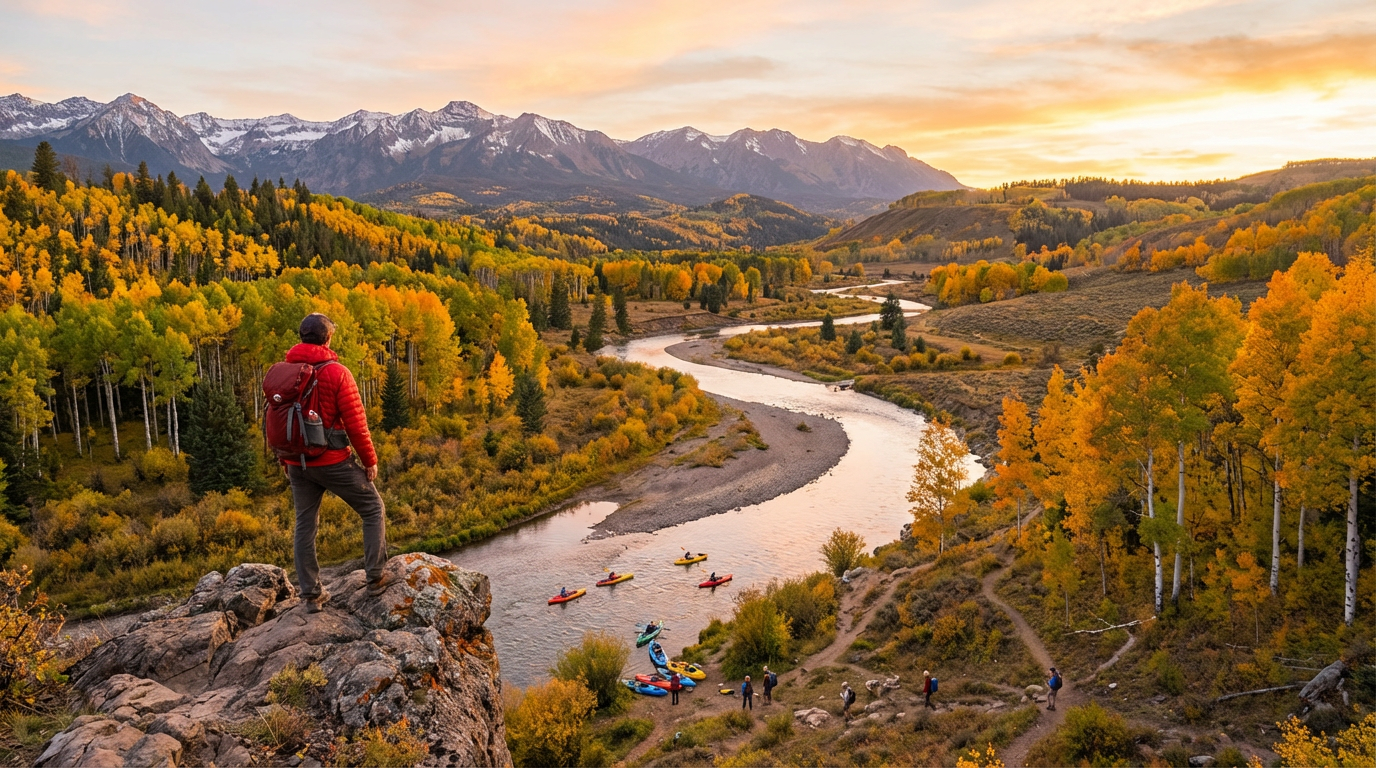
A professional hands you a properly loaded hydration pack, handles the exact navigation, and walks you directly to the secluded aspen groves the internet hasn't ruined yet. You get the deep, ringing silence of a high-alpine environment without the absolute misery of logistical planning. It feels like securing the answers to a test before you even sit out to take it.
5. Afternoon Lightning is a Mandatory Appointment
This brings us to why paying for a seasoned chaperone isn't a sign of weakness. It is a vital survival tactic. Welcome centers constantly downplay afternoon storms to keep local gift shop sales predictably high, but above the tree line, the air eventually tastes distinctly like dry copper. That is the atmospheric ozone shifting.
A recent 2026 meteorology bulletin from Colorado State University warns that towering alpine formations generate their own isolated microclimates. The sky simply decides it wants to drop icy marbles on your head at 1 PM, regardless of what your smartphone weather app fiercely claims. Lightning above 11,000 feet does not politely rumble in the distance. It cracks like a physical whip directly above your head.
When coordinating these altitude adventures, colorado guides know the subtle difference between a fluffy white cloud that brings shade and a menacing gray shelf that brings electrical strikes. When the barometric pressure drops so fast your ears pop, your guide is already turning you around. A bruised ego heals considerably faster than a lightning strike.
6. The Furry Locals Strictly Hold the Right of Way
Wait, what? The most stubborn obstacle on the trail isn't the weather. It is the wildlife hierarchy. Marmots absolutely have the right of way. Always. Do not argue with a rock squirrel at 11,000 feet while your lungs desperately beg for oxygen.
Back in Florida, when we tell folks booking a Dolphin Cruise Pensacola Beach to respect marine life, it realistically means keeping your hands inside the boat. Up here, mammals dictate the actual hiking pace. Countless visitors foolishly try to get within reaching distance for a macro smartphone photo. They learn the hard way that these animals are persistent, fearless opportunists holding surprisingly sharp teeth.
If you visit in the early fall of 2026, you also have to aggressively navigate the elk rutting season. Out-of-state tourists frequently mistake massive, territorial bull elk for docile petting-zoo animals right up until the animal charges. Survival on these trails frequently means yielding the narrow dirt path entirely to the locals.
7. The Wide Gap Between a Walk and a Scramble
The state tourism board desperately wants you to believe every mountain path is a gentle stroll ending in a perfect, glowing sunset. I read their official 2026 summer guide. The entire document felt like an elaborate marketing trap. If a specific overlook is proudly printed on a heavy cardstock brochure, the parking lot is completely full by sunrise.
When hunting for unforgettable adventures, colorado geography forces you to learn the harsh difference between a dirt walk and a boulder scramble. A walk means you get to look up at the bright yellow aspen leaves. A scramble means you taste dust. The transition from a packed dirt path to a loose scree field happens abruptly. One minute you are walking normally, and the next you are sliding backward half a step for every forward stride.
Your hands will smell like cold, wet iron from grabbing raw granite. You physically pull your body weight up over giant, uneven stone blocks. This is precisely why aligning with a guided outfitter who correctly matches your physical ability to the route is critical. Nobody wants to sign up for a walk and end up doing amateur parkour over a rocky ravine.
8. The Ongoing Absurdity of Automated Digital Booking
I spent four nights cross-referencing topographic maps with obscure Reddit threads from 2019 just to visually vet a single trail. I do this purely so you don't have to. Relying on massive, generic tech platforms to plan a rugged mountain trip usually leaves you wandering around an empty dirt lot.
I recently ran into a hilarious digital wall where a major booking website advertised a wild canyon hike, but the linked GPS pin dumped confused users at a suburban strip mall. I actually drove there out of morbid curiosity. The heavy, chemical smell of a commercial dry cleaner completely replaced the scent of ponderosa pine.
Corporate software developers just scrape keywords off the web without verifying reality. The federal US Forest Service explicitly warns against relying purely on smartphone map applications in the backcountry for precisely this reason. Cell network towers rarely penetrate the deep granite folds of the Front Range. Real wilderness mapping requires human beings who actually walk outside. At Rockon Recreation Rentals, we demand that operators verify their staging areas strictly in person.
9. The High Elevation Quiet Radically Adjusts Your Baseline
Top-tier preparation only goes so far against an indifferent mountain range. We outfit plenty of warm coastal trips where outdoor elements remain stubbornly predictable. Up past the tree line, the air temperature easily drops ten degrees in a matter of seconds. You heavily pull your collar up against the biting wind.
You are cold. You are tired. Your rented boots feel significantly heavier than they looked in the warm, well-lit store.
And then the wind just stops. The silence in a high-elevation basin is absolute. It is a heavy, thick quiet that rings in your ears. Without the howling gusts, the space feels enormous. The rich, metallic smell of approaching rain hits your nose just as heavy droplets start smacking your shoulders. This is what real travel looks like. It is rarely comfortable, but it leaves a lasting mark.
Leaning your back against a cool granite slab to rest your lungs, you realize exactly why people keep paying to return to these pristine guided ascents year after year. The mountain gracefully strips down your ego until you are just profoundly grateful for a gentle breeze.