According to municipal grade data, the incline on Marion Street is 18.4 percent. You will feel every single decimal point in your hamstrings. A guy holding a half-eaten piroshky just stood on the corner and watched me push my aluminum frame up the sidewalk in absolute defeat. I leaned the bike against a damp gray wall. The heavy, metallic scent of boat fuel drifted up from the harbor. My lungs burned. A city bus hissed past, spraying a fine mist of pavement water onto my left shoe.
I spent three days before this trip cross-referencing topographic overlays with the city's designated bike routes, desperately trying to find a flat egress from downtown. Research is my love language; reality is my ex. I stared at red and green legend markers on my dual monitors until my eyes physically throbbed. Banging my head against Seattle Department of Transportation (SDOT) PDF maps from 2021 through 2026 taught me a hard lesson. A thick green line on a municipal app does not equal a level road. Cycling in Seattle is a beautiful, punishing lie if you look strictly at 2D transit grids.
Back in my 2018 Florida days, mapping trails meant calculating humidity levels and dodging iguanas entirely on flat pavement. Moving operations for VisitFlorida partners to the Pacific Northwest in 2026 meant ripping up that mental baseline. My previous definition of an intense elevation gain was a sandy highway overpass in Tampa. Seattle's glacial-carved ridges require an entirely new set of physical survival mechanics.
3 Reasons Digital Topography Maps Lie to You
You cannot trust the glowing primary line on your phone. Commuter routing software prioritizes distance over contour. It does not care about your calves. I read a glowing 2025 profile in Travel + Leisure that claimed the core grid was casually accessible for sightseeing. They clearly never tried pedaling a rented beach cruiser up Yesler Way.
The Hardware Disconnect on Two Wheels
You need the proper mechanical advantage to tolerate cycling in Seattle. At Rockon Recreation Rentals, we mandate wide-range cassettes for coastal cities that feature this kind of aggressive terracing. A Tuesday afternoon ride to grab coffee should not require a lactic acid recovery plan. You hear the faint, high-pitched mechanical whine of a heavily loaded chain stretching as you try to force a standard ten-speed up a 12 percent grade.
According to the Seattle Department of Transportation, modern urban traffic revision projects are specifically formulated to incorporate gradual protected lanes to reduce commuter strain. In practice, historical transit maps often draw commuter safety corridors straight up steep ridgelines without a single switchback in sight. The pavement just tilts toward the sky and dares you to try.
If you want to protect your joints, keep these routing survival tactics in mind this season:
- Manually reroute your apps Loop through the lower commercial districts. It adds about ten minutes but keeps you on level ground.
- Identify the elevator cheats Several downtown public buildings feature cavernous elevators you can roll a bike right into, completely bypassing the worst staircases near the waterfront.
- Embrace the switchback Zig-zagging across a steep grid block is mostly legal and entirely necessary for survival.
4 Reasons the Pike Place Cobblestones Are a Trap
My front tire hit the Pike Place Market entrance. Instantly, my handlebars turned into a jackhammer. The harsh vibration of the uneven cobblestones shot straight up my forearms, rattling my teeth. The air here hangs heavy with a chaotic, beautiful mix of melting fish ice and caramelized sugar from a corner bakery.
Ever notice you never see actual residents riding through the main market alley? Because the 2026 pedestrian zone is a tightly packed free-for-all. Delivery trucks, lost tourists, and aggressive seagulls share the same narrow space every morning. Do not be the person weaving a heavy metal frame through a dense crowd holding delicate floral bouquets. Get off the saddle and walk.
Historical records from the Pike Place Market Preservation and Development Authority show much of this foundational pavement dates back generations. That aged charm means the bricks are physically worn down, rounded off, and completely slick under narrow tires. Trying to pedal through just ruins the magic of cycling in Seattle entirely.
I expected to scowl and push my bike out of the congestion as fast as possible. Wait, what? The forced walking pace completely shifted my mood. Dismounting led me to a tiny pop-up stall selling warm, cinnamon-dusted peaches I would have otherwise rolled right past in an anxious blur. I chatted with the farmer for a few minutes while the rain tapped against his canvas tent.
The pastry was phenomenal.
Escaping the Market Pavement
Navigating the lower street levels requires situational awareness. Loop around the back side near Western Avenue. You will find a dedicated, paved ramp connecting straight down to the Elliott Bay Trail. Surviving the quirks of cycling in Seattle requires finding these hidden concrete release valves. The salty ocean breeze hits your face as the path finally stretches out along the harbor.
Someone had left a single, perfectly good black dress shoe sitting on top of a parking meter near the ramp.
Finding the Essential Coastal Route
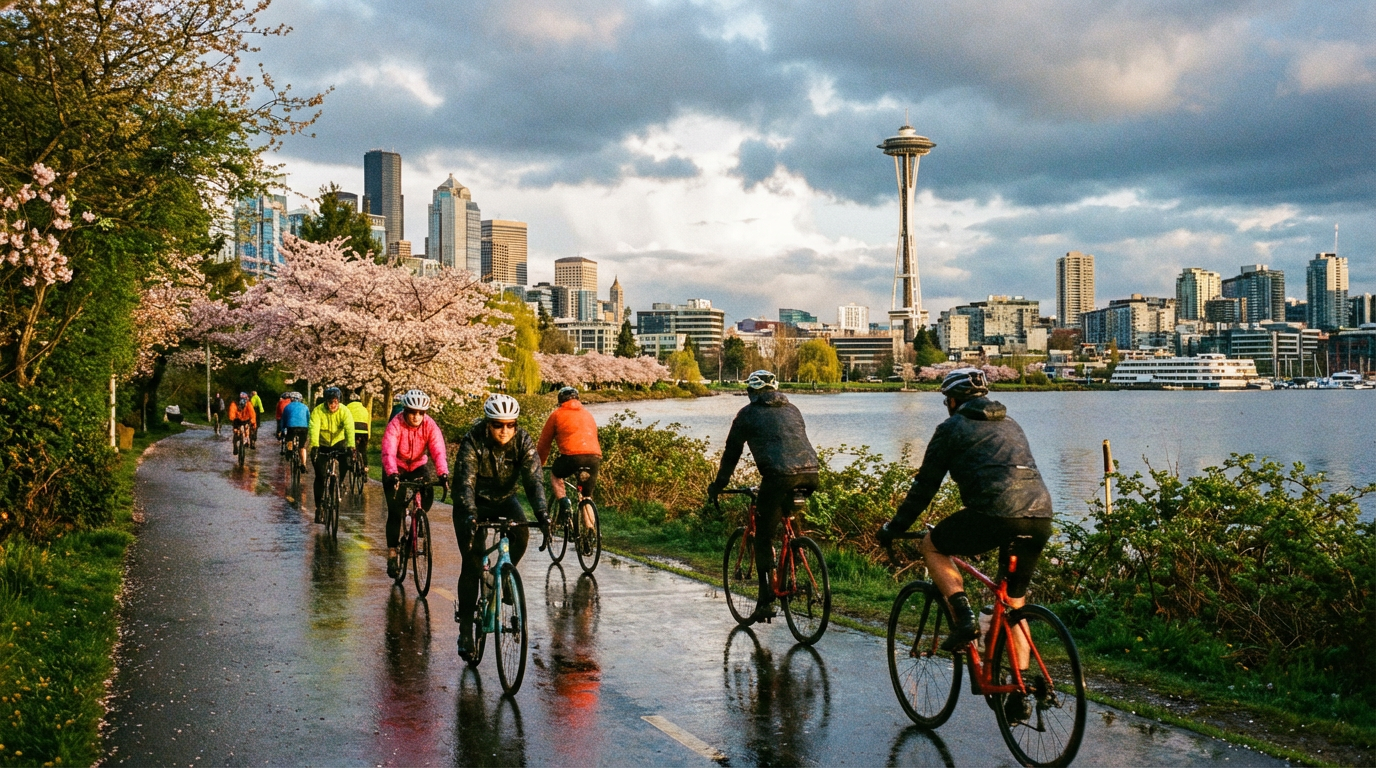
Hitting a flat coastal trail after those cobblestones feels like pure physical relief. The city built an expansive waterfront pathway system that practically begs you to ride it all day. Cargo ships glide through the dark blue water in the distance, inspiring immediate thoughts of booking cruises from Seattle. We always direct incoming riders toward this specific stretch because it showcases the skyline without actively punishing your body.
5 Reasons Understanding the Infrastructure Matters
The Protected Network Experience
The protected bike lane on 2nd Avenue is a massive relief. You catch the rich, dark roast espresso venting straight onto the path from street-level cafes. Your tires hum over the grippy green tarmac. It feels shockingly safe, partitioned from the angry main road by thick concrete planters and parked cars.
According to 2026 safety data directly from the Cascade Bicycle Club, the city prioritized these separated corridors to reduce dangerous intersection conflicts. Of course, that safety bubble pops occasionally. Left-turning delivery drivers develop sudden amnesia about bicycles existing in their blind spots.
I stopped at a crosswalk near Pioneer Square. The air was totally still for a second. Someone had draped a blue latex glove over a plastic traffic bollard. A guy on a scooter clicked past in the opposite lane.
Navigating the South Lake Union Streetcar Tracks
Not all designated routes are your friend. Riding up Westlake Avenue introduces you to the ultimate tire trap: the South Lake Union streetcar rails. The groove in these metal tracks is exactly the width of a standard commuter tire. I cannot prove this, but I am fairly certain local orthopedic surgeons sponsor that specific stretch of road.
If your front wheel slips into that groove, you are going over the handlebars. Period. When you ride anywhere near the streetcar lines, you must cross the tracks at a hard 90-degree angle. The sudden, jerky maneuvers required to stay upright while dodging traffic will absolutely test your peripheral vision.
Connecting the Dots to Elliot Bay
I braced myself for the protected lane to end abruptly, as urban grids usually dump you back into morning traffic without warning. Instead, I found a shielded transition ramp dropping gently right onto the scenic waterfront trail. The expansion connects seamlessly.
If you want a stress-free afternoon, stick to this lower coastal path. It gives you room to breathe and soak in the freezing kinetic energy of the harbor, making cycling in Seattle a joy instead of an exhausting chore.
3 Reasons Electric Power is Essential Here
Normally, my calves burn within ten minutes of pedaling near Capitol Hill. Today? I just felt a cool breeze on the damp morning air. You smell roasted garlic from the sidewalk spots as you glide upward. The scent mixes beautifully with the harbor mist.
I have to admit I am a complete convert. Back in 2019, writing trail profiles for Forbes Travel, I would have loudly called e-bikes cheating. Florida pathways are flat, sandy, and predictable. They never demanded much leg strength, so I happily relied on my own analog pedals for years.
Now in 2026, I know a motor is basic survival gear in this vertical geography. Electric momentum changes everything about cycling in Seattle, completely rewiring your relationship with the local map. A route that used to feel like a punishing gym gauntlet turns into a pleasant sightseeing exercise, much like the guided tours Seattle visitors rave about. You just sit upright and let the lithium-ion battery do the heavy lifting.
Bridging the Topography Gap
You probably think the long, sweeping hill climbs are the hardest part of riding here. The real struggle is starting from a dead stop at a traffic light on a steep grade.
The light turns green. Gravity completely locks up your pedals. Trying to generate enough bare-leg momentum before the cars behind you start honking is deeply stressful. The electric motor vaporizes that wobble. You get a smooth, immediate boost the second your shoe hits the pedal.
Choosing Your Route Hardware
If you grab gear through Rockon for your trip, renting e-bikes in Seattle WA makes those endless starts from a dead halt beautifully painless. Passing slower traffic safely is a breeze with electric assist. It is a relief to explore a demanding coastal city when the equipment is genuinely on your side. You can hear the crisp snap of wet pine needles under your tires heavily as you cruise along the Burke-Gilman Trail.
2 Reasons Riding in the Rain Requires Proper Planning
Glossy transit posters and articles in The New York Times feature smiling commuters riding dry bicycles under bright blue skies. Do you honestly think city marketing tells the truth about the weather? If it is on a postcard, it is a trap. The reality of planning for cycling in Seattle means accepting a constant, inescapable layer of atmospheric dampness. You will probably start feeling the mist as soon as you touch the tarmac at Seattle Boeing Field International Airport.
The Myth of the Downpour
It rarely pours massive, dramatic drops here. The precipitation just mists over the streets constantly. It sticks to your glasses until the world blurs into a smear of gray concrete and red taillights. You feel the icy, prickling moisture settling deep into the collar of your supposedly waterproof jacket.
A crumpled pastry receipt plastered itself to a wet crosswalk pole next to me. You spend half your ride wiping your lenses with the back of a damp glove. This persistent, sneaky wetness seeps into your bones much faster than a heavy summer thunderstorm.
Why Wet Pavement is the True Enemy
Fenders are not an aesthetic accessory in the Pacific Northwest. They are a mandatory courtesy. I cannot prove this, but I am fairly certain rental shops that do not provide full fenders actively despise their customers.
A few years ago, I rented a naked urban commuter bike near the water. For an hour, the rear wheel threw surface puddles straight up into the air. It left a thick, permanent skunk-stripe of city grime right up the back of my light-colored jacket.
The dirt tasted vaguely of motor oil and wet potting soil when a rogue drop hit my lip. You only need to make this mistake once.
When you are dialing in your setup for cycling in Seattle, demand better than bare tires. We outfit all commuter fleets with full-coverage rain guards specifically because we actually respect your laundry bill. Beige travel is a sin, but wet-back travel is just cruel.