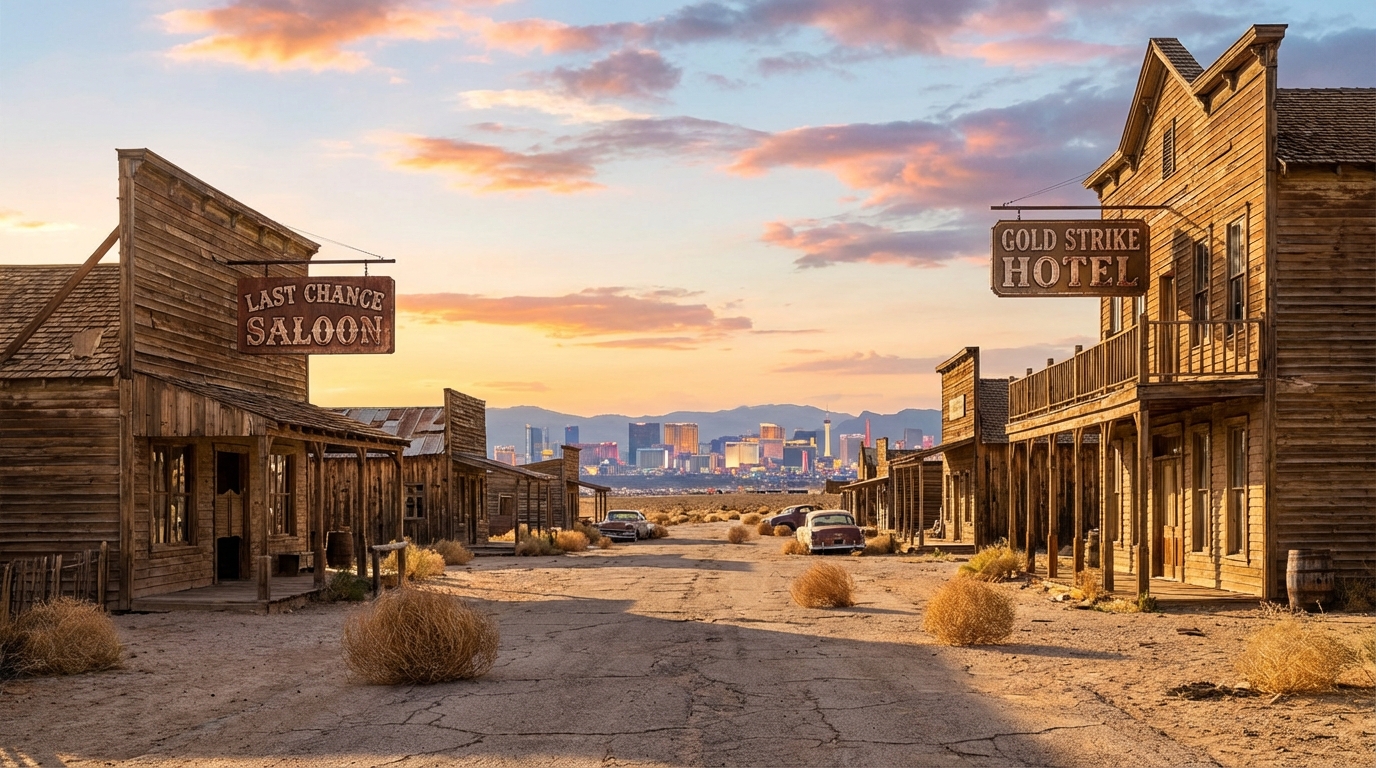
Exploring the eerie ghost towns in Las Vegas and its surrounding desert offers a stark, grounding contrast to the neon-soaked, 4.2-mile corridor of luxury that defines the Strip. As local adventurers and history enthusiasts know, the glitter of the casinos is a relatively recent anomaly in a region defined by grit, isolation, and rapid industrial decay. Just beyond the manicured golf courses and the sprawling campus of the University of Nevada, Las Vegas (UNLV), the geography shifts aggressively from urban sprawl to the harsh, unforgiving basin and range topography of the Mojave Desert. It is here, often less than an hour from the high-rise hotels, that the silence becomes heavy with history.
For those willing to trade air conditioning for dust, visiting the ghost towns in Las Vegas vicinity offers a narrative of intense ambition and sudden collapse. This isn't just empty land; it is a graveyard of dreams. Southern Nevada is dotted with the skeletal remains of settlements that were built overnight and abandoned just as quickly, preserved in a state of arrested decay by the arid desert climate. As a nationwide adventure provider, Rockon Recreation Rentals emphasizes that understanding this region requires looking past the pavement to where the rugged wilderness begins—a transition that happens surprisingly fast once you leave the I-15 corridor.
Fact #1 The Desert Climate Preserves Wood for Centuries
One of the most surprising aspects of exploring the Mojave is the pristine condition of structures that should have rotted away decades ago. In humid climates like Florida or Louisiana, a wooden shack collapses into mulch within twenty years. In the high desert of Nevada, however, the extreme aridity acts as a natural preservative, mummifying wood and halting the decay process. According to the National Park Service, the moisture content in the air is often so low that fungi and bacteria—the primary agents of decomposition—cannot survive. This is why visitors can still see the distinct grain on the timber frames of mines in Eldorado Canyon that date back to the 1860s.
However, this preservation comes with a caveat: structural integrity. While the wood may look sound, the fasteners—nails and bolts—often rust or loosen due to the extreme thermal expansion and contraction caused by temperature swings that can range from 30°F at night to 110°F during the day. When booking an off-road excursion or a Death Valley Tour from Las Vegas, guides will strictly warn visitors against leaning on or entering fenced-off structures. The dry rot is invisible, and what looks like a sturdy porch can collapse instantly under human weight. This unique atmospheric quirk creates open-air museums that feel uncannily frozen in time, rather than slowly eroding ruins.
Fact #2 Not All Ghost Towns Are Dead
The term "ghost town" typically conjures images of tumbleweeds and total abandonment, but in the Las Vegas vicinity, the term represents a spectrum. A "living ghost town" is a settlement where the population has plummeted from its boom-town peak but never hit zero. The most accessible example is Goodsprings, located approximately 35 miles southwest of the Las Vegas Strip via I-15 South and NV-161. Once the heart of a zinc and lead mining empire with over 800 residents in 1910, today it hosts a population of roughly 200 people who choose to live amidst the history.
The anchor of this living history is the famous Pioneer Saloon, which has been continuously operating since 1913. Unlike a museum exhibit, you can walk in, order a burger, and touch the stamped tin walls that have witnessed over a century of miners, movie stars, and bikers. The saloon is renowned for its connection to Hollywood tragedy; the holes in the wall are said to be bullet holes from a cheater's demise, and the bar is where Clark Gable reportedly waited for three days in 1942 for news of his wife Carole Lombard’s plane crash on nearby Potosi Mountain. Visiting a living ghost town like Goodsprings offers amenities—specifically food, restrooms, and cold drinks—that purely abandoned sites lack, making it an ideal first stop for casual explorers.
Fact #3 Hollywood Created Some of the Best Ruins
Visitors to Nelson Ghost Town (located in Eldorado Canyon, about 45 minutes southeast of the Strip) often find themselves confused by the eclectic mix of artifacts. Alongside authentic 19th-century stamp mills and mining heads, you will find crashed airplanes, alien saucers, and vintage cars that seem oddly placed. This is because Nelson is a favorite location for film scouts, music video directors, and photographers. The "plane crash" site—a fuselage from the 2001 Kevin Costner film 3000 Miles to Graceland—was left behind after production and has since weathered into the landscape, becoming as much a part of the "history" as the actual mines.
This blurring of lines between historical authenticity and Hollywood set design makes Nelson arguably the most photogenic of the ghost towns in Las Vegas immediate area. Because the land surrounding the Techatticup Mine is privately owned, the owners have curated the decay to maximize visual impact. For photographers, this means paying a fee (typically around $10–$20 per hour for access) to wander grounds that feel cinematic. Rockon Recreation Rentals notes that this is legally distinct from public BLM land; commercial photography here requires a permit, and drones are heavily regulated. The resulting photos, however, are spectacular, blending the stark desert backdrop with curated Americana.
Fact #4 Concrete Cities Crumbled Faster Than Wood
If Nelson is a testament to wood, Rhyolite is a monument to the hubris of concrete. Situated approximately 120 miles northwest of Las Vegas near Beatty, Rhyolite was the premier city of the Bullfrog Mining District. Unlike the tent cities that were expected to blow away, Rhyolite was built with a sense of permanence that bordered on delusion. Between 1905 and 1910, investors poured millions into constructing three-story concrete banks, a railway depot, and schools with electricity. Yet, when the financial Panic of 1907 struck and the ore proved shallow, the city collapsed faster than it was built.
Today, the ruins of the Cook Bank Building serve as the most iconic silhouette in the Nevada ghost town circuit. Because the buildings were made of concrete and stone, their skeletons remain standing against the blue sky, creating a haunting, post-apocalyptic visual that wooden towns cannot match. Interestingly, one of the few structures that remains intact is the Tom Kelly Bottle House, built from 50,000 beer and medicine bottles—a pragmatic solution in a town where lumber was scarce but glass waste was abundant. According to the Bureau of Land Management (BLM), Rhyolite is free to enter, but its remote location means visitors must be self-sufficient with water and fuel.
Fact #5 One Ghost Town Spent Decades Underwater
Perhaps the most surreal of the ghost towns in Las Vegas vicinity is St. Thomas, a settlement that offers a visual narrative entirely different from the dry dust of the rest of the state. Founded by Mormon settlers in 1865, the fertile farming town was purchased by the federal government and intentionally submerged in the 1930s with the creation of the Hoover Dam and Lake Mead. For decades, it remained 60 feet underwater, a modern Atlantis known only to divers and historians. However, persistent drought conditions over the last twenty years have brought St. Thomas back to the surface.
The National Park Service now maintains a 2.5-mile loop trail that allows visitors to walk among the resurfaced foundations. The visual appeal here is alien; the ruins are coated in white silt and dried aquatic shells, creating a bleached, monochromatic effect that contrasts with the red mudstone hills. You can see the concrete steps of the schoolhouse and the stumps of cottonwood trees that died nearly a century ago. Visiting St. Thomas requires checking current water levels and weather conditions, as flash floods can make the access road impassable. It serves as a stark reminder of the power of water in the West—both its presence and its absence.
Fact #6 The "Hauntings" Have a Violent Body Count
The allure of the local ghost towns isn't just architectural; for many, it is paranormal. However, unlike the manufactured haunted houses on Fremont Street, the unease felt in Rhyolite or Goldfield stems from a documented history of violence. The mining boom was a period of extreme lawlessness where disputes over claims were frequently settled with gunplay. The Techatticup Mine in Eldorado Canyon was notorious for this; historical records indicate that murders were so common during the 1870s that they barely made the headlines in distant newspapers. Labour conditions were equally lethal, with miners descending into unventilated shafts where temperatures exceeded 100 degrees, risking silicosis and collapse.
When you take a guided tour into these mines, the pitch-black environment and the drop in temperature (mines stay a constant, cool ~70°F) create a sensory deprivation that amplifies this history. Guides often recount stories of "The Wizards," a group of renegade miners who killed claim jumpers, adding a layer of dread to the experience. Whether one believes in ghosts or not, the documented mortality rate of these camps provides a sobering context. Standing in a shaft where men died for a few dollars' worth of silver changes the atmosphere from a fun day trip to a respectful encounter with the past.
Fact #7 The "Affordable" Adventure Has Hidden Costs
A common misconception is that visiting broken-down buildings in the desert is a free activity. While access to BLM land (like Rhyolite) is technically fee-free, the logistical costs of safely reaching these sites are significant. First, there is the vehicle requirement. Standard rental car contracts from major airport agencies (like Hertz or Enterprise) almost universally void insurance coverage if the vehicle is driven on unpaved roads. Since many ghost towns require travel on gravel washes, taking a sedan is a financial gamble. A single punctured oil pan on a dirt road can lead to a recovery bill exceeding $1,000.
For visitors who want to avoid the liability of self-driving and the stress of desert navigation, organized tours are the most reliable option. A high-quality Death Valley and Rhyolite day tour typically costs between $200 and $285 per person. While this price point is higher than a rental car day rate, it typically includes:
- Duration: A full 10 to 12-hour day, covering 300+ miles of driving.
- Transportation: Use of a luxury SUV or Tour Trekker with industrial air conditioning (critical in summer).
- Amenities: Unlimited bottled water, lunch, and park entrance fees (Death Valley currently charges $30 per vehicle).
- Expertise: A guide who knows exactly where the private property lines are and how to identify symptoms of heat exhaustion.
For those intent on self-guiding, Rockon Recreation Rentals recommends budgeting at least $150 for a proper 4x4 Jeep rental and carrying five gallons of extra water. In the Mojave, cheap preparation often leads to expensive rescues.