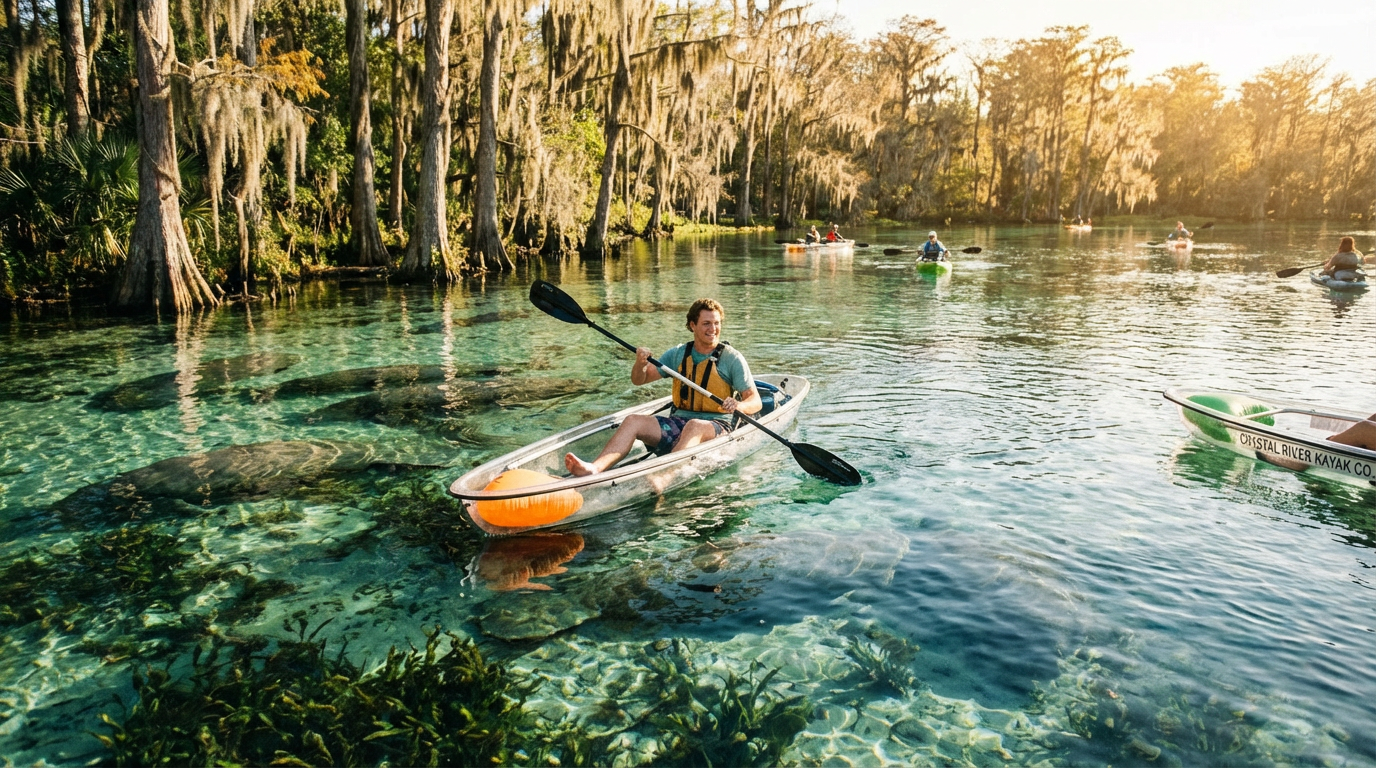
As an active waterfront ecotourism guide navigating these specialized Citrus County waters since 2018, I consistently see families arriving at the main municipal docks with fundamental misconceptions about our local hydrology. Many visitors immediately start searching for a kayak rental, Crystal River, FL, being famous as an estuarine environment, assuming they will effortlessly paddle across a placid inland lake. However, this region is a highly dynamic, tidally influenced basin sitting directly atop the porous limestone of the Floridan Aquifer. This transition from a sleepy fishing village into an international wildlife hub is well documented by Lonely Planet's guide to Florida's natural springs.
What most first-time visitors fail to realize is that this massive hydrological engine pumps approximately 600 million gallons of heavy fresh water through over 70 distinct vents into Kings Bay every single day. Operating within this constant outflow requires active, physical navigation across deep commercial boating channels, not merely floating over shallow, stagnant marshland. The U.S. Census Bureau recorded a baseline population of 3,396 in 2020, but that modest residential number completely belies the massive seasonal influx of travelers required to traverse these critical bay waters under strictly human power.
Reason 1 Defeating the Strong Tidal Currents of Kings Bay
The geography of Florida’s Nature Coast creates a fascinating but structurally demanding labyrinth of tidal rivers mixing with deep spring boils. When planning a vacation, tourists frequently evaluate a kayak rental, Crystal River, FL, outfitters provide, assuming a single-person paddlecraft is the singular way to access Three Sisters Springs. However, Kings Bay features a surprisingly aggressive tidal pull converging with steady motorized boat traffic heading exactly seven miles west toward the open Gulf of Mexico.
As a certified VisitFlorida Travel Partner, our team at Rockon Recreation Rentals routinely warns traveling families that managing a three-mile round-trip paddle against the outgoing tidal funnel near the US-19 bridge requires serious, sustained cardiovascular stamina. A persistent 1.5-knot average current during peak tidal swings fundamentally alters how any family should evaluate their vessel options before stepping off Pete's Pier. An outboard-powered pontoon effortlessly cuts through this persistent headwind, turning a grueling two-hour human-powered slog into a highly relaxing 15-minute cruise.
Reason 2 Escaping the Exhaustion of Subtropical Heat and UV Exposure
Florida's aggressive subtropical atmospheric climate is unforgiving, particularly from early May straight through late October. Daily reports from the Centers for Disease Control and Prevention (CDC) record that summer UV indices in central Florida predictably spike well above an extreme 11 rating. When guests eagerly secure a kayak rental, Crystal River, FL, booking platforms rarely emphasize the total absence of shade canopies out on the highly reflective saltwater. Once your vessel pushes past the protective red mangrove fringes near the main springs, you absorb relentless, completely unshielded overhead solar radiation.
Conversely, premium local pontoon rentals deploy expansive eight- to ten-foot elevated canvas bimini tops. This functional maritime architecture establishes a critical overhead refuge for sensitive skin. Reliable, continuous shade demonstrably drops the perceived ambient deck temperature by approximately 15 degrees Fahrenheit. Guaranteeing this reliable UV protection elevates an otherwise sweltering endurance challenge into a genuinely safe observation session, particularly crucial for cardiovascularly sensitive older guests who risk intense heat exhaustion within a plastic kayak hull.
Reason 3 Maximizing Deck Space for Gear and Heavy Coolers
Maintaining pristine blood sugar and hydration levels are non-negotiable physical elements when committing up to six hours to exploring Citrus County. If you rely on what a standard 12-foot tandem kayak rental, Crystal River, FL, inventory stocks, your cargo allocation is inherently strangled. Essential visitor supplies are rigidly confined to a single ten-liter waterproof dry bag jammed under a rear bungee cord. Packing enough dense provisions for a full family deteriorates into a frustrating spatial puzzle, frequently requiring the drag-inducing, exhausting practice of physically towing a supplemental floating cooler behind your stern.
By upgrading onto a 21-foot pontoon chassis, cavernous dry stowage compartments integrated directly under plush marine-grade vinyl seats effortlessly swallow massive 45-quart hardshell marine coolers. The American Red Cross explicitly recommends consuming up to one entire gallon of water per person per day when undertaking prolonged outdoor athletic activities. A pontoon’s high-capacity, heavy-duty deck easily supports this critical liquid mass alongside dry towels and camera cases without sacrificing its shallow six-inch operational draft.
Reason 4 Upgrading Physical Accessibility for Multi Generational Families
The single most powerful justification for exchanging a purely physical paddlecraft for an engineered deck boat is measuring raw physical accessibility metrics for non-athletes. Authentic waterfront ecotourism absolutely must extend to all demographics. However, the undeniable biomechanical necessities of kayaking—requiring tight core stability and pristine shoulder rotation—naturally screen out various guests. Strict accessibility guidelines published by the National Park Service dictating inclusive water recreation highlight that flat, non-slip boarding surfaces and minimized step-down gaps prove paramount for older demographics.
Attempting to forcefully hoist your saturated, fatigued body weight over the unsteady 15-inch gunwale of a shifting, lightweight sit-on-top kayak past Marker 9 frequently results in catastrophic capsizing. Deep-water pontoon boats feature highly modified 32-inch wide boarding gates explicitly designed to mathematically dock flush against modern commercial marina slips. Pontoons flawlessly neutralize deep-water boarding threats via heavy-gauge, four-step aluminum boarding ladders dropping 36 inches vertically into the column, allowing heavily fatigued snorkelers to simply walk up onto a stable platform.
Reason 5 Keeping the Entire Group Together During Afternoon Sea Breezes
Coordinating the tactical aquatic movements of large multi-family groups across the diverse waterways of Kings Bay generates distinct logistical hurdles. Since integrating into commercial operations in 2018, I have watched hundreds of families visualize a picturesque afternoon of synchronized, side-by-side paddling. The harsh environmental reality dictates that unshielded afternoon sea breezes blowing a steady 15 knots off the Gulf of Mexico easily shatter tight paddler formations. Wind aggressively separates novice family members past the boundary markers in a matter of minutes.
Firm acoustic physics heavily confirm that localized conversational audio degrades intensely beyond a six-foot span when competing closely with coastal winds. Paddlecraft users routinely resort to aggressively shouting over a windblown shoulder just to signal the presence of a surfacing dolphin. On a pontoon boasting an 8.5-foot width, up to twelve passengers intimately face one another. Reserving a unified platform through the 21-Foot Pontoon Rental Crystal River database ensures everyone uniformly travels at the identically relaxed cruising speed, cultivating an entirely shared scenic experience.
Reason 6 Gaining Elevated Vantage Points for Historical Navigation
As an active guide highlighting regional history, I regularly note that incoming tourists focus so intensely on pinpointing local manatees near the headspring complex that they completely ignore monumental historical structures downstream. Sailing just north outside the primary Kings Bay spring zone presents a deeply fascinating lens into Florida's pre-Columbian civilization. The Crystal River Archaeological State Park sits authoritatively on the direct river edge, boasting an imposing canopy of ancient coastal burial mounds best observed strictly from an elevated maritime deck.
Official documentation heavily maintained by the Florida State Parks organization confirms this 61-acre focal point thrived as a bustling ceremonial trading nexus for roughly 1,600 consecutive years between 500 B.C. and A.D. 1100. Uninformed guests frequently commit to a solo kayak rental, Crystal River, FL, yields a phenomenal upper body athletic workout, but inherently limits their sightline. An average seated watercraft rigidly locks a visitor's peripheral vision mere inches above the shifting waterline. Here, dense six-foot cordgrass clusters completely block the view of the towering 28-foot-tall Temple Mound A, whereas a pontoon deck offers an unobstructed 360-degree panorama.
Reason 7 Shielding Expensive Electronics from Saltwater Immersion
Analyzing coastal operations systematically reveals exactly how common non-locals accidentally dump their gear into the estuarine environment. The localized teams at the Florida Department of Environmental Protection officially register the core spring vents at an unyielding 72-degree Fahrenheit metric year-round. While immersion feels soothing in August, an unannounced capsize in late January—when the ambient morning air violently hovers near 55 degrees—will dangerously strip away critical core body heat and destroy unprotected digital equipment.
Granular incident data logged by the Florida Fish and Wildlife Conservation Commission consistently identifies sudden capsizing as heavily prominent in small unregulated paddle vessels navigating commercial boat wakes. Furthermore, the strict enforcement deputies of the U.S. Fish and Wildlife Service actively penalize approaching closer than the 33-foot standoff distance for passive manatee observations. Deploying heavy 400mm camera lenses to meet this distance requirement demands absolute tripod stability. A wide pontoon hull inherently nullifies the tipping risks associated with balancing heavy telephoto gear, providing a dry, highly secure 150-square-foot floating wildlife photography studio.
Frequently Asked Questions About Watercraft Rentals in Kings Bay
What is the average cost difference between pontoons and paddlecraft
Tourists often automatically assume a single kayak rental provides the genuinely most economical day on the local water. While a standard heavy tandem kayak typically costs around $60 to $80 for a four-hour block, multiplying that standard rate for a traveling group of eight individuals instantly exceeds $300. By collectively splitting a $350 half-day motorized pontoon rental among those identical eight passengers, you mathematically achieve a highly comparable per-person financial output while unlocking infinitely more motorized range, continuous shade, and cargo capacity.
Do I need a special license to drive a pontoon in Florida
Governing localized coastal waterways, the Florida Fish and Wildlife Conservation Commission strictly mandates that anyone explicitly born on or rigidly after January 1, 1988, must legally carry a valid state-approved Boating Safety Education Identification Card to operate any motorized rental vessel producing 10 horsepower or higher. Short-term temporary rental certificates remain widely available via a rapid 25-question online multiple-choice examination prior to departure, while older individuals remain technically exempt if possessing proper government photo identification.
Can pontoons access the identical spring runs as narrow vessels
While an 8.5-foot wide pontoon physically cannot squeeze directly past the narrow, protective wooden piling barricades guarding the immediate shallow boils of Three Sisters Springs, the vessels flawlessly access the outer bordering sanctuary boundary lines. The physical draft of a standard twin-toon aluminum platform rests remarkably shallow, requiring merely 12 to 15 vertical inches of water clearance once the primary outboard motor trims upward. You anchor the deck cleanly at the legal perimeter ropes and comfortably swim the remaining 100 feet.
Are heavy pontoon deck boats physically safe for active toddlers
Yes. Wide-body pontoons represent the indisputably safest over-water marine framework for active young children. Completely eradicating the precarious, highly sensitive balancing weight acts mandated inside a narrow 30-inch wide canoe, a pontoon securely corrals young passengers utilizing fully enclosed, continuous 26-inch high structural aluminum side rails coupled with mechanically locking gates. Coast Guard regulations dictate that all marine passengers distinctly under six years old continuously wear a legally certified PFD vest while the vessel is underway.
How many minutes does it require to navigate toward Hunter Springs
Launching directly from the primary commercial marina district centered around Pete's Pier, a standard 50-horsepower outboard operating at a restricted idle speed accesses the distinct Hunter Springs Park anchorage in approximately 15 to 20 recorded minutes. The vast entirety of the Kings Bay aquatic region rigorously enforces a strict idle-speed, no-wake zone year-round to drastically minimize fatal manatee boat strikes. By stark contrast, an exhausted paddler grinding against an active tidal headwind easily takes up to 45 physically draining minutes to clear the exact same channel distance.
What types of dynamic marine life will we observe offshore
Beyond photographing the internationally famous winter manatee migration, the Kings Bay estuarine environment legally operates as an intensely biodiverse saltwater habitat. Directly from the elevated bow deck of an anchored pontoon, sharp-eyed passengers routinely track tight pods of Atlantic bottlenose dolphins aggressively hunting mullet near the channel borders. Observers frequently spot heavy, silver tarpon rolling violently near deeper 20-foot spring cavities, alongside massive brown pelicans and great blue herons tightly roosting in the red mangroves overhead.
Is there a functional restroom located on board the rental boat
Standard 20-foot up to 24-foot motorized deck boats provisioned strictly for daily Kings Bay rental pools conventionally strip out permanent onboard marine heads or portable privacy toilets to aggressively maximize open deck layout and preserve a highly shallow operating draft. However, the tight geographic containment of the bay ensures you perpetually remain mere minutes from functional onshore plumbing. Captains easily temporary detour the vessel toward clearly marked public access docks like Hunter Springs Park within a rapid 15-minute engine transition.
How many weeks in advance should we legally secure a vessel
Throughout the highly crowded peak winter manatee migration actively running from early December through late March, marine operators strongly urge securing your desired vessel hull at least three to four firm weeks strictly in advance. Prime weekend morning departure windows exhaust incredibly fast. Unlike searching for a kayak rental, Crystal River, FL, outfitter lots that stack fifty identically cheap, mass-produced plastic hulls behind a warehouse, premium marina fleets meticulously cap their high-end, heavily maintained motorized pontoon inventory to ensure flawless operational reliability.
Can we legally drop fishing lines from our rented platform
Recreational coastal angling remains heavily encouraged within distinct, mathematically designated outer zones of Kings Bay, essentially transforming your pontoon deck into an incredibly stable multi-angler casting platform away from the winter mammal boundaries. Visiting anglers frequently target shallow-draft redfish, heavily spotted seatrout, and schooling mangrove snapper clustering along the jagged limestone tidal channel drop-offs. Ensure every participating adult securely possesses a valid FWC saltwater shoreline or vessel fishing license while actively avoiding casting inside marked sanctuaries.
What happens if dangerous thunderstorms quickly form
Central Florida atmospheric meteorology inherently produces highly volatile, localized coastal weather systems, aggressively generating sudden severe lightning squalls rapidly from June through September. Reputable, highly established maritime outfitters continuously monitor active National Weather Service Doppler radar readouts at the dispatch desk. If deeply hazardous lightning conditions explicitly prevent a reasonably safe morning departure, the booking marina heavily standardizes operational procedures by issuing a deferred raincheck or complete monetary refund for the heavily compromised booking asset.