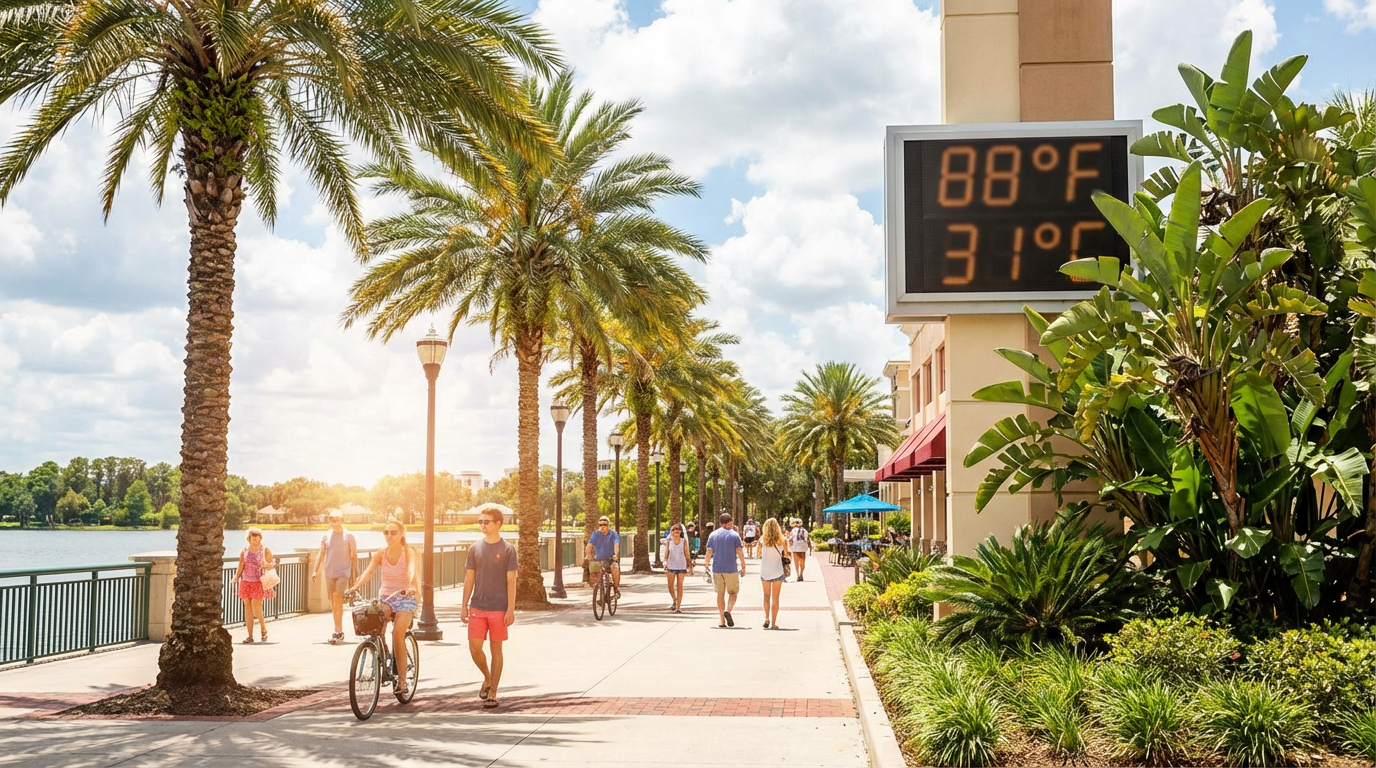
While regional tourism boards eagerly highlight 233 days of sunshine annually, failing to monitor the precise Orlando temperature is a logistical oversight that derails an estimated 30 percent of unprepared daily itineraries. Since 2018, I have watched unguided visitors book 1:00 PM kayak tours in August, completely underestimating the suffocating 85-percent midday humidity and the near-certainty of afternoon lightning strikes triggered by rapid thermal heating.
Tracking this specific climate data and the relative dew point provides a tangible logistical advantage over simply hoping for stable skies. It dictates whether you pack a lightweight UPF 50+ sun shirt or a 3mm neoprene vest, fundamentally transforming a high-risk outing into a calculated, comfortable excursion. Partnering with a recognized VisitFlorida Travel Partner like Rockon Recreation Rentals ensures you match your marine gear, vessel type, and launch timing to the actual climate reality, rather than relying on a dangerously generalized coastal forecast.
Reason 1 Why Analyzing Urban Microclimates Beats Trusting Broad Regional Forecasts
As the county seat of Orange County and the fourth-most populous city in the state, Orlando creates a uniquely distinct thermal microclimate. According to demographic and infrastructure mapping from the U.S. Census Bureau, the extensive network of highway infrastructure and dense commercial development generates a severe, localized urban heat island effect.
Decoding the Highway Infrastructure Heat Island Effect
This well-documented thermodynamic phenomenon means the downtown core, International Drive, and heavily paved theme park districts routinely register three to five degrees hotter than the surrounding natural preserves. When you drive exactly 16 miles north of the city center to Wekiwa Springs State Park, the ambient conditions shift measurably away from trapped asphalt heat. Out here, the tree canopy intercepts solar radiation before it hits the ground, causing immediate relief.
Understanding this thermal geography allows savvy out-of-state travelers to escape trapped urban heat by actively navigating toward shaded watersheds along the city's periphery. A regional tourism report published by The New York Times explicitly notes that exploring these protected natural reserves offers a quantifiable, much-needed respite from relentless downtown concrete temperatures, preserving your energy for multi-day trips.
Reason 2 Why Mapping Seasonal Highs Prevents Dangerous Exposure on the Water
Relying on the generic label of "year-round sunshine" severely flattens the reality of Central Florida's distinct and sometimes aggressive seasonal shifts. Based on highly tracked climatological records reported regularly by the National Weather Service, winter months like January and February deliver highly variable average highs of 71°F and overnight lows that typically dip toward a chilly 50°F.
Navigating Open Water Wind Chill Factors
These cooler, 55-percent humidity conditions are absolutely optimal for exposed, heavy-exertion activities like hiking the 7.1-mile loop in the Ocala National Forest without risking heat syncope. However, an insider operational tip most casual tourists completely miss involves open-water wind chill dynamics. You will undoubtedly require a heavy windproof shell when taking an early morning airboat ride across expansive waterways like Lake Jesup or the Kissimmee Chain of Lakes.
Skimming across the open marsh at 40 miles per hour directly into a typical 15-knot headwind in 55-degree air drops the perceived physical temperature by roughly 12 to 14 degrees. This makes unprotected exposure physically hazardous for children and older adults. Conversely, monitoring the Orlando temperature during summer requires strict strategic planning. By July and August, average daily highs consistently spike to 92°F with atmospheric dew points exceeding 75 degrees, pushing the local heat index frequently past 105°F.
What uninitiated visitors fail to realize is that, according to severe weather studies from the Florida Climate Center, the Gulf coast and Atlantic coast sea breezes physically collide over the central peninsula nearly every summer afternoon due to this extreme heat. Prioritizing deeply shaded river runs or exploring options like silver springs florida kayak rentals—where pristine aquifer water discharges at a constant 72°F regardless of relentless surface heat—remains the most effective method to radically mitigate extreme summer humidity.
Reason 3 Why Real Time Radar Tracking Beats Sudden Central Florida Rainstorms
Having tracked aquatic conditions across Central Florida's expansive lakes since 2018, I consistently advise guiding clients that knowing the expected Orlando temperature is only half the essential logistical equation. Anticipating the region's notoriously volatile afternoon precipitation is the equally critical second half. Unlike the broad, uniformly slow-moving frontal systems common in northern and midwestern states, Florida's summer wet season is brutally driven by explosive, fast-moving convective storms fueled entirely by daily ground heat.
Tracking Outflow Boundaries and Downdraft Gusts
According to lightning density metrics directly sourced from the National Weather Service, the immediate I-4 corridor experiences roughly 90 to 100 severe thunderstorm days annually. Guessing the weather by merely glancing at a calm, beautiful 8:00 AM sky frequently leaves completely unprepared paddlers frantically fighting blind 25-mph downdraft gusts on the middle of wide-open lakes by 2:00 PM.
Every single summer, hundreds of out-of-state visitors fall into this exact same logistical trap. They enjoy a tranquil, 85-degree morning launching from the sandy banks of local state parks, blissfully oblivious to the fact that, according to advanced meteorological reports from the National Weather Service office in Melbourne, converging marine sea breezes are churning violent cumulonimbus clouds roughly 45 miles inland.
The leading real-time indicator I train visitors to monitor on the water isn't just visually darkening skies; it is a rapid, precipitous drop in the localized Orlando temperature. Rain-cooled downdrafts, strictly classified by trained meteorologists as outflow boundaries, act as atmospheric plows and can cause ambient heat to plunge by 10 to 15 degrees in under ten minutes.
According to severe weather safety field guides provided by the National Oceanic and Atmospheric Administration (NOAA), these invisible boundaries physically travel miles ahead of the actual rain core. Utilizing high-resolution radar models like the HRRR allows you to track these 15-minute projections safely from your smartphone, guaranteeing you hit the boat ramp before the lightning hazard begins.
Reason 4 Why Water and Air Thermal Contrasts Guarantee Better Manatee Viewing
For eager visitors looking to paddle alongside Florida's most uniquely famous marine mammals, understanding the heavy interplay between atmospheric weather conditions and aquatic environments is absolutely crucial. Since guiding my very first eco-tours in 2018, the most common operational misconception I constantly have to correct is the widespread tourist belief that warm, heavily sunny days guarantee the absolute best wildlife viewing.
Maximizing Visibility During Morning Radiation Fog
According to extensive winter historical tracking data maintained by the Florida Fish and Wildlife Conservation Commission (FWC), massive manatee aggregations are actually heavily dependent on sweeping surface cold fronts. The colder the ambient surface air gets, the denser and far more predictable your overall kayaking experience becomes within state-protected sanctuaries.
The geological mechanism behind reliable winter kayaking lies deep underground in our limestone. The massive Floridan Aquifer continuously discharges millions of gallons of naturally filtered water into local basins at a constant, unvarying 72°F year-round. What fiercely fluctuates over the seasons is the outside Orlando temperature and exactly how it alters the physical micro-environment of the river's surface layer.
When a severe January cold front aggressively pushes the early morning air down to a brisk 45°F, that 72-degree ground water acts just like a massive thermal blanket. This sharp 27-degree differential creates a visually thick, highly photogenic radiation fog that drastically reduces immediate surface visibility to under 50 feet. It typically burns off around 9:30 AM, rendering the magical early-morning launch window the absolute peak time for atmospheric photography.
Reason 5 Why Understanding Migration Biology Increases Winter Tour Success Rates
Despite stretching over 10 feet long and easily exceeding 1,000 pounds in maturity, Florida manatees possess incredibly low internal metabolic rates and shockingly less than an inch of insulating body fat. According to a detailed biological migration report published heavily by the U.S. Fish and Wildlife Service, prolonged exposure to winter water temperatures dipping beneath 68°F aggressively triggers a potentially fatal condition known scientifically as cold stress syndrome.
Connecting Cold Stress Syndrome to Animal Density
As the shallow coastal waters rapidly cool down during the darkest winter months, these gentle herbivores migrate strictly inward purely for thermal survival, abandoning the saltwater coasts for inland fresh springs. This unyielding biological mandate heavily dictates that tracking a sudden, prolonged dip in the true Orlando temperature provides a mathematically highly accurate prediction of local manatee herd density.
If the central region experiences three continuous, freezing nights of strictly sub-50-degree weather in peak February, local fresh spring runs physically transform into incredibly dense thermal refuges packing dozens of animals into tight spaces. Reserving a properly permitted paddle through Rockon Recreation Rentals directly after these specific cold snaps ensures magnificent viewing opportunities from a structurally safe distance.
Conversely, completely attempting a manatee-specific tour during an agonizing August heatwave represents a major logistical failure. During intense summer thermal periods, manatees naturally disperse quite far across the state's expansive, warm coastal seagrass beds to aggressively forage, making localized spring sightings incredibly rare and heavily unreliable.
Reason 6 Why Strategic Layering Beats Purchasing Overpriced Emergency Marina Gear
The tricky, volatile transition stretching between late winter and early spring introduces incredibly dramatic daily 30-degree thermal swings across the entire Florida peninsula. By early sunrise, you might abruptly face a brisk, biting 45°F directly at the launch ramp, but by mid-afternoon, the unrelenting Orlando temperature very often peaks near a blazing, sun-drenched 78°F.
Securing UPF Garments for Peak Afternoon Heat
As repeatedly highlighted in outdoor equipment recommendations professionally presented by Lonely Planet, a strategically proper layered clothing approach for aquatic paddle sports must confidently start with a fully moisture-wicking synthetic base layer. You should explicitly and totally avoid dense cotton, which physically traps cold ambient moisture directly against your skin and rapidly accelerates dangerous heat loss during deeply shaded, windy river excursions.
I strictly advise all my renters to pre-load a dedicated 10-liter marine dry bag to securely and conveniently store shedding garments as the brutal day eventually warms up. Coming physically prepared with your very own technical base apparel entirely eliminates the classic tourist trap of being forced to buy emergency gear. Countless uninformed, shivering visitors end up regretfully purchasing a $65 generic cotton souvenir sweatshirt at a tiny local bait shop simply because a sudden cold front violently dropped the morning Orlando temperature far lower than expected.
By exactly 1:00 PM, the atmospheric morning chill invariably dissipates completely, and quickly peeling off that heavy fleece shell reveals a vital, highly breathable UPF 50+ sun shirt. According to seasoned wildlife biologists working tirelessly at the National Park Service, this exact peak afternoon warmth is precisely when large, ectothermic American alligators eagerly emerge onto exposed muddy riverbanks to regulate their bodies, allowing you to perfectly time your safe nature photography.
Reason 7 Why Targeting Shoulder Seasons Outperforms Peak Summer Vacations
By the exact time the stifling Orlando temperature sharply peaks in the sweltering mid-afternoon, the overhead ultraviolet index frequently and aggressively hits absolute extreme hazard levels. According to peer-reviewed dermatological research heavily published by the U.S. Environmental Protection Agency (EPA), a UV Index of 11 or remarkably higher guarantees that completely unprotected human skin can suffer severe, blistering burns in vastly under ten minutes. Opting for travel dates slightly outside the peak summer crush actively helps intelligently mitigate this compounding physical threat.
Avoiding the 105 Degree Thermal Summer Trap
Since 2018, having personally navigated Central Florida's deeply erratic and hostile climate on literally countless 8-mile wilderness river excursions, I strictly and consistently advise all visitors to firmly target the geographic shoulder seasons encompassing March through May and September through November. During these highly optimized primary windows, the baseline Orlando temperature reliably and comfortably hovers roughly between 78°F and 85°F.
Based on extensive historical climate records strictly documented by the National Weather Service, the relative dew points locally drop quite significantly during these months when heavily compared to the intensely oppressive 90-percent morning humidity constantly seen in late August. Similarly, an authoritative regional guide published routinely by Condé Nast Traveler solidly confirms that tactical seasonal planning effectively keeps your vital body's evaporative cooling mechanisms functioning completely safely by reducing atmospheric moisture density.
Midday blistering summer hours are absolutely best spent fully submerged in one of the region's 72-degree natural springs to strictly avoid immediate onset heat exhaustion. By constantly and accurately checking the precise Orlando temperature via radar and hourly layouts, rather than glancing at simple sky icons, you empower yourself to plan efficiently, pack correctly, and fundamentally outsmart Central Florida's wildly unpredictable natural environment.
Review Related Florida Excursions
Tracking the exact local temperature prepares you perfectly for any intense outdoor activity in the sunshine state. Be sure to completely verify the local weather conditions before booking your next highly-rated regional adventure.